
Don't Be Fooled by Reflective Paints: Why Your Industrial Roof Gets Hot Again in Year Two
During the scorching summer, industrial roofs and large-scale agricultural farms often turn into massive "ovens." Many facility owners invest in reflective ceramic coatings (radiative cooling paints) hoping for a quick fix, only to fall into the "Dust Failure" trap—where insulation performance drops off a cliff after just one or two years. This article reveals the physical truth behind this failure and explains why Hebei Woqin’s Aerogel Coating, featuring a certified 0.032 W/(m·K) thermal conductivity and an A1 non-combustible rating, is becoming the ultimate, maintenance-free thermal shield for Net-Zero buildings.
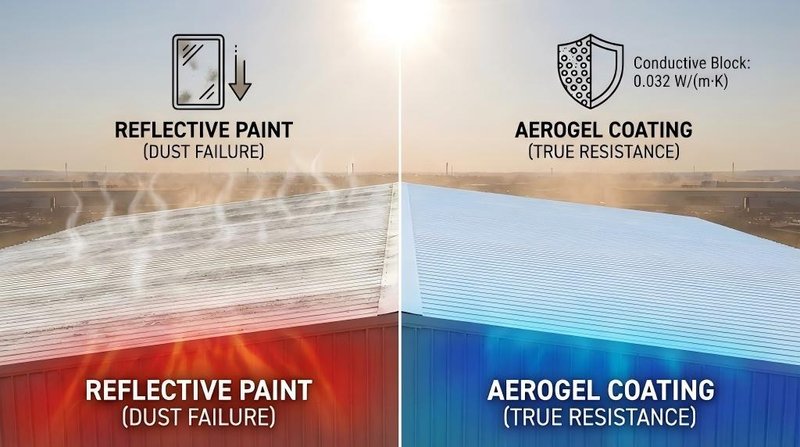
The "Oven" on Your Roof and an Expensive Illusion
Under the relentless summer sun, heavy industrial plants, cold-chain warehouses, and modern agricultural farms (poultry and dairy) face a deadly challenge. Traditional metal corrugated roofs are often equipped with a flimsy layer of low-quality rock wool (sometimes less than 10mm thick), which is practically useless against sustained high temperatures.
The results are disastrous: factory workers suffer from heatstroke, egg production in poultry farms plummets, dairy cows experience heat stress leading to a drop in milk yield, and skyrocketing AC bills eat away at your profit margins.
To solve this, many businesses have been lured by "radiative cooling" or "reflective ceramic coatings." Painting the roof bright white does feel cooler initially, but facility managers soon realize this is an incredibly expensive illusion.
Uncovering the Physical Truth: What is "Dust Failure"?
Reflective ceramic coatings rely entirely on one simple metric: Solar Reflectance (SR). Essentially, they act as a "mirror" on your roof.
However, reality hits hard. Industrial zones and agricultural farms are filled with dust, emissions, and dirt. In just 1 to 2 years, once these white coatings accumulate dust or get stained by muddy rain tracks, their reflectivity drops off a cliff.
In engineering, this is known as "Dust Failure." Once the mirror gets dirty, it degrades into nothing more than a layer of regular paint. The heat, once again, marches straight into your building.
The Aerogel Advantage: True "Conductive Resistance"
Unlike ceramic paints that rely on superficial "optical reflection," Aerogel coatings utilize a defense mechanism deeply embedded in the material: thermodynamic blocking. The nanoporous structure of the Aerogel permanently traps air, completely cutting off the path of heat transfer.
According to the authoritative 2024 test report from the China Building Material Test & Certification Group (CTC), Woqin's Aerogel Coating delivers crushing physical performance:
- Extreme Thermal Conductivity of 0.032 W/(m·K): This means no matter how much dirt or mud covers the surface, the space underneath remains cool. It provides a permanent "volume insulation" that simply doesn't care about surface grime.
- A1 Class Non-Combustible Armor: Many water-based reflective paints contain organic binders and fail strict fire tests. Woqin's Aerogel Coating has a Total Heat of Combustion of only 0.3 MJ/kg (far below the stringent ≤2.0 standard) and 0 seconds of sustained burning. It is the ultimate safety shield for Data Centers and high-value factories.
- Weatherproof Adhesion: With an extremely high bond strength of 1.1MPa and showing absolutely no abnormalities after 96 hours of water resistance testing, it grips perfectly to metal roofs and concrete substrates.
Industry Secret: Why Top Brands Are Now Using Aerogel as a "Primer"
An interesting trend is emerging in the industry: many top-tier international paint brands are now quietly adding an "Aerogel middle-coat" under their radiative cooling paints.
But this raises a fundamental question: If the Aerogel layer underneath is the one actually doing the heavy lifting and blocking the heat, why spend wasted money maintaining a reflective topcoat that is destined to suffer from "Dust Failure"?
It’s like putting a fragile sunshade over a heavy-duty waterproof membrane—the sunshade will inevitably get dirty and degrade, while the membrane underneath is the one actually doing the real work. Using pure, high-performance Woqin Aerogel Coating as your core thermal shield is the most cost-effective, truly maintenance-free ultimate solution.
Core Scenarios & Immediate ROI
Abandoning traditional reflective schemes in favor of Aerogel coatings is generating massive economic benefits in several sectors:
- Modern Agriculture (Livestock/Poultry): Stabilizes indoor temperatures, eliminates heat stress, secures egg/milk production rates, and delivers a double win for animal welfare and economic returns.
- Data Centers: Effectively blocks external heat loads, drastically lowering the PUE (Power Usage Effectiveness) of cooling systems to meet the strictest Net-Zero targets.
- Heavy Industry & Warehousing: Improves the working environment for frontline staff and reduces inventory loss caused by extreme heat.
Stop Paying for "Dust"
Insulation shouldn't be a superficial fix that requires re-painting every year; it should be hardcore armor that lasts as long as your building. It’s time to say goodbye to fragile reflective paints and embrace true nanoporous thermal resistance.
Grab a free sample board from us and leave it on the sunniest, dustiest part of your factory roof. Check it three months later—you’ll naturally know the answer. Contact us today to get your sample and our full 2024 CTC lab test report.

Written by - Zhongjian An
Certified Passive House Designer (PHI Germany), validated by Prof. Dr. Wolfgang Feist. With 15+ years of expertise in high-performance solutions for both Green Buildings and Industrial Applications (Petrochemical Pipelines, LNG Cryogenic, & High-Temp Equipment).
LATEST NEWS
High-Density Rigid PU Thermal Break Blocks: North American Code-Compliant Structural Solution
2026-07-01
Beyond Insulation: Why Structural Thermal Breaks Are Essential for Modern Industrial Infrastructure
2026-06-29
The Ultimate Guide: "Survival Rules" and System Defenses for Industrial Piping Insulation in Extreme Middle Eastern Environments
2026-06-25
Unlocking Aramco & SABIC Compliance: The Highly Secure Path to Mechanical Completion Sign-Off
2026-06-25
Cutting Pipeline Insulation Labor Costs by 40% in 50°C Middle East Heat
2026-06-18