
Underground Combat: Defeating Condensation and Fire Risks in SEA's Expanding Metro Networks
Southeast Asia’s extreme heat and high humidity are causing critical condensation and fire safety issues in metro trains. Discover how HEBEI WOQIN’s Aerogel insulation—backed by Longertek laboratory testing—eliminates "sweating trains," maximizes cabin headroom, and provides Class A1 zero-toxic-smoke fire protection for next-generation rail projects.
Southeast Asia is currently experiencing a golden age of rail transit infrastructure. With massive projects like the Jakarta MRT, Bangkok BTS extensions, and Kuala Lumpur transit networks rapidly expanding, global Original Equipment Manufacturers (OEMs) are deploying next-generation trains across the region.
However, they are encountering a brutal climate reality: the tropical combination of 35°C+ heat and up to 90% humidity. This extreme environment is causing severe "sweating train" nightmares and raising critical concerns about underground fire safety. Outdated materials like glass wool and anti-condensation paints are failing. To solve these engineering bottlenecks, top HVAC engineers and train car body designers are turning to HEBEI WOQIN Aerogel Train Insulation as the ultimate thermal shield.
Eliminating the "Sweating Train" Nightmare & HVAC Failures
In tropical climates, the massive temperature differential between the scorching outdoor heat and the 22°C air-conditioned train cabin leads to severe thermal bridging. This causes rapid condensation on the train's aluminum roof and HVAC air supply grilles. Water dripping onto passengers leads to severe complaints, while condensation inside electrical cabinets can cause train-stopping short circuits.
The Longertek Laboratory Proof: To prove the superiority of Aerogel, we look at the official testing data from Longertek, a leading supplier of railway HVAC systems in China, during their Beijing Metro Inverter Retrofit Project. They conducted an extreme enthalpy difference laboratory test simulating rigorous summer conditions (26°C ambient with 80% Relative Humidity, and 13-15°C supply air).
- Traditional Solution (Anti-Condensation Paint Only): After just 20 minutes of operation, visible condensation appeared on the grilles. Within 3 hours, the condensation reached its maximum, forming heavy dripping water.
- The HEBEI WOQIN Aerogel Solution: The grilles upgraded with our Aerogel composite ran continuously under the exact same extreme conditions for 5 hours (300 minutes). The surface remained absolutely bone-dry, achieving a 0% condensation rate. Aerogel completely severs the thermal bridge.
The Millimeter Space War in Car Shells
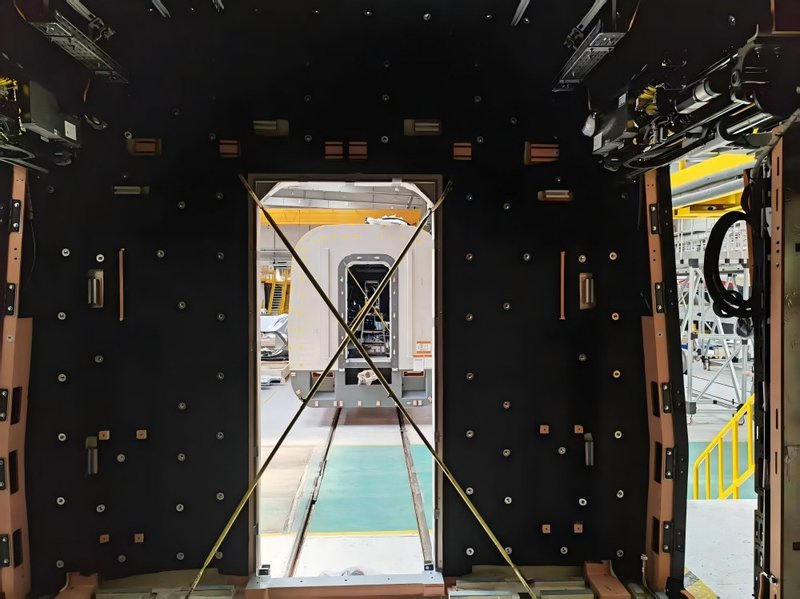
Train cabin cross-sections (clearance gauges) are strictly limited. As seen in our site installation photos, the internal structures of train roofs and sidewalls are packed with complex aluminum stiffening ribs, curved frames, and dense wiring. Forcing thick, traditional glass wool into these tight cavities is a construction nightmare, often leaving uninsulated "dead zones" and severely compressing the passenger cabin's headroom.
With an ultra-low thermal conductivity of 0.020 W/(m·K), HEBEI WOQIN Aerogel Blankets deliver superior thermal resistance at just 1/3 the thickness of traditional materials. It is fundamentally flexible, molding seamlessly around complex curves and frames like a second skin.
Beyond space-saving, this ultra-thin profile delivers massive lightweighting benefits, reducing total train weight by up to 500kg per car. Reducing the tare weight of the train shell translates to massive traction electricity savings for metro operators over a 30-year lifecycle.
The Underground Firewall: Class A1 & Zero Toxic Smoke
When a metro train operates in a highly enclosed underground tunnel, fire is the ultimate disaster. However, the open flames are rarely the primary killer; it is the toxic black smoke generated by traditional B1-rated flame-retardant foams and rubbers that causes asphyxiation, leaving passengers with nowhere to escape.
This is why global rail fire standards (like EN 45545 and GB 8624) are incredibly strict. HEBEI WOQIN Aerogel is an inorganic, silica-based material that fundamentally solves this crisis:
- Fire Rating: Class A1 (Absolute Non-Combustible)
- Sustained Burning Time: 0 seconds
- The Ultimate Advantage: Zero Toxic Smoke Emission. Even under extreme heat, it does not burn and does not release toxic gases, buying passengers the most precious golden time to evacuate safely.
Enduring High-Speed 3D Vibration
Throughout a 30-year service life, metro and high-speed trains endure relentless high-frequency 3D vibrations from constant starts, stops, and high-speed running. Under these conditions, traditional glass wool inevitably suffers from structural breakdown and sagging. Once pulverized, microscopic glass dust can be blown into the passenger cabin through the HVAC system, posing serious respiratory health risks.
HEBEI WOQIN completely eliminates this hazard. According to rigorous laboratory testing, our Aerogel blanket boasts an incredibly low Vibration Mass Loss Rate of just 0.3% (tested per GB/T 34336-2017). Combined with our zero-dust encapsulation technology (such as aluminum foil or non-woven fabric facing), the insulation layer remains structurally intact and absolutely dust-free, no matter how many decades the train runs.
Upgrade Your Rolling Stock with HEBEI WOQIN
Aerogel is not just an insulation material; it is the ultimate climate and safety armor for Southeast Asia's expanding transit networks. It defeats condensation, saves cabin space, guarantees zero-smoke fire safety, and survives decades of intense vibration.
Are you an OEM engineer designing the next generation of metro cars for the Southeast Asian market? Don't let condensation and fire risks derail your project.
Contact HEBEI WOQIN today for rail-specific Aerogel technical data, thermal calculations, and to request your professional engineering sample box.

Written by - Ruibin An
Industry Veteran with 13+ Years of Experience. Deeply rooted in the insulation industry for over 13 years, specializing in supply chain optimization and global market trends for Rock Wool and Aerogel materials.
LATEST NEWS
The Southeast Asia Industrial Insulation Guide: Defeating Humidity, CUI, and Extreme Heat
2026-03-22
Underground Combat: Defeating Condensation and Fire Risks in SEA's Expanding Metro Networks
2026-03-22
Surviving -196°C: Aerogel Insulation for LNG and Cryogenic Piping in Southeast Asia
2026-03-22
The Ultimate Shield: Defeating CUI and Toxic Cr(VI) Risks in Fertilizer & Chemical Plants
2026-03-21
Defeating Vibration and Deadweight: Why IMO-Certified Aerogel is the Future of Marine Insulation
2026-03-21