
Surviving -196°C: Aerogel Insulation for LNG and Cryogenic Piping in Southeast Asia
Southeast Asia’s extreme heat and 90% humidity create the ultimate stress test for LNG and cryogenic piping. Discover how flexible Aerogel Cryogenic Blankets eliminate thermal cracking, prevent frost heaving, reduce BOG, and save massive pipe rack space compared to traditional Cellular Glass and PIR.
Surviving -196°C: Aerogel Insulation for LNG and Cryogenic Piping in Southeast Asia
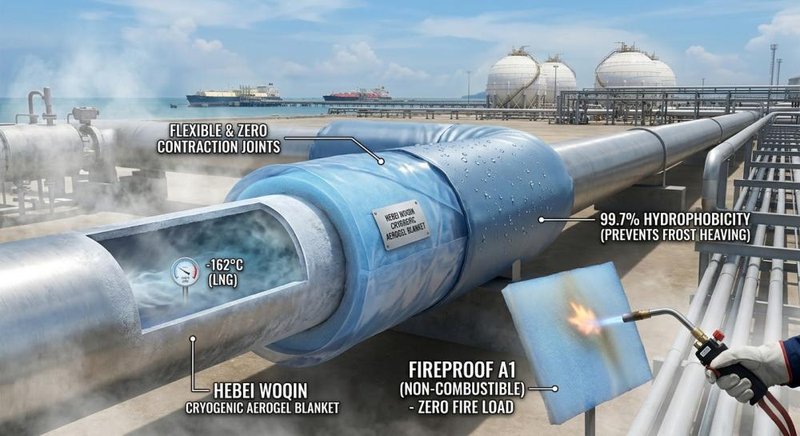
Designing Liquefied Natural Gas (LNG) terminals and cryogenic gas facilities in Southeast Asia presents a unique, brutal engineering challenge. Inside the pipe, liquid nitrogen or LNG flows at extreme sub-zero temperatures (-162°C to -196°C). Outside the pipe, the ambient environment in Singapore, Malaysia, or Indonesia boasts year-round temperatures of 35°C and up to 90% relative humidity.
This staggering 230°C temperature differential acts as a relentless stress test. Under these extremes, traditional cold insulation materials like Cellular Glass (CG) and Polyisocyanurate (PIR) frequently fail, leading to massive maintenance costs and safety hazards.
Enter the Aerogel Cryogenic Blanket—a next-generation, flexible insulation material that is redefining safety, longevity, and efficiency standards for the Southeast Asian LNG cold chain. Here is why top EPC contractors are making the switch.
Eliminating Thermal Cracking and Shock
The most critical moment for any cryogenic pipeline is the "cool-down" phase. As the internal temperature plummets, the steel piping undergoes severe and rapid contraction.
The Traditional Flaw: Cellular Glass is widely used for cold insulation, but it is a highly rigid and brittle material. To prevent the glass from shattering under the pipe's mechanical stress, contractors are forced to engineer complex "contraction joints" every few meters, filling them with flexible sealants. Over time, these joints degrade, leading to complete system failure.
The Aerogel Solution: Aerogel cryogenic blankets are fundamentally flexible. They act like a high-tech thermal jacket, effortlessly absorbing the mechanical stress and movement caused by thermal shock. The result? Zero contraction joints are required. The insulation fits seamlessly around elbows, valves, and straight pipes, ensuring 100% structural integrity without ever cracking.
Defeating Frost Heaving and Jacketing Failure
In the tropical climates of Southeast Asia, water vapor is the invisible enemy of cryogenic systems. If a traditional PIR or CG system develops even a hairline crack, the pervasive ambient moisture immediately infiltrates the insulation layer.
At -162°C, this infiltrated water vapor instantly freezes into solid ice. Because water expands by about 9% when it freezes, it generates a terrifying physical force known as "frost heaving." This outward pressure can literally burst the outer metal jacketing, exposing the pipe to severe corrosion under insulation (CUI) and total thermal failure.
The Aerogel Solution: HEBEI WOQIN's Aerogel Blankets boast a laboratory-tested hydrophobic rate of >99.7%. Even in 90% humidity, liquid water simply bounces off. When combined with a standard cryogenic vapor barrier, this extreme hydrophobicity physically blocks moisture from migrating toward the cryogenic pipe, completely breaking the cycle of ice formation and jacketing rupture.
BOG Reduction and Saving Massive Pipe Rack Space
For LNG terminal operators, inadequate insulation translates directly to financial loss. Heat leak causes the liquid gas to vaporize into Boil-Off Gas (BOG), wasting valuable product and increasing internal pipe pressure.
The Aerogel Solution: With an astonishingly low thermal conductivity of 0.020 W/(m·K) at room temperature (and performing even better in deep cryogenic states), Aerogel provides the ultimate thermal barrier. It drastically minimizes heat leak, keeping BOG rates to an absolute minimum.
More importantly for EPC contractors, Aerogel achieves this elite thermal performance at a fraction of the thickness. To prevent surface condensation, an Aerogel system typically requires only 1/2 to 1/3 the thickness of a Cellular Glass system. In the space-constrained refineries of Singapore or Indonesia, thinner insulation means the spacing between pipes on a pipe rack can be significantly reduced, freeing up to 30% more space for adjacent pipes. This translates to massive capital expenditure (CAPEX) savings on steel structures and facility footprints.
The Cryogenic and Fireproof Paradox Solved
The LNG sector requires materials that can survive deep cryogenic freezing while also preventing catastrophic fires.
The Traditional Flaw: Organic foams like PIR offer decent cold insulation but are highly flammable. Even with fire-retardant additives, they typically only achieve a Class B1 (combustible) rating, making them a significant fuel source if an LNG facility catches fire.
The Aerogel Solution: Aerogel is an inorganic, silica-based nanomaterial. According to rigorous testing, HEBEI WOQIN’s Aerogel achieves a Class A1 (Non-combustible) fire rating. It registers a 0-second sustained burning time and a negligible mass loss rate of just 2.1% under direct fire, with zero contribution to fire load. It is one of the only materials on the planet that simultaneously delivers elite Cryogenic Protection and uncompromising Passive Fire Protection (PFP).
Upgrade Your LNG Infrastructure with HEBEI WOQIN
Installing insulation on a cryogenic pipeline is not just a construction task; it is a life-cycle insurance policy. Aerogel cryogenic blankets accelerate installation speeds (no contraction joints to cut), eliminate frost heaving, reduce BOG, and guarantee supreme fire safety.
Are you designing or upgrading an LNG terminal, air separation unit, or ethylene plant in Singapore, Malaysia, or Indonesia? Stop wasting pipe rack space and risking thermal cracking with outdated materials.
Contact HEBEI WOQIN today to consult with our thermal engineers. Let us provide a customized Aerogel thickness calculation and dispatch a professional engineering sample box directly to your site.
Written by - Ruibin An
Industry Veteran with 13+ Years of Experience. Deeply rooted in the insulation industry for over 13 years, specializing in supply chain optimization and global market trends for Rock Wool and Aerogel materials.
LATEST NEWS
Cutting Pipeline Insulation Labor Costs by 40% in 50°C Middle East Heat
2026-06-18
Acoustic & Thermal Insulation for HVAC Piping in Middle East Luxury Hotels
2026-06-16
Calculated Oppression: How Thermal Drift and Structural Sagging Bleed Millions from Middle East Piping TCO (And the 20-Year Closed-Loop Solution)
2026-06-15
District Cooling in the Gulf: The Physics of Inevitable Condensation and How Pre-Formed Glass Wool Shells Stop It
2026-06-12
CCGT Power Plant Pipe Insulation English Marketing Copy (99-point Final Benchmark Version)
2026-06-10