
Defeating Vibration and Deadweight: Why IMO-Certified Aerogel is the Future of Marine Insulation
Land-based insulation standards cannot survive the brutal realities of the open ocean. In a ship's engine room, continuous three-dimensional vibration, high-salt environments, and severe space limitations cause traditional rock wool to slump, degrade, and create massive fire hazards. Discover how next-generation IMO-Certified Silica Aerogel Blankets are revolutionizing marine engineering by completely eliminating vibration-induced slumping, slashing vessel deadweight, and providing an impenetrable hydrophobic shield against saltwater CUI and oil-wicking fires.
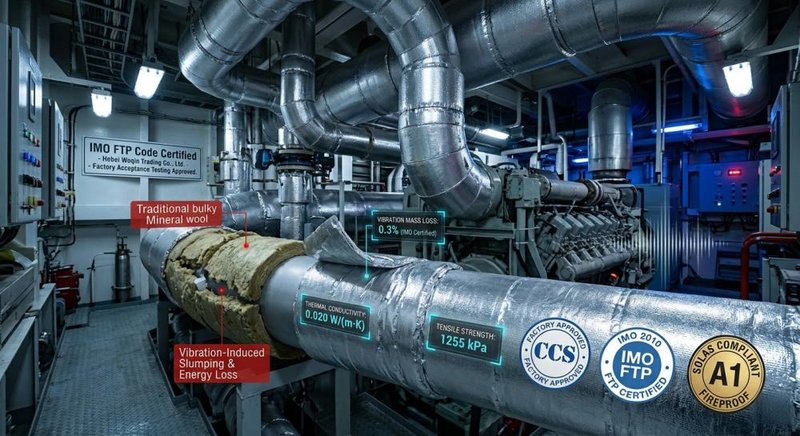
While we have successfully solved extreme humidity challenges for HVAC and Data Centers across Southeast Asia, this region (particularly maritime hubs like Singapore and Malaysia) is also home to some of the world's busiest shipyards and repair docks. The vessels built and retrofitted here sail across the global oceans, facing dynamic environments far more brutal than any land-based facility.
Inside a vessel's engine room, thermal insulation is subjected to relentless torture: high-frequency vibrations from massive diesel engines, hull twisting in heavy swells, salt-laden air, and extreme space constraints. For decades, shipbuilders have relied on traditional mineral wool or rock wool for high-temperature steam and exhaust pipes. However, under maritime conditions, these materials quickly reveal their fatal flaws—leading to catastrophic energy loss, severe corrosion, and life-threatening fire risks. It is time for the maritime industry to adopt the ultimate thermal armor: Aerogel Blankets.
1. Surviving the Swell: Zero Slumping Under Constant Vibration
A ship is a moving, vibrating structure. When traditional rock wool is subjected to the 24/7 high-frequency vibration of a ship's engine and propeller shaft, the brittle mineral fibers break and pulverize. Over time, the insulation material sinks to the bottom of the pipe—a phenomenon known as "Insulation Slumping." This leaves the top of the high-temperature pipe completely bare, radiating lethal heat into the engine room and wasting massive amounts of energy.
Aerogel blankets are engineered with a flexible, reinforced fiber matrix designed specifically to absorb kinetic energy.
- Tested for the Ocean: In rigorous laboratory testing, our aerogel blankets demonstrated a staggering Vibration Mass Loss Rate of just 0.3% (drastically outperforming the industry standard limit of 1.0%).
- Extreme Tensile Strength: With a transverse tensile strength of 1255 kPa and longitudinal strength of 414 kPa, our aerogel blankets will not tear, crush, or flatten during tight installations or routine maintenance impacts. Even after 20 years of navigating rough seas, the insulation structure remains completely intact.
2. The Hydrophobic Shield: Stopping Saltwater CUI and Oil-Wicking Fires
Two of the greatest nightmares for any Marine Chief Engineer are engine room fires and Corrosion Under Insulation (CUI).
Traditional rock wool acts like a sponge. If a microscopic leak occurs in an engine room's hydraulic or fuel oil lines, the rock wool wicks up the oil. Once this oil-soaked insulation touches a 500°C exhaust pipe, it becomes a massive firebomb. Furthermore, when high-humidity saltwater air penetrates traditional insulation claddings, the chlorides aggressively eat away at the carbon steel pipes underneath, causing hidden CUI that can lead to catastrophic pipe ruptures at sea.
Aerogel fundamentally eliminates these risks. Boasting a Hydrophobic Rate of 99.7%, liquid water and oils simply bounce off its surface. It prevents oil-wicking entirely, removing the fuel source for potential fires. Simultaneously, it acts as a breathable barrier, allowing vapor to escape while keeping corrosive saltwater away from the pipe's surface, effectively stopping maritime CUI at its root.
3. Cutting Deadweight and Reclaiming Engine Room Space
In commercial shipping, payload and fuel economics dictate profitability. Every unnecessary ton of weight and every lost cubic meter of space costs money.
Traditional rock wool requires extreme thicknesses (often exceeding 150mm) to achieve the required thermal drop, turning engine rooms into cramped, hazardous labyrinths where crew members struggle to perform maintenance.
By utilizing silica aerogel with an ultra-low thermal conductivity of 0.020 W/(m·K), shipyards can achieve the exact same thermal performance at 1/3 to 1/4 the thickness of traditional materials.
- Space Reclaimed: Walkways are widened, and pipe racks become dramatically more compact, vastly improving maintenance accessibility and crew safety.
- Deadweight Slashed: By stripping thousands of cubic meters of heavy, bulky mineral wool from the vessel's pipeline network, the total insulation weight is drastically reduced. This direct reduction in deadweight translates directly to improved fuel efficiency and increased cargo payload capacity.
4. The Non-Negotiable Baseline: IMO/SOLAS Certified A1 Fireproof
At sea, you cannot call the local fire department. Fire safety in marine engineering allows for absolutely zero compromises.
We don't just claim our materials are safe; we have the rigorous international certifications to prove it. Our Aerogel Blankets have been officially granted the Works Approval Certificate by the China Classification Society (CCS).
Our materials strictly comply with:
- The International Convention for the Safety of Life at Sea (SOLAS), 1974, as amended.
- The IMO 2010 FTP Code (Fire Test Procedures).
- Class A1 Non-Combustible standards.
In the event of an extreme engine room fire, our aerogel will not ignite, will not spread flames, and crucially, will not release toxic black smoke—providing the ultimate safeguard for both the vessel and her crew.
Upgrade Your Vessel's Thermal Defense
The era of bulky, fragile, and water-absorbent marine insulation is over. Whether you are constructing a new LNG carrier, retrofitting a bulk freighter in a Southeast Asian drydock, or designing an offshore platform, your assets deserve insulation that actually withstands the ocean.
Stop carrying deadweight and risking vibration failures. Contact our marine engineering team today to request our CCS/IMO certifications, technical data sheets, and physical samples for your next shipyard project.
[Contact Us Today for Marine Specifications & Certifications]

Written by - Ruibin An
Industry Veteran with 13+ Years of Experience. Deeply rooted in the insulation industry for over 13 years, specializing in supply chain optimization and global market trends for Rock Wool and Aerogel materials.
LATEST NEWS
Cutting Pipeline Insulation Labor Costs by 40% in 50°C Middle East Heat
2026-06-18
Acoustic & Thermal Insulation for HVAC Piping in Middle East Luxury Hotels
2026-06-16
Calculated Oppression: How Thermal Drift and Structural Sagging Bleed Millions from Middle East Piping TCO (And the 20-Year Closed-Loop Solution)
2026-06-15
District Cooling in the Gulf: The Physics of Inevitable Condensation and How Pre-Formed Glass Wool Shells Stop It
2026-06-12
CCGT Power Plant Pipe Insulation English Marketing Copy (99-point Final Benchmark Version)
2026-06-10