
Defeating the "Temperature Drop Avalanche": Upgrading CIS District Heating Mains with Pre-Formed Glass Wool Shells
In the extreme sub-zero corridors of the CIS region and the Arctic Circle, district heating networks are more than industrial infrastructure—they are a survival lifeline for millions. However, legacy manual-wrap insulation methods are causing catastrophic thermal losses of 15% to 20% across long-distance transmission lines. This technical deep-dive explores how Hebei Woqin’s Pre-formed Fine-Fiber Glass Wool Shells utilize a superior 0.034 W/mK thermal conductivity to eradicate the "Temperature Drop Avalanche" and redefine energy efficiency for the frozen North.
Chapter 1: The "Avalanche Effect" & The 0.034 W/mK Shield
The Engineering Challenge: The Temperature Drop Avalanche
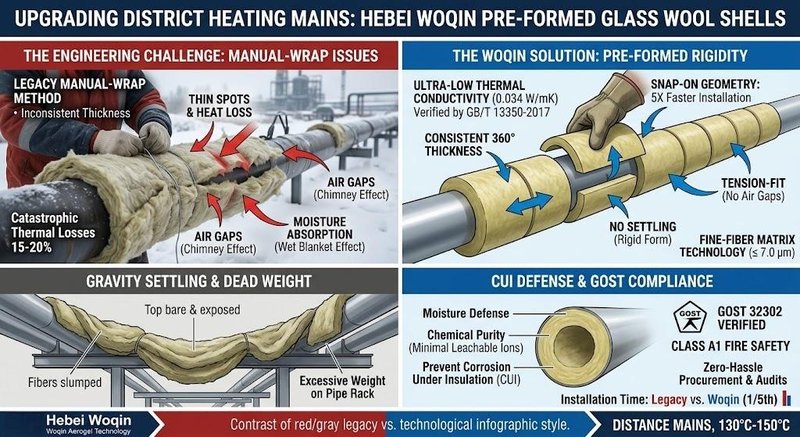
For district heating operators in the CIS region, the ultimate nightmare is the "Temperature Drop Avalanche." Because mainlines often stretch for 20 to 50 kilometers, even a minor insulation defect is magnified by the sheer distance. If a pipeline loses an extra 1°C per kilometer due to inconsistent insulation, the fluid temperature arriving at the terminal heat exchange station will fall below the required threshold for residential heating. To compensate, plants must over-burn natural gas, causing operational costs to skyrocket as heat evaporates into the atmosphere.
The Woqin Solution: Locking in Every Degree
To defeat the Avalanche Effect, Hebei Woqin provides a thermal shield specifically engineered for long-distance stability:
- Ultra-Low Thermal Conductivity (0.034 W/mK): Verified by rigorous testing (GB/T 13350-2017), our glass wool shells maintain a thermal conductivity of 0.034 W/mK or less at 25°C. This high-precision performance allows district heating networks to reduce cumulative fluid temperature drops by over 15% compared to traditional loose-fill materials.
- Fine-Fiber Matrix Technology: Our manufacturing process ensures an average fiber diameter of 7.0 microns (μm) or less. This microscopic precision creates a denser, more uniform network of "dead air" pockets, establishing an almost impenetrable thermal barrier against extreme external cold.
By utilizing a pre-formed, perfectly cylindrical geometry, we guarantee consistent insulation thickness across 360 degrees of the pipe. This eliminates the "thin spots" common in manual wrapping and ensures a predictable, high-performance thermal curve for the entire length of the district heating mainline.
Chapter 2: Solving Structural Load and the Settling Nightmare
The Engineering Challenge: Dead Weight and Pipe Rack Stress
In CIS nations, many district heating mainlines are installed on above-ground pipe racks to avoid the complexities of permafrost. This requires kilometers of steel support structures that must carry the "dead weight" of the pipeline, the fluid, and the insulation system.
Traditional high-density rock wool, while effective, adds significant weight to the racks, driving up civil engineering costs. More critically, when low-grade soft blankets are used, they suffer from "Gravity Settling." Over time, vibration and gravity cause the fibers to slump toward the bottom of the pipe. This leaves the top of the pipe—the area most exposed to arctic wind chill—dangerously thin or even bare, creating massive thermal bridges.
The Woqin Solution: Lightweight Rigidity
Hebei Woqin’s pre-formed glass wool shells solve the structural dilemma through engineered geometry:
- Lightweight Advantage: Glass wool is significantly lighter than rock wool at equivalent thermal performance. For long-distance overhead projects, this reduction in dead weight allows for lighter, less expensive steel support designs, slashing overall capital expenditure (CAPEX).
- Rigid Pre-formed Structure: Our shells are factory-cured into a solid cylindrical shape. This rigid matrix ensures the material never sags, never settles, and never deforms. Whether installed for one year or twenty, the pipe maintains 100% of its rated insulation thickness across the entire circumference.
Chapter 3: Eradicating the "Wet Blanket" Effect and CUI
The Engineering Challenge: Snowmelt and the Thermal Death Spiral
The Arctic Circle is a world of freezing rain and heavy snowmelt. Legacy manual-wrap methods create hundreds of seams where moisture can penetrate. Once water enters a soft mineral wool blanket, the "Wet Blanket Effect" takes hold. Because water is over 20 times more thermally conductive than air, the insulation layer essentially becomes a heat conductor, causing thermal efficiency to collapse.
Furthermore, trapped moisture against the steel pipe creates a perfect environment for Corrosion Under Insulation (CUI). In the alternating temperatures of a heating main, leachable chemicals can trigger rapid pitting and stress corrosion, threatening the metallurgical integrity of the entire network.
The Woqin Solution: Tension-Fit and Moisture Defense
To eliminate CUI risks, Hebei Woqin shells provide a multi-layered defense:
- Tension-Fit Engineering: Our pre-formed shells are manufactured with precise inner diameter tolerances. This ensures a tight, snug fit against the pipe surface, eliminating the "Chimney Effect" (internal air gaps) where cold air and moisture typically circulate.
- Superior Chemical Purity: According to our lab data, Woqin glass wool maintains exceptional purity with minimal leachable ions. It does not provide the "fuel" for electrochemical corrosion, keeping your carbon steel and stainless steel assets safe from CUI.
- Hydrophobic Stability: Even in high-humidity environments, our fine-fiber shells maintain their 0.034 W/mK stability by resisting moisture absorption, ensuring the insulation stays dry and the pipe stays protected.
Chapter 4: Escaping the "Wrap-and-Wire" Labor Hell
The Engineering Challenge: The Dexterity Crisis in Extreme Cold
In the CIS and Arctic regions, construction and maintenance don't stop when the temperature hits -30°C. However, human efficiency does. Technicians wearing heavy Arctic gear and thick gloves lose nearly 80% of their manual dexterity.
Traditional insulation methods—manually wrapping soft wool blankets and securing them with miles of steel wire—are not just slow; they are prone to failure. In extreme cold, it is nearly impossible to maintain consistent tension, leading to air gaps that trigger the "Chimney Effect," where cold air is sucked into the insulation layer, causing localized freezing.
The Woqin Solution: The "Snap-On" Revolution
Hebei Woqin’s pre-formed glass wool shells are designed to work with the environment, not against it:
- Precision Snap-On Geometry: Our shells feature a factory-engineered longitudinal cut. A single technician can snap a 1000mm shell onto the pipe in seconds, even while wearing heavy gloves.
- 5X Faster Installation: Field data shows that our pre-formed systems can be installed up to five times faster than traditional manual wrapping. This drastically reduces the time workers are exposed to hazardous cold and keeps projects on schedule during tight winter windows.
- Tension-Fit Accuracy: Because the shells are rigid and perfectly sized, they create a natural tension-fit that eliminates air bypass, ensuring the system performs exactly as the thermal model predicted.
Chapter 5: GOST 32302 Compliance—The Gateway to CIS Projects
The Engineering Challenge: Bureaucratic and Technical Barriers
For major energy projects in Russia, Kazakhstan, and Uzbekistan, technical excellence is only half the battle. Without the correct certification, a product cannot clear customs or pass a technical audit. EPC contractors cannot afford the risk of using non-compliant materials that might be rejected by state regulators.
The Woqin Solution: Verified Compliance for Peace of Mind
Hebei Woqin understands the specific regulatory landscape of the CIS market:
- GOST 32302 Verified: Our glass wool shells meet the rigorous technical requirements for mineral wool insulation in the CIS region. We provide the full documentation needed to ensure smooth procurement and technical approval.
- Class A1 Fire Safety: Fire safety is non-negotiable in urban district heating. Our products are verified as non-combustible (Class A1), ensuring that your infrastructure meets the highest global and local safety standards.
- Zero-Hassle Procurement: By providing official GOST reports and Fire Safety Certificates, we eliminate the bureaucratic hurdles that often delay international infrastructure projects.
Conclusion: Investing in "Thermal Certainty"
In the district heating industry, you are either transporting heat or losing money. Legacy insulation methods that allow for settling, moisture absorption, and slow installation are no longer viable in a high-cost energy market.
Upgrading to Hebei Woqin’s Pre-formed Fine-Fiber Glass Wool Shells is not just a technical choice; it is a financial strategy to protect your Opex. Stop "heating the Siberian sky" and start securing your thermal lifeline.
Call to Action (CTA):
- Request Your Free Thermal Analysis: Contact our engineering team today at [an@cn-aerogel.com] to receive a customized heat loss calculation based on your specific DH mainline parameters.
- Download the GOST Library: Access our full suite of GOST 32302 and Fire Safety certifications for your next project bid.
- Get an "Arctic Sample Box": Qualified EPC firms can request a project-specific sample kit, including our high-density glass wool shells and waterproof cladding solutions.

Written by - Ruibin An
Industry Veteran with 13+ Years of Experience. Deeply rooted in the insulation industry for over 13 years, specializing in supply chain optimization and global market trends for Rock Wool and Aerogel materials.
LATEST NEWS
The Ultimate Guide: "Survival Rules" and System Defenses for Industrial Piping Insulation in Extreme Middle Eastern Environments
2026-06-25
Unlocking Aramco & SABIC Compliance: The Highly Secure Path to Mechanical Completion Sign-Off
2026-06-25
Cutting Pipeline Insulation Labor Costs by 40% in 50°C Middle East Heat
2026-06-18
Acoustic & Thermal Insulation for HVAC Piping in Middle East Luxury Hotels
2026-06-16
Calculated Oppression: How Thermal Drift and Structural Sagging Bleed Millions from Middle East Piping TCO (And the 20-Year Closed-Loop Solution)
2026-06-15