
Locking in the Heat: Grooved Pre-formed Shells for EHT Systems in -40°C CIS Climates
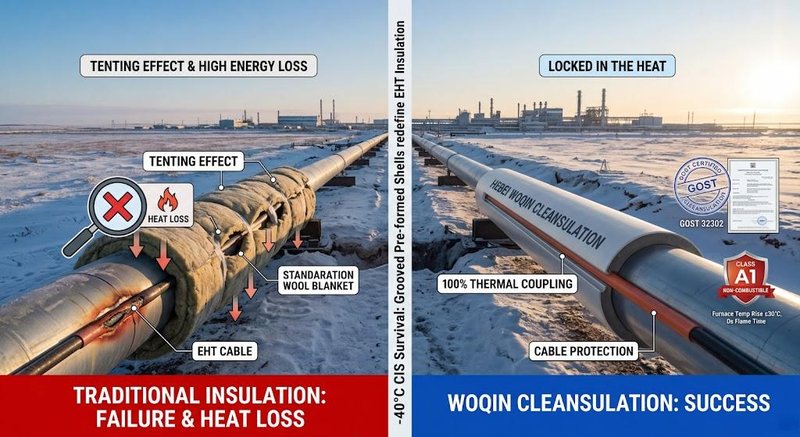
In the -40°C CIS industrial landscape, Electrical Heat Tracing (EHT) is the heartbeat of pipelines. But wrapping traditional insulation around EHT cables creates a fatal "tenting" effect, leading to heat loss, cable burnout, and CUI. Hebei Woqin’s CNC-grooved pre-formed shell systems ensure 100% thermal coupling and save 20% in energy OPEX.
1. Introduction: The -40°C Lifeline and the EHT Dilemma
In the brutal winter landscapes of the CIS region, Siberia, and the Arctic Circle, ambient temperatures routinely plummet below -40°C. For oil, gas, and mining pipelines, Electrical Heat Tracing (EHT) is not an optional accessory—it is the industrial lifeline. EHT cables act as the "pacemaker" of the piping network, continuously injecting heat to prevent the catastrophic "Flash-Freeze" of slurries, heavy crude, and critical fluids.
However, generating heat is only half the battle; transferring that heat to the pipe is where the true engineering challenge lies. A premium EHT system is utterly useless if the surrounding thermal insulation fails to properly couple the cable to the pipe wall. Unfortunately, the industry's reliance on wrapping standard flexible blankets or standard rigid shells over raised EHT cables is creating a silent engineering disaster across the frozen North.
2. The 6 Engineering Nightmares of Traditional EHT Insulation
When standard insulation materials are forced over heating cables without proper internal accommodation, the physical geometry of the installation fundamentally breaks down. Here are the six fatal engineering nightmares currently plaguing EPC contractors and facility managers in extreme cold climates:
- Nightmare 1: The "Tenting" Effect & Thermal Blocking When a standard rigid shell or a stiff insulation blanket is strapped over a raised EHT cable, it cannot sit flush against the pipe. It creates an inverted V-shaped air cavity on both sides of the cable—known as the "Tenting" Effect. Because air is a powerful thermal insulator, this cavity physically blocks the heat from reaching the pipe wall. The thermal coupling is destroyed.
- Nightmare 2: Hot Spots and Cable Burnout As the tenting effect traps heat within the air pocket, or when workers bind insulation too tightly around the cable, the generated heat has nowhere to go. This causes the localized temperature around the EHT cable to skyrocket, creating lethal "Hot Spots." For constant wattage cables, this inevitably melts the insulation jacket, leads to short circuits, and poses a severe fire/explosion risk in petrochemical zones.
- Nightmare 3: The Moisture Highway & CUI The gap created by the tenting effect doesn't just block heat; it runs longitudinally along the entire pipeline, creating a continuous micro-tunnel. If the external cladding is slightly compromised by snowmelt or heavy rain, liquid water travels freely down this "Moisture Highway," saturating the insulation from the inside and rapidly accelerating Corrosion Under Insulation (CUI).
- Nightmare 4: Mechanical Crushing of Expensive Cables Standard pre-formed shells (rock wool or glass wool) have perfectly cylindrical inner walls. When installation crews attempt to close two rigid shell halves over a raised EHT cable, they must use brute force to clasp them together. This severe clamping pressure physically crushes the cable’s delicate fluoropolymer jacket and can sever the internal heating matrix, destroying the expensive EHT system before the plant even powers on.
- Nightmare 5: The On-Site Manual Grooving Disaster To avoid crushing cables, experienced site workers attempt to carve a channel into the inside of the insulation shell using handsaws or knives. In a -30°C blizzard, this manual grooving is an absolute nightmare. It is painfully slow, driving up labor costs astronomically. The grooves are inaccurate and jagged, and the process releases massive amounts of irritating mineral dust into the faces of the workforce.
- Nightmare 6: Massive Energy Waste (Exploding OPEX) Because the heat transfer efficiency is crippled by air gaps and poor coupling, the pipeline's temperature sensors constantly read below the set-point. This forces the EHT control panels to run the heating cables at 100% capacity, 24 hours a day. The facility ends up burning a massive amount of electricity simply to heat the trapped air inside the insulation, devastating the plant's OPEX.
3. The Woqin Solution: CNC-Grooved Pre-formed Shell Systems
To eradicate the failures of manual wrapping and standard rigid shells, Hebei Woqin has engineered a dedicated pipeline winterization system specifically for Electrical Heat Tracing (EHT) networks.
Our Grooved Pre-formed Shells shift the burden of precision from the freezing construction site to our state-of-the-art CNC manufacturing facility.
- CNC Precision Grooving (Zero Manual Cutting): We do not expect your workers to carve insulation in a blizzard. Based on your specific EHT cable dimensions (e.g., 10x5mm, 15x8mm, or multiple tracing lines), we CNC-mill a precise longitudinal groove into the inner wall of the shell. On-site, the installation crew simply snaps the two halves together. The shell locks seamlessly around the pipe, accommodating the cable perfectly.
- 100% Thermal Coupling: By eradicating the "Tenting" effect, our grooved shells ensure that the EHT cable is held securely against the pipe wall, transferring 100% of its generated heat directly into the fluid medium. This optimization typically reduces annual EHT energy consumption (OPEX) by over 20%.
- Zero Mechanical Stress: The pre-cut channel provides a dedicated, safe housing for the heating cable. It completely eliminates the clamping pressure that crushes delicate fluoropolymer jackets, preserving the lifespan of your expensive EHT investment.
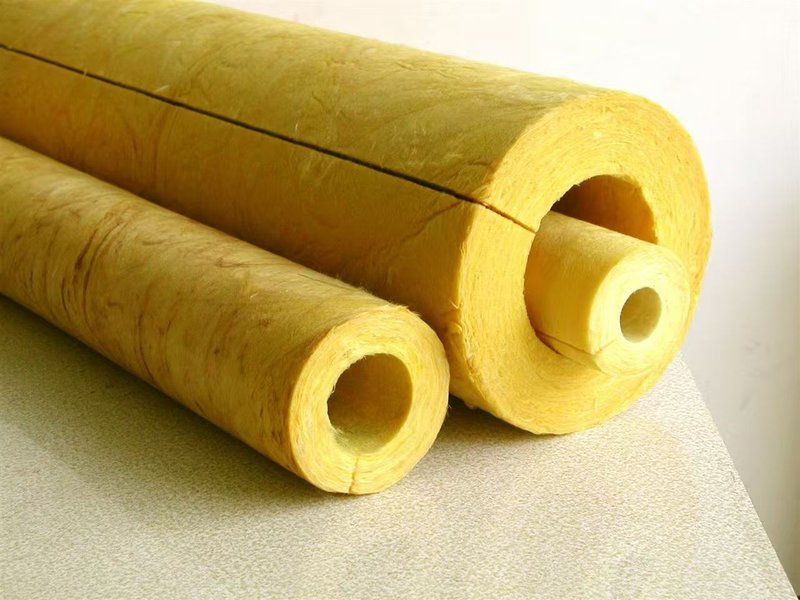
- The "Triple-Core" Flexibility: Because industrial pipelines operate at different temperatures, we offer these CNC-grooved shells in three core materials to suit your exact engineering needs:Fine-Fiber Glass Wool (0.034 W/mK): The ultimate lightweight, low-thermal-conductivity solution for long-distance water and medium-temp utility lines.High-Density Rock Wool: Engineered for high mechanical strength and vibration resistance in heavy petrochemical refineries.Alumino-Silicate (Ceramic) Wool: The extreme-temperature shield designed for highly specialized, ultra-hot tracing applications.
4. Hardcore Backing: Certified for the CIS Market
Entering the Russian and CIS industrial markets requires more than just marketing promises; it requires absolute regulatory compliance.
- GOST 32302 Certified: Hebei Woqin’s pre-formed shell systems are fully tested and certified under GOST 32302 standards. We provide the complete documentation required to ensure smooth customs clearance, technical approval, and project sign-off in CIS territories.
- Class A1 Fire Safety: In petrochemical environments, fire safety is non-negotiable. Our rock wool and alumino-silicate shells are rigorously tested to Class A1 Non-Combustible standards. Under intense testing, our materials recorded a Furnace Temperature Rise of ≤30°C and a Sustained Burning Time of 0 seconds. Even if a localized electrical short occurs, our insulation will never ignite or spread the flame.
5. Conclusion & Call to Action: The Mathematics of Arctic OPEX
In the -40°C reality of the CIS region, trying to save a few dollars by buying standard, non-grooved insulation is mathematically indefensible. The money "saved" on raw materials is instantly obliterated by skyrocketing manual labor costs (site grooving), cable replacements (crushing and burnouts), and massive wasted electricity (poor thermal coupling).
Upgrading to Hebei Woqin’s CNC-Grooved Pre-formed Shells is not an expense—it is a strategic investment in pipeline uptime and energy efficiency.
Stop crushing your EHT cables and heating the Siberian air. Are you engineering an Arctic pipeline or managing a petrochemical winterization project in the CIS?
- Get a Custom CAD Design: Email your pipe outer diameter (OD) and EHT cable dimensions to [an@cn-aerogel.com]. Our engineering team will provide a customized grooved-shell technical drawing free of charge.
- Request the CIS Sample Box: Qualified EPC firms can request our exclusive "CIS Project Sample Box," containing physical samples of our precision-grooved shells and GOST certification library. See the perfect fit for yourself!

Written by - Ruibin An
Industry Veteran with 13+ Years of Experience. Deeply rooted in the insulation industry for over 13 years, specializing in supply chain optimization and global market trends for Rock Wool and Aerogel materials.
LATEST NEWS
Beyond Insulation: Why Structural Thermal Breaks Are Essential for Modern Industrial Infrastructure
2026-06-29
The Ultimate Guide: "Survival Rules" and System Defenses for Industrial Piping Insulation in Extreme Middle Eastern Environments
2026-06-25
Unlocking Aramco & SABIC Compliance: The Highly Secure Path to Mechanical Completion Sign-Off
2026-06-25
Cutting Pipeline Insulation Labor Costs by 40% in 50°C Middle East Heat
2026-06-18
Acoustic & Thermal Insulation for HVAC Piping in Middle East Luxury Hotels
2026-06-16