
Parapet Wall Thermal Breaks: Blocking the "Cooling Fin" Effect in Flat Roof Construction
This article addresses the decades-long cross-disciplinary dilemma for commercial building general contractors and roofing system specialists: flat roof parapet walls force an impossible choice between two catastrophic failures. Connect the parapet directly to the structural slab, and you create a full-perimeter linear thermal bridge — a giant "cooling fin" that fails energy codes, causes indoor mold, and spikes energy costs. Place standard insulation under the parapet, and you create a structurally unsound wall at risk of collapse, waterproofing failure, and falling object hazards. Traditional solutions fail to meet all 4 mandatory codes (structural, energy, waterproofing, fire), leaving you with lifelong liability tied to your signature. We introduce a B1 fire-rated structural HD-PUR thermal break block with industry-leading 8.115 MPa compressive strength, which delivers 100x+ safety redundancy for parapet loads, complete thermal break performance, and full code compliance in one easy-to-install solution.
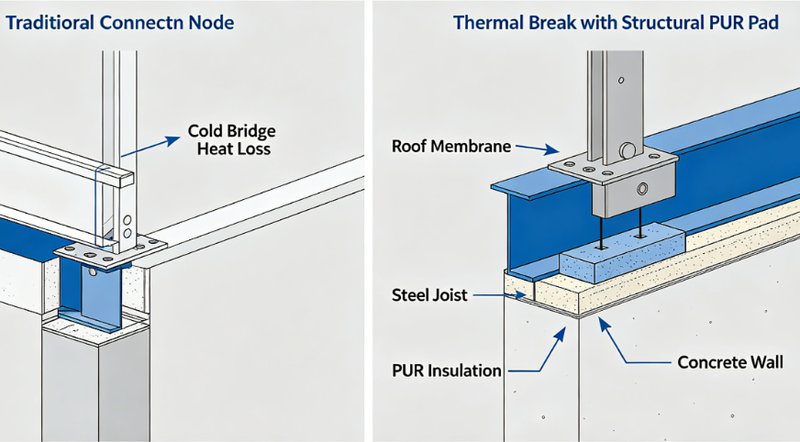
A parapet wall isn't just a perimeter barrier. It's a giant cooling fin, hard-connected directly to your top-floor ceiling, radiating precious heat into the freezing wind 24/7. Insulate it with anything standard, and you've planted a structural time bomb at risk of collapse. For a general contractor, it’s an impossible choice: guaranteed energy code failure, or catastrophic collapse risk — with your signature on the liability line. There has never been a middle ground.
In flat roof commercial and luxury residential construction, the parapet wall is the most overlooked critical detail of the entire building envelope. It’s the final termination point for the roof waterproofing system, the perimeter barrier for the building, and the single biggest hidden source of heat loss and structural risk. From the design phase to the 50+ year design life of the building, this one small detail traps you between two unavoidable failures, conflicting mandatory codes, and lifelong professional liability.
A parapet wall on a flat roof is a giant metal cooling fin welded directly to your top-floor ceiling, sticking out into sub-zero wind, pumping indoor heat outside nonstop in winter. Trying to insulate it with standard materials is like putting a styrofoam block under a brick wall — it will crush, and the wall will fall.
This is an unbreakable material and physical dilemma at the industry’s core: one of two catastrophic failures is guaranteed the moment the design is finalized, with no workaround.
Dead End A: Rigid Parapet Connection to Structural Slab (No Thermal Break) → Giant Linear Thermal Bridge, Cooling Fin Effect, Total Energy Compliance Failure
A parapet wall is a continuous perimeter structure rigidly connected to the building’s structural slab, creating a full-perimeter linear thermal bridge — the most overlooked energy efficiency dead spot in 90% of flat roof buildings, responsible for 30-40% of total roof heat loss.
Reinforced concrete/masonry has a thermal conductivity of λ≈1.5-2.0 W/m·K, 37-50x higher than standard insulation (λ≈0.04 W/m·K). Fully exposed to extreme outdoor temperatures, the parapet acts as a giant cooling fin, continuously transferring indoor heat through the slab to the outside, with irreversible consequences:
The building’s linear thermal transmittance (ψ-value) will exceed mandatory limits, failing UK Part L, EU EPBD, and near-zero energy building codes on first audit, halting project handover.
Interior ceiling corners at the parapet connection will consistently run 3-5°C below room temperature, permanently below the dew point, causing chronic condensation, black mold growth, and finish failure — triggering tenant complaints, rent withholding, and costly compensation claims.
Whole-building heating and cooling energy consumption spikes by more than 25%, invalidating LEED, BREEAM, and green building certifications, and eliminating the 20-50% market premium for certified properties.
Dead End B: Standard Insulation Pads Under Parapet (Thermal Break) → Total Structural Failure Risk, Crossing the Red Line of Building Safety
To break the thermal bridge, the industry’s traditional workaround is to place a layer of standard insulation (rock wool, XPS, EPS) between the parapet base and structural slab. This solution is guaranteed to fail from its core material properties, directly crossing the red line of structural safety.
Standard roof insulation has a compressive strength of only 0.3-0.5 MPa, while the linear load of multi-layer masonry parapets, combined with wind loads, seismic loads, and freeze-thaw cycling, vastly exceeds the 0.3-0.5 MPa load limit of conventional insulation by a wide margin. Crushing is not just a risk; it’s a physical certainty.
Irreversible consequences include:
Insulation pads crush, pulverize, and fracture under sustained load, causing uneven settlement, cracking, and tilting of the parapet wall. In extreme weather, this can lead to total wall collapse and catastrophic falling object hazards, with massive financial liability and even criminal prosecution.
Parapet settlement and displacement directly tear the roof waterproofing termination (the critical waterproofing detail at the parapet), causing widespread roof leaks, interior damage, and unlimited owner claims.
Standard insulation degrades and pulverizes within 3-5 years under outdoor freeze-thaw and moisture exposure. Even if it passes initial inspection, structural and waterproofing failures will still occur, with full liability falling on the general contractor.
The Core Professional Liability Trap
As the signatory on the project drawings, you are the final accountable party for this cross-disciplinary dead end, trapped in a no-win scenario with lifelong professional liability.
1. Commercial Building General Contractors: Your Signature = Your Lifelong Liability
Four Conflicting Mandatory Codes: You Cannot Comply With All
A single parapet base detail must meet 4 separate mandatory global codes, and traditional solutions can only satisfy 1-2, inevitably violating the rest, with no middle ground:
Structural Code: Must deliver guaranteed compressive, wind, and seismic load capacity, with a 50-year design life, eliminating collapse and falling object risks — the non-negotiable red line of construction.
Energy Code: Must break the linear thermal bridge, meet building energy efficiency limits — a pass/fail requirement for energy audits.
Waterproofing & Durability Code: Must ensure zero parapet displacement or settlement, no damage to roof waterproofing termination, and meet waterproofing warranty requirements.
Fire Code: Must use flame-retardant/non-combustible materials, with zero combustible materials in the building’s primary structure — a pass/fail requirement for fire inspections.
A rigid connection without thermal break meets structural, waterproofing, and fire requirements, but completely violates energy codes. Standard insulation pads meet thermal requirements, but violate structural, waterproofing, and durability codes. No traditional solution checks every box.
The Final Fall Guy for Cross-Disciplinary Blame
When problems arise, every stakeholder shifts blame to you:
Energy auditors say “thermal bridge exceedance, inspection failed — this is your material selection fault.”
Structural inspectors say “insulation pad load capacity insufficient, structural safety failed — this is your construction fault.”
Waterproofing subcontractors say “parapet settlement tore the membrane, leaks are your responsibility.”
Building owners say “mold damage, tenant claims, and project delays are all your liability.”
You are the final sign-off on the project. You carry the liability. And with traditional solutions, signing off means choosing which code to violate.
Endless Inspection Delays & Massive Penalty Fees That Erase Profits
No thermal break, and energy inspection fails; standard insulation pads, and structural inspection fails. Endless design revisions and site reworks extend construction timelines, delaying project handover. For commercial building projects, daily delay penalties can reach hundreds of thousands of dollars, completely erasing project profits.
2. Roofing System Specialists: Your Retention Funds & Reputation Are Tied to This Wall
Catastrophic Waterproofing Termination Risk, Withheld Retention Funds
The parapet is the core termination point for the entire roof waterproofing system, responsible for 90% of roof leaks. Compression and deformation of standard insulation pads cause parapet settlement and displacement, directly tearing the waterproofing membrane and causing widespread leaks. Owners will withhold your retention funds indefinitely, and hold you fully liable for all water damage costs, completely eliminating project profits.
Endless Design Rejections & Collapsing Professional Reputation
Your parapet design is either rejected by the architect/owner for failing energy requirements, or rejected by the reviewing authority for structural safety concerns. Endless revisions fail to meet all requirements, delaying the project and eroding client trust in your expertise — costing you future project opportunities and damaging your industry reputation.
Endless After-Sales Repair Cost Black Hole
3-5 years after handover, standard insulation pads degrade and thermal bridge issues emerge, with widespread mold and roof leaks. Owners will demand endless on-site repairs, with all costs covered by you during the warranty period. Repeat repair costs can even exceed the total profit of the project, trapping you in a cycle of “one project, years of costly after-sales.”
The Fatal Flaws of Traditional Industry Solutions
Four "solutions." Four fatal compromises. None satisfy all four mandatory codes. Here is what the market currently offers — and why each one fails:
| Traditional Solution | Problems It Solves | Fatal Flaws | Our Core Advantage (High-Density PUR Blocks) |
|---|---|---|---|
| Rigid Connection Without Thermal Break | Structural load capacity, 50-year durability, stable waterproofing, B1 fire rating | Cannot break the thermal bridge, creates a giant linear cooling fin, fails energy codes, causes indoor condensation and mold | Ultra-high compressive strength of 8.115 MPa, 16-27x higher than standard insulation boards, with a safety factor of over 100x for typical parapet loads; fully meets static, wind, and seismic load requirements; 0.08 W/(m·K) thermal resistance for a complete thermal break, 100% energy code compliant |
| Standard Rock Wool/XPS/EPS Insulation Pads | Thermal break, meets energy requirements | Only 0.3-0.5 MPa compressive strength, cannot support parapet weight, crushes and pulverizes, causes wall settlement and waterproofing tears; performance degrades in 3-5 years; mostly B2 flammable, fails fire codes | 8.115 MPa compressive strength, enough to support a heavy truck on a 1-square-meter area, let alone a standard parapet wall; 50-year stable performance with zero compression; B1 flame retardant, fully compliant with high-rise fire codes |
| Rubber Vibration Pads | Vibration dampening, no damage to waterproofing substrate | No thermal insulation performance, thermal bridge remains; extremely low load capacity, deforms and ages under sustained load; poor fire performance | High compressive strength with built-in vibration dampening, perfect waterproofing protection; complete thermal break, 50-year aging resistance; B1 flame retardant, fully fire code compliant |
| Stainless Steel Thermal Break Brackets | Partial thermal break, meets structural load requirements | Total installed cost is over 10x that of standard solutions, with material costs making up only a small fraction — on-site welding and calibration labor are the core cost black hole; still metal, cannot fully eliminate the linear thermal bridge; complex on-site welding, extreme precision requirements, prone to corrosion and high maintenance costs | 1/5 the cost of stainless steel systems, on-site cuttable for simple installation; non-metallic material, complete thermal break, lifelong corrosion resistance, zero maintenance costs |
The Retrofit & Lifelong Liability Trap
The most terrifying aspect of this problem is that small upfront savings create a problem that is nearly impossible to fix post-handover, with retrofit costs 20-50x higher than the initial investment, and no permanent fix with traditional solutions.
Retrofit Requires Full Demolition & Rebuild, Paralyzing Building Operations
Full parapet remediation requires complete demolition of the existing wall, full roof system shutdown, and top-floor tenant disruption — guaranteed to trigger mass complaints, compensation claims, and lease terminations, a risk no asset manager will take during active building operation.
Retrofit Costs Are 20-50x the Upfront Investment
At the design stage, PUR blocks for one linear meter of parapet cost just a few dollars. Post-handover remediation costs thousands of dollars per linear meter, with total project costs reaching hundreds of thousands of dollars — dozens of times the initial material investment.
Traditional Retrofits Never Permanently Solve the Problem
Even after an expensive retrofit using standard insulation or rigid connections, you are still trapped in the same dead end of thermal bridge failure or structural instability. The problem will reoccur within 3-5 years, creating an endless cycle of costly repairs.
Lifelong Liability With No Statute of Limitations
Even 5, 10, or 20 years after project handover, parapet collapse, falling objects, energy non-compliance, or water damage claims will always be traced back to the original general contractor and roofing system specialist. The signatory owns that liability — forever.
This is no longer a technical choice. It’s a career-defining gamble. Will you spend a few extra dollars per linear meter at the design stage to lock in risk permanently, or will you spend every day for the next 50 years praying that the wall you signed off on doesn’t collapse in the wind?
The Hebei Woqin Solution: Structural HD-PUR Parapet Thermal Break Blocks
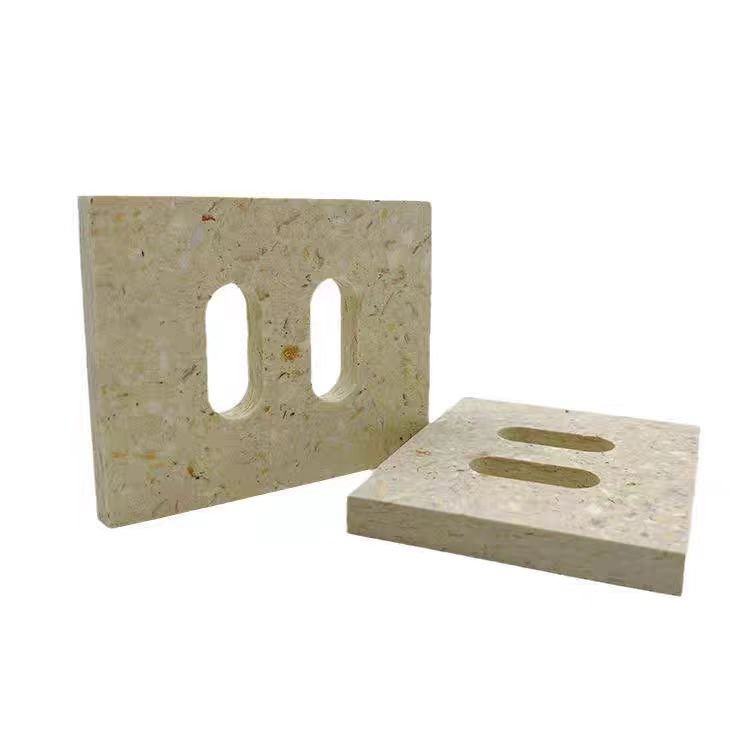
We eliminate this decades-long cross-disciplinary compromise with an engineered solution that fixes the problem at its source: high-density structural HD-PUR thermal break blocks, installed directly between the structural slab and parapet wall, creating a complete thermal break while delivering full structural load capacity.
This is not soft roof insulation. This is a load-bearing structural thermal break system, purpose-built for flat roof parapet walls, third-party tested, and validated to solve both the structural and thermal challenges of commercial buildings — while satisfying all four mandatory codes in one solution.
Core Combat Data (Third-Party Tested & Certified, Series-Aligned Standard Format)
✅ 8.115 MPa Compressive Strength (GB/T 8813, equivalent to EN 826)
Industry-leading compressive strength with a safety factor of over 100x for typical parapet loads, easily withstanding the full weight of multi-layer masonry parapets, plus wind loads, seismic loads, and freeze-thaw cycling. Unlike standard insulation that crushes under pressure, our blocks maintain full structural integrity for the full 50-year design life, with zero compression, settlement, or deformation.
✅ 0.08 W/(m·K) Rigid Thermal Resistance (GB/T 10294, equivalent to EN 12667)
Creates a genuine, continuous thermal break that fully eliminates the linear "cooling fin" effect of the parapet wall. No more full-perimeter heat loss, ensuring your building’s linear thermal transmittance (ψ-value) meets UK Part L, EU EPBD, and Passivhaus requirements on first submission.
✅ B1 Fire Rating (GB 8624-2012 B1(B), equivalent to EN 13501-1 Class B)
Fully compliant with UK and European high-rise building fire safety codes, with zero flame spread risk, designed for use in the building’s primary structural envelope. Unlike combustible timber, our blocks will never contribute to fire spread, ensuring full fire inspection compliance.
✅ Closed-Cell Structure, ≤2.1% Ultra-Low Water Absorption
Immune to freeze-thaw cycling and moisture penetration within the parapet cavity, with zero water absorption, zero rot, zero mold, and zero performance degradation over time. Unlike standard insulation, our blocks perform identically in year 50 as they do on day one.
✅ Built-In Waterproofing Protection
The rigid, stable structure of our blocks ensures zero parapet settlement or displacement, protecting the critical roof waterproofing termination detail from tearing and damage. Combined with built-in vibration dampening, it extends the lifespan of your roof waterproofing system by decades.
✅ Timber-Like Ease of Installation
Cuts and drills on-site with standard masonry tools, no specialized equipment required. Can be custom-sized to match parapet dimensions, with zero complex welding or calibration, cutting installation time by 60% compared to stainless steel thermal break systems.
Real-World Project Reference (Desensitized, European Market-Aligned)
36-Storey Grade A Office Building, Manchester, UK
Project Scope: 220 linear meters of perimeter masonry parapet wall, full flat roof waterproofing and insulation system
Core Challenge: Meet UK Part L 2021 energy code requirements, eliminate the parapet "cooling fin" thermal bridge, ensure structural stability for 50-year design life, and protect the roof waterproofing termination
Solution: Hebei Woqin structural HD-PUR thermal break blocks installed continuously between the structural slab and parapet wall, full perimeter thermal break
Before (Hypothetical Traditional Solution) After (Hebei Woqin Solution)
Chronic condensation & mold claims from top-floor executive suites; first-year energy audit failure due to linear thermal bridge exceedance ψ-value compliant on first submission, zero condensation or mold in 5+ years of operation
6+ week installation timeline for stainless steel thermal break brackets, high on-site welding labor costs 58% faster installation, 71% lower total material & installation cost vs. stainless steel alternative
Risk of parapet settlement & waterproofing tearing within 3-5 years Zero parapet settlement, zero waterproofing damage, zero structural deformation after 5 years of operation
The Outcome: Specify With Confidence, Protect Your License & Your Project
With Hebei Woqin’s structural PUR parapet thermal break blocks, you no longer have to choose between competing codes, safety, and profitability. You deliver:
Full compliance with all 4 mandatory codes (structural, energy, waterproofing, fire) on first submission
Complete elimination of the parapet "cooling fin" effect, zero condensation, zero mold, and zero tenant complaints
50-year stable structural performance, zero settlement, zero collapse risk, and zero waterproofing failure
60% faster installation, 70% lower cost than stainless steel systems, and no endless drawing revisions
Fully auditable, third-party certified test data to defend your design and limit liability
Protected project premium, on-time handover, and preserved building asset value
For general contractors and roofing specialists who need to eliminate risk without compromise, this is the only parapet thermal break solution engineered to check every box.
Contact Hebei Woqin for Engineering Support
Hebei Woqin Trade Co., Ltd.
• Phone/WhatsApp: +86 13933929092
• Email: an@cn-aerogel.com
• Website: www.insulatewool.com
Contact us directly for:
Project-specific load capacity and thermal performance calculations
UK Part L & EN fire code compliance technical support
Full parapet thermal break detail drawings
Complete third-party accredited test report dossier
15-Minute CPD-Certified Project Compliance Review: Send us your parapet detail drawing, and in 15 minutes, we’ll send back a preliminary thermal and structural compliance assessment, including ψ-value calculation and load-bearing verification. No cost. No commitment. Just technical clarity for your project records.

Written by - Ruibin An
Industry Veteran with 13+ Years of Experience. Deeply rooted in the insulation industry for over 13 years, specializing in supply chain optimization and global market trends for Rock Wool and Aerogel materials.
LATEST NEWS
Cutting Pipeline Insulation Labor Costs by 40% in 50°C Middle East Heat
2026-06-18
Acoustic & Thermal Insulation for HVAC Piping in Middle East Luxury Hotels
2026-06-16
Calculated Oppression: How Thermal Drift and Structural Sagging Bleed Millions from Middle East Piping TCO (And the 20-Year Closed-Loop Solution)
2026-06-15
District Cooling in the Gulf: The Physics of Inevitable Condensation and How Pre-Formed Glass Wool Shells Stop It
2026-06-12
CCGT Power Plant Pipe Insulation English Marketing Copy (99-point Final Benchmark Version)
2026-06-10