
Preventing Frost Heave in Mega Cold Storage & ASRS: HD-PUR Dual System (Load-Bearing Waterproof + Auxiliary Insulation)
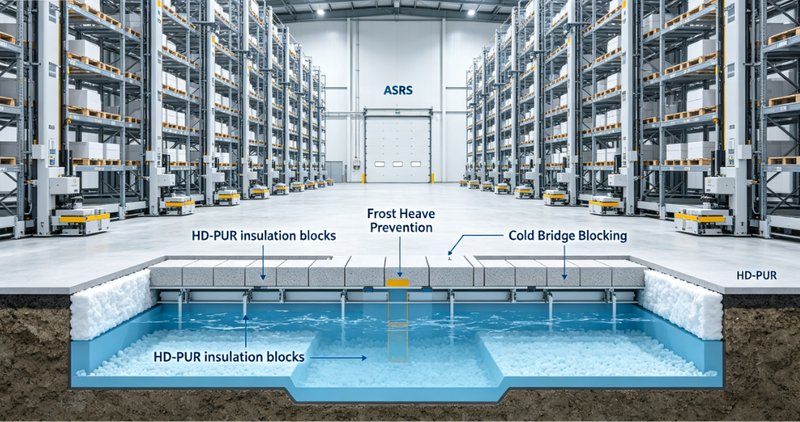
This article addresses the core pain point of frost heave in industrial freezers: cold air penetration and moisture intrusion that lead to foundation damage. Our solution adopts a targeted dual-system approach: high-density structural PUR (HD-PUR) serves as a load-bearing waterproof barrier with auxiliary insulation performance, paired with high-performance thermal insulation materials (e.g., XPS, VIP). Leveraging HD-PUR’s ultra-high compressive strength and low water absorption, we eliminate frost heave risks at the root, protect cold storage foundation safety, and solve the pain point of "insufficient load-bearing capacity of traditional insulation materials" in heavy-load mega cold storage and ASRS scenarios.
Opening (Engineer-Centric Hook)
Frost heave is not a trivial maintenance issue—it is a structural risk that can destroy the entire cold storage facility in weeks. For geotechnical engineers and cold storage investors, the most terrifying disaster is not sudden collapse, but the invisible and irreversible damage caused by frost expansion, which often goes unnoticed until it is too late. For ASRS facilities, even millimetres of frost-induced heave can disable automated cranes and collapse racking systems — making frost heave prevention not optional, but a structural necessity. What’s more, traditional insulation materials (EPS, XPS) that focus solely on thermal insulation often fail to withstand heavy loads, leading to insulation layer damage and further exacerbating frost heave risks.
1. The Hidden Danger of Frost Heave & The Shortcomings of Traditional Insulation
In deep-freeze cold storage (-25℃ to -30℃), frost heave occurs when two necessary conditions are met: low temperature (cold air penetration) and moisture (groundwater/capillary water). Ordinary insulation materials (such as low-density EPS or XPS) have two fatal flaws in this scenario:
First, while XPS/EPS have good thermal insulation performance (thermal conductivity 0.030–0.038 W/(m·K)), their compressive strength is extremely low (only 0.3–0.5 MPa), which cannot withstand the upward thrust generated by frost heave or the heavy load of forklifts and equipment. Over time, they are easily crushed, cracked, or deformed, losing their insulation effect.
Second, conventional insulation materials often lack reliable waterproof performance, allowing moisture to seep in and accumulate, providing a continuous water source for frost heave. According to geotechnical engineering data, the upward pressure generated by frozen soil can reach 200–500 kPa, which is equivalent to the pressure of a 50kg adult standing on a 1cm² area—enough to tear concrete and steel structures apart.
2. The Cost of Neglecting Load-Bearing & Waterproof Protection
Many cold storage owners and even some engineers mistakenly believe that "adding a heater mat + ordinary insulation" is enough to prevent frost heave. However, if the insulation layer cannot withstand heavy loads or block moisture intrusion, the heater mat will only delay the freezing time, not eliminate the root cause. Once the heater fails, the insulation layer is damaged, or the temperature drops sharply, the frozen soil will immediately expand.
The cost of repairing the foundation, replacing the insulation layer, and re-establishing the cold storage system is often 5–10 times the cost of the initial insulation investment. For mega cold storage and ASRS facilities, even a short-term shutdown can lead to massive losses in logistics revenue and order defaults.
3. The Definitive Solution: HD-PUR + High-Performance Thermal Insulation Dual System
Our high-density structural PUR (HD-PUR) is not positioned as a "single thermal insulation layer" to solve frost heave, but as a load-bearing waterproof barrier + auxiliary insulation layer. It works with high-performance thermal insulation materials (e.g., XPS, VIP) to form a dual-protection system, eliminating frost heave risks from the root while solving the pain point of insufficient load-bearing capacity of traditional insulation materials. Its core advantages lie in three key performance indicators:
Auxiliary Insulation Performance: With a thermal conductivity of 0.08 W/(m·K) (GB/T certified, ≤0.08), the thickness requirement varies by configuration. When used as the sole insulation layer, HD-PUR requires a thickness of 250–300mm to achieve adequate thermal resistance. In dual-system configuration, the HD-PUR thickness can be optimized to 100–150mm for load-bearing and waterproofing, while a separate XPS/VIP layer handles thermal break. These thicknesses are based on typical -25℃ cold storage conditions; actual values depend on local climate and soil temperature.
Ultra-Low Water Absorption: The dense closed-cell structure ensures ultra-low water absorption (≤2.1% in 24 hours), which completely cuts off the capillary water and groundwater channels, eliminating the water source required for frost heave and preventing insulation layer damage caused by moisture intrusion.
Ultra-High Compressive Strength: With a compressive strength of 8 MPa (GB/T certified), it is 10–20 times that of ordinary XPS/EPS. More impressively, 8 MPa equals 8000 kPa—16–40× the typical 200–500 kPa frost heave thrust. That’s a margin of safety that no traditional insulation material can match, easily withstanding the upward thrust generated by frost heave and the long-term heavy load of forklifts.
4. Material Comparison & Engineering Logic (Enhance Professional Credibility)
We are honest about the performance characteristics of our HD-PUR: it is not the material with the lowest thermal conductivity, but it is unmatched in terms of "compressive strength + waterproof performance" for heavy-load cold storage floors. The following comparison table clearly shows the positioning of each material:
| Material | Thermal Conductivity (W/(m·K)) | Compressive Strength (MPa) | Water Absorption (24h) | Best For |
|---|---|---|---|---|
| XPS | 0.030–0.038 | 0.3–0.5 | ~1% | General thermal insulation scenarios with no heavy load |
| VIP (Vacuum Insulation Panel) | 0.002 | 0.1 | ~1% | Thin high-performance thermal insulation with no load-bearing requirements |
| HD-PUR (Ours) | 0.080 (Certified ≤0.08) | 8.0 | ≤2.1% | Heavy-load mega cold storage & ASRS floors, requiring both waterproofing and load-bearing capacity |
Our engineering logic is clear: to solve frost heave, we need to "block cold + cut off water + resist thrust". High-performance thermal insulation materials (XPS/VIP) are responsible for blocking cold, while our HD-PUR is responsible for cutting off water and resisting the upward thrust of frost heave. Together, they form an impenetrable defense system, avoiding the flaws of single-material solutions—critical for mega cold storage and ASRS facilities where structural stability is non-negotiable.
5. Closing (Reinforce Trust & Alignment with Pain Points)
For geotechnical engineers and cold storage investors, choosing the right insulation solution is not about pursuing the "lowest thermal conductivity" blindly, but about matching the material characteristics to the actual scenario. In mega cold storage, high-bay ASRS facilities, and other heavy-load scenarios, the insulation layer not only needs to have certain thermal insulation performance, but also must withstand heavy loads and block moisture—especially for ASRS, where even minor foundation heave can lead to catastrophic equipment failure.
Our HD-PUR + high-performance thermal insulation dual system does exactly that: it solves the pain point of traditional insulation materials being "strong in thermal insulation but weak in load-bearing and waterproofing", eliminates frost heave risks, and provides long-term structural stability for the entire cold storage system, ensuring that the foundation remains intact for decades.
| Performance Data | Pain Point Solved | Engineering Logic |
|---|---|---|
| 0.08 W/(m·K) Thermal Conductivity (auxiliary insulation) | Slow down cold penetration, avoid soil freezing | Cooperate with high-performance thermal insulation materials to cut off cold transfer path, reduce low-temperature conditions for frost heave |
| ≤2.1% Water Absorption | Block capillary water and groundwater, avoid moisture accumulation | Dense closed-cell structure, no water seepage, fundamentally eliminate the water source of frost heave |
| 8 MPa Compressive Strength (8000 kPa) | Withstand frost heave thrust (200–500 kPa) and heavy loads, avoid insulation layer damage | 16–40× safety margin against frost heave thrust; ensure structural stability, no deformation or fracture under pressure—critical for ASRS |
| 30+ Year Service Life | Avoid long-term maintenance and repeated repairs | Dimensional stability, no creep or degradation, reducing long-term operational costs and shutdown losses for mega cold storage & ASRS |
CTA
Request a free frost heave risk assessment report
Get on-site technical support for foundation insulation design (including thickness calculation)
Receive a customized dual insulation system solution for your mega cold storage & ASRS project
Hebei Woqin Trade Co., Ltd.
For PUR solutions, contact: +86 13933929092
Email our technical desk: an@cn-aerogel.com
Visit our website: www.insulatewool.com

Written by - Ruibin An
Industry Veteran with 13+ Years of Experience. Deeply rooted in the insulation industry for over 13 years, specializing in supply chain optimization and global market trends for Rock Wool and Aerogel materials.
LATEST NEWS
Cutting Pipeline Insulation Labor Costs by 40% in 50°C Middle East Heat
2026-06-18
Acoustic & Thermal Insulation for HVAC Piping in Middle East Luxury Hotels
2026-06-16
Calculated Oppression: How Thermal Drift and Structural Sagging Bleed Millions from Middle East Piping TCO (And the 20-Year Closed-Loop Solution)
2026-06-15
District Cooling in the Gulf: The Physics of Inevitable Condensation and How Pre-Formed Glass Wool Shells Stop It
2026-06-12
CCGT Power Plant Pipe Insulation English Marketing Copy (99-point Final Benchmark Version)
2026-06-10