
Pharma-Grade VNA Cold Storage: Eradicating Dynamic Mast Sway in 15m Operations with Near-Zero Deflection HD-PUR Insulation
In the ultra-precision environment of pharmaceutical VNA (Very Narrow Aisle) cold storage, the margin for structural error is nonexistent. As automated racking heights reach 15 meters and beyond, a microscopic 2mm deflection in the sub-slab insulation layer can trigger a catastrophic 20-30mm lateral sway at the forklift mast head. This technical paper investigates the fatal "Deformation Trap" of conventional XPS materials under heavy dynamic stress. To solve this industry-wide failure, we introduce Hebei Woqin’s 8.115 MPa Structural HD-PUR—an engineered matrix offering <1.5% permanent deformation under max load. It is designed to guarantee TR34 DM1 (US ACI Fmin 100) superflat compliance and absolute structural "immortality" for mission-critical logistics.
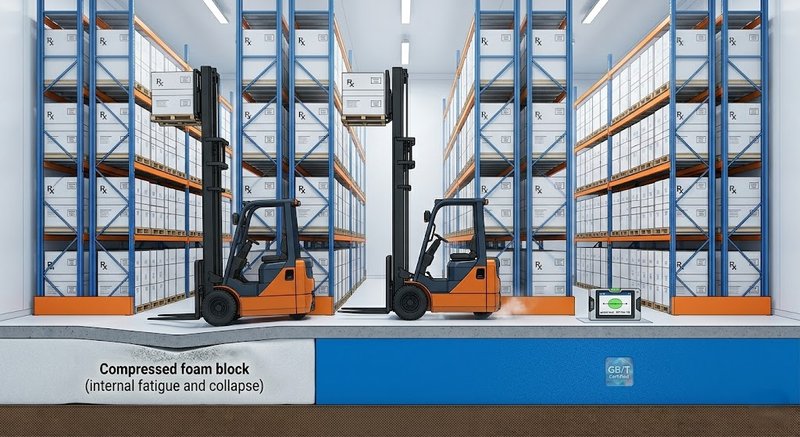
The Invisible Threat to Pharma ASRS: When 2mm Deflection Becomes a 30mm Disaster
In the world of high-bay pharmaceutical logistics, "flatness" is not an aesthetic preference—it is a functional mandate. To maximize volumetric efficiency, modern facilities utilize VNA trucks operating in aisles as narrow as 1.6 meters, reaching storage heights that were once thought impossible.
However, a silent mechanical phenomenon threatens these multi-million-dollar investments: The Multiplier Effect.
Because VNA trucks have an extremely narrow wheelbase and operate at high elevations, they exert extreme dynamic point loads onto the floor via solid polyurethane tires. The sub-slab insulation layer, often treated as a mere thermal barrier, suddenly becomes the foundation's "Achilles' heel."
Let us look at the structural math. If an engineer specifies a standard 100mm thick XPS board with a nominal compressive strength of 500 kPa, the extreme point load of a fully loaded VNA wheel instantly induces approximately 6 to 8mm of immediate vertical deflection. Factor in the long-term "Cold Creep" of an additional 2 to 5mm over a decade of operation, and the foundation has permanently yielded.
In VNA dynamics, if the ground beneath the left and right wheels suffers a differential settlement of just 2 millimeters (2mm), that tiny tilt is amplified ten-fold by the time it reaches the top of the 15-meter mast.
The result is a 20mm to 30mm lateral deviation. In an aisle with only centimeters of clearance, this dynamic sway causes high-speed collisions with racks, triggers expensive automated emergency braking (system lockouts), and risks the destruction of high-value, temperature-sensitive biologics. Crucially, this microscopic settlement permanently disqualifies the floor from its TR34 DM1 (Equivalent to US ACI Fmin 100) superflat tolerance forever.
To secure these mega-assets, facility owners must move beyond yielding plastics and demand engineering rigidity.
⚠️ The "10% Deformation" Trap: Why Standard XPS Fails Under VNA Trucks
When reviewing Technical Data Sheets (TDS), structural engineers often specify High-Strength Extruded Polystyrene (XPS) rated at 500 kPa or 700 kPa. However, a critical caveat in the testing standards is frequently overlooked: Compressive strength is measured at 10% deformation.
Under ASTM D1621 or EN 826 testing protocols, XPS achieves its nominal strength only after being compressed by 10% of its original thickness. For a standard 100mm sub-slab insulation layer, the material is technically permitted to yield by 10mm under load.
Let us look at the structural math. VNA trucks operate on solid polyurethane tires, exerting extreme dynamic point loads onto the floor. For a 100mm thick XPS slab with a nominal compressive strength of 500 kPa, the extreme point load of a VNA wheel instantly induces approximately 6 to 8mm of immediate vertical deflection. Add long-term "Cold Creep" of up to 2 to 5mm over a decade of operation, and the foundation has permanently yielded.
If your insulation can be compressed by 10%, it is not a load-bearing material—it is a sponge.
📉 The Collapse of Superflat Floors: An Irreversible Financial Catastrophe
To achieve the millimeter-precision required by 15-meter VNA trucks, flooring contractors invest heavily in laser-screeded concrete to achieve and maintain the required TR34 DM1 floor flatness tolerance (Equivalent to US ACI Fmin 100).
However, a floor acts as a unified structural system. Pouring expensive, rigid superflat concrete over a yielding XPS base inevitably leads to system failure:
- Hollowing & Cracking: As the underlying insulation creeps, hollow voids form beneath the concrete. The slab experiences severe bending moments under extreme dynamic point loads, eventually cracking and losing its superflat profile.
- Irreversible Downtime: Sub-slab insulation failure cannot be patched or surface-repaired. Restoring DM1 compliance requires emptying the deep-freeze facility, dismantling the 15-meter dense racking systems, demolishing the concrete slab, and rebuilding from scratch. For pharmaceutical giants, the resulting supply chain disruptions and FDA/EMA compliance breaches cost 15 to 20 times the initial insulation savings.
📊 The Engineering Benchmark: Woqin HD-PUR vs. Conventional XPS
To bridge this engineering gap, Hebei Woqin developed the 8.115 MPa Structural HD-PUR—an engineered polymer matrix designed not to "resist" pressure, but to actively reject deformation.
| Key Technical Indicator | Standard High-Strength XPS | Woqin Structural HD-PUR | Impact on VNA Operations |
| Compressive Strength | 0.5 - 0.7 MPa (at 10% yield deformation; ASTM D1621) | 8.115 MPa (8115 kPa) (Rigid structural limit) | Delivers 11x to 16x higher load-bearing capacity; prevents microscopic crushing. |
| Deformation Under Max Load | 10% allowed yield | Near-Zero Deflection (<1.5% permanent deformation tested per GB/T 8813 / ISO 844 eq.) | Provides a true, immovable base for TR34 DM1 superflat concrete. |
| Long-Term Cold Creep | Noticeable; yields continuously under dynamic point loads. | Near-Zero Creep | Guarantees ACI Fmin 100 flatness compliance over a 30-year design life. |
| Flexural Strength (8.17 MPa) | Low; prone to brittle snapping under shear stress. | The Invisible Shield (Heavy forklifts don't just push down; they tear sideways during emergency braking. Our 8.17 MPa flexural strength ensures the slab remains a monolithic block). | Absorbs horizontal tearing forces from forklift acceleration and braking. |
| Water Absorption (24h) | ~ 1.0% - 3.0% | ≤ 2.1% (GB/T 8810) | Blocks capillary moisture, eliminating sub-slab frost heave risks. |
| VNA Suitability | High Risk | Engineering Gold Standard | Eradicates 15m dynamic mast sway and equipment lockouts. |
🛡️ Engineering Certainty: 8.115 MPa Structural HD-PUR for Near-Zero Deflection Operations
For decades, structural engineers have been trapped in a design dilemma: traditional materials that insulate well are too soft, and materials that bear extreme loads do not insulate. In the high-stakes, zero-tolerance environment of pharmaceutical VNA logistics, compromising on either leads to structural disaster.
Hebei Woqin shatters this compromise. Our 8.115 MPa Structural HD-PUR is not just an insulation board; it is an engineered foundation armor.
By delivering a rigid structural limit equivalent to 8115 kPa—far exceeding the extreme dynamic point loads of 15-meter VNA trucks—our HD-PUR blocks act as an impenetrable shield beneath your slab. Tested under sustained maximum load (per GB/T 8813 / ISO 844 equivalent), it exhibits <1.5% permanent deformation. This is not merely "low-creep"; it is engineering immortality for your floor. It completely neutralizes dynamic mast sway, ensuring that the laser-screeded TR34 DM1 (US ACI Fmin 100) surface above remains flawlessly flat for its entire 30-year design life.
Furthermore, heavy forklifts do not just push down; they tear sideways during rapid acceleration and emergency braking. The elite 8.17 MPa flexural strength of our HD-PUR acts as an invisible shield against these horizontal tearing forces, ensuring the concrete slab remains a rigid, monolithic block without snapping under shear stress.
Combined with an ultra-low water absorption rate of ≤2.1% and a stable 0.08 W/(m·K) thermal break, it simultaneously eradicates thermal bridging and cuts off the capillary moisture channels that cause sub-slab frost heave. It is the ultimate, all-in-one structural defense system for your mega-cold storage.
🎯 Secure Your VNA Floor Integrity Today
Do not let a 2mm insulation failure destroy a multi-million-dollar automated logistics facility. Stop relying on yielding plastics for mission-critical pharmaceutical cold chains. Partner with Hebei Woqin to build your facility on a foundation of absolute engineering certainty.
Contact our cold storage engineering desk today to:
- Request a Custom VNA Point-Load Calculation: Tailored to your specific racking heights, forklift wheelbases, and slab thicknesses.
- Get the Third-Party HD-PUR Test Dossier: Full lab reports verifying 8.115 MPa compressive strength, 8.17 MPa flexural strength, and <1.5% deformation limits.
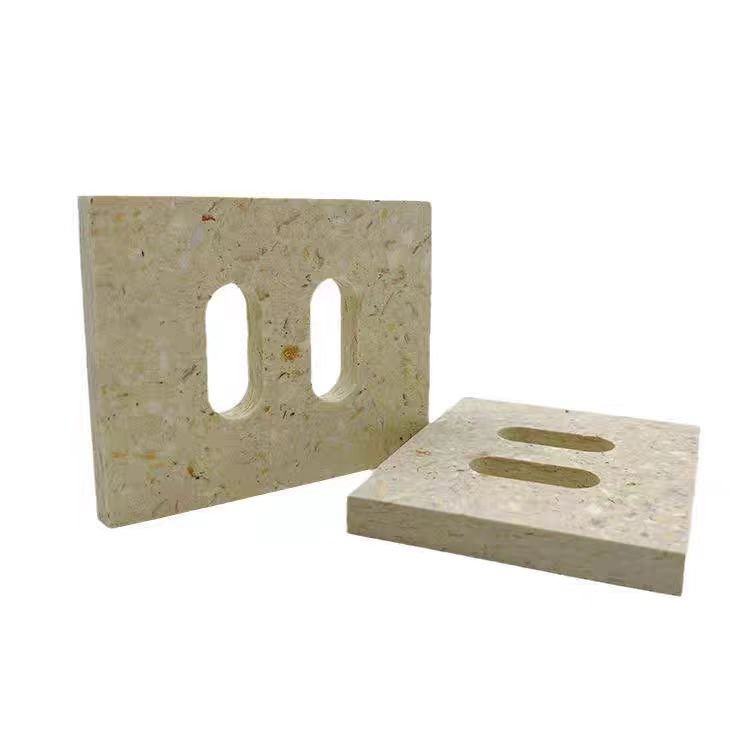
- Order a Physical Structural Prototype Block: Let your engineering team test the absolute rigidity of our HD-PUR in-house.
Hebei Woqin Trade Co., Ltd.
Phone/WhatsApp: +86 13933929092
Email our Technical Desk: an@cn-aerogel.com
Explore our Factory-Direct Capabilities: www.insulatewool.com
🔗 Explore Related Heavy-Load Engineering Solutions:

Written by - Ruibin An
Industry Veteran with 13+ Years of Experience. Deeply rooted in the insulation industry for over 13 years, specializing in supply chain optimization and global market trends for Rock Wool and Aerogel materials.
LATEST NEWS
Acoustic & Thermal Insulation for HVAC Piping in Middle East Luxury Hotels
2026-06-16
Calculated Oppression: How Thermal Drift and Structural Sagging Bleed Millions from Middle East Piping TCO (And the 20-Year Closed-Loop Solution)
2026-06-15
District Cooling in the Gulf: The Physics of Inevitable Condensation and How Pre-Formed Glass Wool Shells Stop It
2026-06-12
CCGT Power Plant Pipe Insulation English Marketing Copy (99-point Final Benchmark Version)
2026-06-10
Locking in 600°C: Composite Shells for CSP Molten Salt Pipelines in the GCC
2026-06-10