
The PFP-CUI Correlation: Why 2026 Asset Integrity Requires a Hybrid Insulation Strategy
In Oil & Gas, the trade-off between Fire Protection (PFP) and CUI is a critical challenge. This article explores how integrating 99.7% hydrophobic Aerogel with Class A1 rockwool creates a synergistic barrier—protecting against fire without trapping moisture.
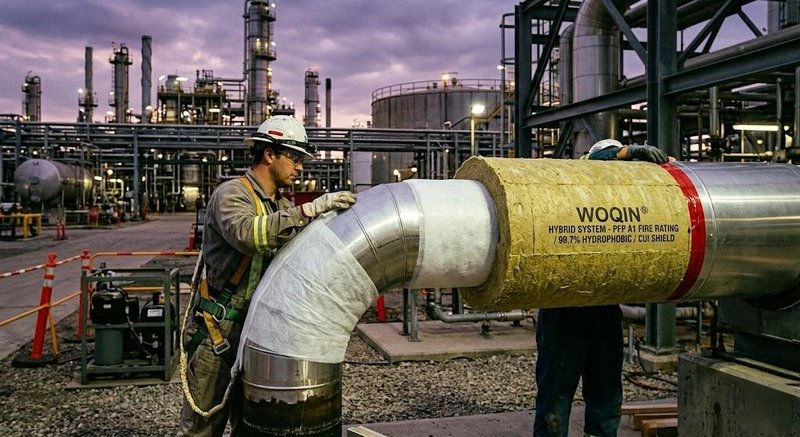
Introduction: The Invisible Trade-off in Industrial Safety
In the high-stakes world of offshore and downstream engineering, a dangerous paradox has emerged. As integrity expert Akshat Agrawal pointedly observed: “We’re fire-proofing our pipes to death, then watching them rust from the inside.” This is the PFP-CUI Correlation. To meet stringent Passive Fire Protection (PFP) audits, facilities often specify extreme insulation thicknesses. However, these bulky systems frequently act as "storage tanks" for moisture, accelerating electrochemical corrosion against the steel pipe. For 2026, the industry standard is shifting: we are no longer just asking "Will it resist fire?" but "Will it compromise the asset while doing so?"
The Foundation: High-Performance Rockwool (The Volume Hero)
Rockwool remains the essential backbone of industrial thermal protection. It provides the necessary thermal mass and cost-efficiency for large-scale installations.
- Fire Integrity: Woqin’s industrial rockwool maintains a Hot Load Shrinkage Temperature of ≥600°C—well above the typical 30-minute hydrocarbon fire exposure curve.
- Cost-Efficiency: For miles of straight-run piping, rockwool provides the most reliable Class A1 (Non-combustible) foundation available today.
The Precision Shield: SiO2 Aerogel (The CUI Eliminator)
To solve the CUI paradox at critical junctions—valves, elbows, and high-vibration zones—SiO2 Aerogel blankets provide the "special forces" intervention:
- 99.7% Hydrophobicity: Per GB/T 10299, our Aerogel repels water at the molecular level. Unlike traditional fibers that may eventually "wick" moisture, Aerogel keeps the pipe surface bone-dry.
- Vibration Resilience: We've achieved a vibration mass loss rate of only 0.3%. To put that in perspective, the industry standard is ≤1.0%, and many traditional materials often exceed 2.0% after years of operational wear. This ensures no "settling" or "fire gaps" develop over the asset's life.
- Reducing PFP Load: With a thermal conductivity of 0.020 W/(m·K), 10mm of Aerogel can replace 50mm of conventional bulk. This leaner profile reduces the total surface area for moisture entrapment and significantly lowers the mechanical load on the PFP cladding.
The Hybrid Strategy: A "Zero-Corrosion" PFP System
By integrating these two materials, engineers no longer have to choose between fire safety and corrosion resistance:
- The Aerogel Layer: Applied directly to the pipe as a hydrophobic, ultra-thin thermal break.
- The Rockwool Layer: Applied as the secondary thermal mass to meet 2-hour or 4-hour fire ratings.
- The Result: A system that passes the fire audit while physically preventing the conditions required for CUI.
Conclusion: From Compliance to Integrity
Meeting fire codes is the baseline; protecting the asset for 20 years is the goal. By moving to a hybrid insulation model, you eliminate the "Silent Killer" hiding under your PFP layers.
Facing a high-cost PFP challenge or recurring CUI issues on your high-temp lines?Send us your junction specifications—our engineering team will provide a comprehensive "Hybrid Insulation Audit," comparing life-cycle costs and thermal bridge simulations for your facility. [Link: Request a Technical Audit]

Written by - Zhongjian An
Certified Passive House Designer (PHI Germany), validated by Prof. Dr. Wolfgang Feist. With 15+ years of expertise in high-performance solutions for both Green Buildings and Industrial Applications (Petrochemical Pipelines, LNG Cryogenic, & High-Temp Equipment).
LATEST NEWS
High-Density Rigid PU Thermal Break Blocks: North American Code-Compliant Structural Solution
2026-07-01
Beyond Insulation: Why Structural Thermal Breaks Are Essential for Modern Industrial Infrastructure
2026-06-29
The Ultimate Guide: "Survival Rules" and System Defenses for Industrial Piping Insulation in Extreme Middle Eastern Environments
2026-06-25
Unlocking Aramco & SABIC Compliance: The Highly Secure Path to Mechanical Completion Sign-Off
2026-06-25
Cutting Pipeline Insulation Labor Costs by 40% in 50°C Middle East Heat
2026-06-18