
CCGT Power Plant Pipe Insulation English Marketing Copy (99-point Final Benchmark Version)
CCGT gas turbine piping across the Middle East suffers from continuous high-frequency vibration. Conventional insulation materials tend to dust, sag and degrade, risking turbine damage and extra operational costs. Our high-strength rock wool pipe shells deliver vibration resistance and dust-free performance for long-term reliable operation.

High-Frequency Vibration Challenges for CCGT Gas Turbines in the Middle East
As the core power supply infrastructure across GCC regions, Combined Cycle Gas Turbine (CCGT) power plants operate 24/7 to meet surging regional electricity demand. The auxiliary high-pressure steam pipelines surrounding gas turbines run under an extremely harsh triple working condition: non-stop high-frequency mechanical vibration, medium pressure, and operating temperatures up to 600°C.
Gas turbines are high-precision power equipment whose intake systems require ultra-clean ambient air. Every tiny fiber particle peeled off from inferior insulation acts like a microscopic abrasive sandblasting the turbine blades, causing irreversible wear and damage to core precision components. Combined with extreme temperature and pressure, this harsh operating environment raises stringent requirements for insulation products on structural stability, dust resistance, high-temperature performance and overall durability — standards that most ordinary insulation materials catastrophically fail to meet.
Hidden Risks: Dusting & Degradation of Traditional Insulation Solutions
Currently, two types of insulation products are widely applied on CCGT pipelines, and both carry inherent structural and performance defects, which will gradually evolve into severe operational risks for power plants.
1. Risks of flexible soft insulation felts (mainstream traditional solution)
Loose soft insulation felts have weak internal fiber bonding. Under persistent mechanical vibration, internal fibers rub against each other continuously, break apart and gradually turn into fine floating dust. Without rigid supporting structure, the soft material slowly settles, sags and deforms over time, forming hollow cavities inside the insulation layer. Meanwhile, the original joints keep expanding under vibration, creating penetrating thermal bridges that lead to massive continuous heat loss.
Corresponding Solution:
Our rigid rock wool pipe shells are manufactured via dense curing process with firmly interlocked fibers. No fiber breakage or dust shedding occurs under vibration. The rigid shell maintains fixed shape without sagging or hollow cavities, and neatly processed joints minimize gaps to block thermal bridges effectively.
2. Risks of standard ordinary rock wool
Many project teams choose common rock wool as an alternative, yet standard rock wool lacks targeted vibration resistance. Its edges and local areas are prone to chipping and peeling under long-term vibration, still generating floating dust and hidden dangers. Worse, some low-grade rock wool has insufficient heat load shrinkage performance, which shrinks and deforms when exposed to 600°C high temperature, destroying the complete insulation system.
Corresponding Solution:
We adopt exclusive high-strength formula to enhance structural toughness and vibration resistance, making up for the defects of standard rock wool. Verified by professional tests, our products feature a heat load shrinkage temperature of no less than 600°C, keeping stable shape without thermal deformation under sustained ultra-high temperature.
3. Common defects of all traditional insulation materials
Both soft felts and ordinary rock wool age rapidly under the combined effect of vibration and high temperature. They require frequent on-site inspection, manual patching and overall replacement throughout service life.
Corresponding Solution:
Our high-strength rock wool shells feature excellent anti-aging performance, supporting long-term stable operation and greatly reducing routine maintenance work.
Critical Risk Definition: This is not a sudden failure. This is a slow, silent, and irreversible degradation of your core generating asset.
Floating fiber dust invades the gas turbine intake system, wearing precision blades and blocking internal pipelines, which gradually reduces the operating efficiency of the whole unit. Insulation sagging and hollow cavities cause severe heat dissipation, raising the thermal load of the plant and accelerating corrosion and aging of metal pipelines. Once equipment faults are triggered by dust and failed insulation, unplanned shutdowns will occur directly, resulting in power supply gaps and substantial power generation losses for CCGT plants, the main power source in the Middle East.
These hidden troubles bring heavy pressure to two core groups of decision-makers:
For operation and maintenance directors, continuous dust hazards and deformed insulation mean daily frequent patrols, repeated on-site repairs and regular full replacement. This not only increases daily labor workload and operational costs, but also keeps the maintenance team under long-term mental pressure of equipment failure.
For EPC design engineers and project managers, selecting unreliable traditional insulation will leave inherent defects for delivered projects. Subsequent rework pushes up extra project costs, delays project acceptance, and damages personal and team professional reputation in the competitive Middle East power engineering industry.
From the perspective of full-lifecycle cost accounting, conventional soft insulation must be fully replaced every 5 to 8 years. The combined cost of production shutdown, labor and new materials for one single replacement is nearly equal to the total investment of installing our high-strength rock wool pipe shells. Frequent repeated replacement keeps the overall lifecycle cost of traditional solutions at a high level all the time.
Woqin’s Core Value Commitment: Woqin’s high-strength rock wool pipe shells are not an incremental improvement over traditional insulation. They are a fundamental redesign — engineered to eliminate every failure mode that vibration, dust, and high temperature can trigger in a CCGT environment.
Woqin Solution: High-Strength Rock Wool Shells for Vibration Resistance, Zero Dust & 600°C Thermal Stability
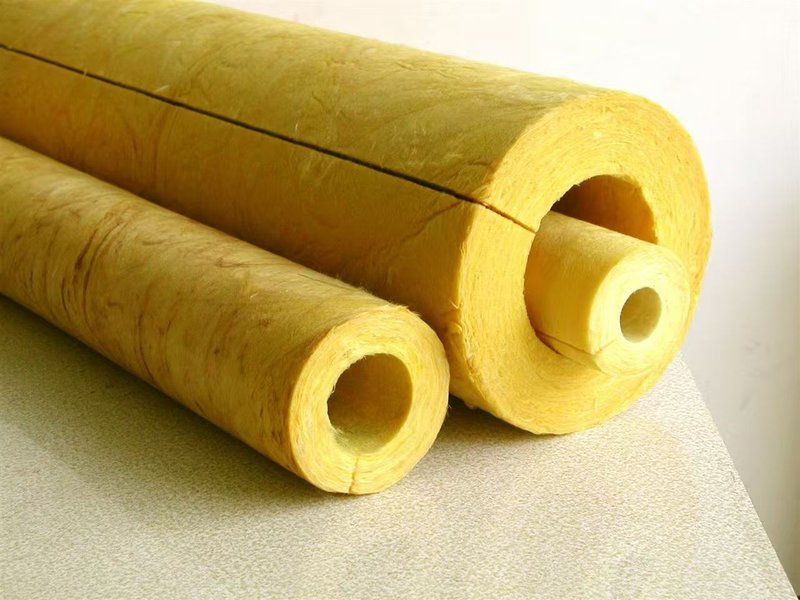
Aiming at all pain points of traditional insulation onCCGT gas turbine auxiliary high-pressure steam pipelines, Woqin specially develops high-strength rigid rock wool pipe shells, professionally customized for high-frequency vibration, high-pressure and 600°C high-temperature working conditions of gas turbine auxiliary piping. Our products solve all root defects of traditional insulation from structural design and material formula.
1. Integrated rigid structure against vibration & deformation
Different from flexible soft materials, our pipe shells are prefabricated into rigid monolithic units. Under long-term high-frequency mechanical shock, the overall structure will not shift, settle, sag or collapse, always maintaining complete and uniform insulation thickness. It completely eliminates hollow cavities caused by material deformation.
2. Dense fiber structure for 100% dust-free operation
Through special dense curing treatment, internal rock wool fibers are tightly interwoven with ultra-high binding strength. Even under continuous vibration and temperature fluctuation, no fiber chipping, breakage or dust shedding happens. It delivers reliable on-site dust-free performance with zero fiber shedding under sustained operating vibration, fundamentally cutting off the dust source that damages gas turbine precision components.
3. Precision size & tight assembly to eliminate thermal bridges
All products are manufactured under accredited quality control systems with fully traceable dimensional certificates. The dimensional tolerance is fully controlled: length deviation -2~+5mm, inner diameter deviation -3~+4mm, thickness deviation -3~+5mm. The flat and neat end faces ensure tight fitting during installation, minimizing joint gaps and thoroughly blocking penetrating thermal bridges to reduce invalid heat loss.
4. Exclusive high-strength formula beyond standard rock wool
Optimized formula greatly improves structural toughness and vibration resistance, making our products far more adaptable to CCGT extreme vibration environment than ordinary rock wool.
5. Ultra-long service life to optimize full-lifecycle cost
Our high-strength rock wool pipe shells supportmore than 15 years of maintenance-free stable operation, far exceeding the 5–8 year service cycle of traditional soft insulation. It saves massive expenditure on repeated procurement, shutdown construction and routine maintenance, and effectively optimizes the full-lifecycle comprehensive cost of power plant projects.
Superior Performance Under High Temperature & High Pressure (Full Combined with Official Test Report)
All performance indicators of our high-strength rock wool pipe shells have passed full professional testing, delivering excellent comprehensive performance to match 400–600°C high-pressure steam pipelines around gas turbines.
1. Excellent thermal insulation performance
Tested thermal conductivity ≤ 0.044 W/(m·K) at 70°C, delivering stable and efficient heat insulation for high-temperature pipelines.
2. Ultra-high temperature structural stability
The heat load shrinkage temperature is no less than 600°C. The product maintains complete physical structure without shrinkage or deformation under long-term 600°C continuous operation.
3. Class A1 non-combustible fire safety performance (power plant standard)
As Class A1 non-combustible material, full fire performance test results: total combustion calorific value ≤ 2.0 MJ/kg, furnace temperature rise ≤ 30°C, no sustained burning and mass loss rate ≤ 50%. It fully meets the strict fire protection requirements of gas turbine high-risk areas.
4. Low ion content to prevent pipeline corrosion
Tested content: $$\omega(\mathrm{Cl^-})+\omega(\mathrm{F^-}) \leq0.0112$$ (when $$\omega(\mathrm{SiO_3^{2-}})+\omega(\mathrm{Na^+})=0.0696$$). Low chloride and fluoride ion formula avoids electrochemical corrosion to metal pipelines under high temperature and pressure, extending the service life of the entire piping system.
5. Standard product specifications for diversified project demands
- Bulk density: 80–150 kg/m³
- Pipe shell inner diameter: 18–610 mm
- Shell thickness: 30–200 mm
- Standard length: 1000 mm
Complete size series covers all conventional pipeline specifications of Middle East CCGT power plants, with flat surface and no axial warpage, convenient for on-site cutting and installation.
Call to Action
Request our CCGT Power Plant Vibration-Resistant Insulation Construction Atlas & Dust-Free Performance Test Report now.
With complete product parameters, standard installation guidelines and authoritative test data, these professional documents serve as reliable technical references for your material selection, project design and on-site construction. Secure long-term stable, dust-free and cost-effective insulation performance for your CCGT power plant projects.
Get in touch with our engineering team for a preliminary consultation on your CCGT project requirements.
[ Project Consultation → ]

Written by - Ruibin An
Industry Veteran with 13+ Years of Experience. Deeply rooted in the insulation industry for over 13 years, specializing in supply chain optimization and global market trends for Rock Wool and Aerogel materials.
LATEST NEWS
CCGT Power Plant Pipe Insulation English Marketing Copy (99-point Final Benchmark Version)
2026-06-10
Locking in 600°C: Composite Shells for CSP Molten Salt Pipelines in the GCC
2026-06-10
Blocking 55°C Desert Sun: Glass Wool Shells for Mega Water Transmission
2026-06-10
Stop the $18M Steam Pipe Burst: Dual-Defense Insulation That Survives C5-M
2026-06-04
Desert Node Armor: Crush-Resistant Pipe Shells for Cross-Country Pipelines
2026-06-03