
Defeating -40°C "Bottom-Ice": How Pre-Formed Rock Wool Shells Prevent Condensate Line Freezing
In -40°C CIS environments, intermittent outdoor condensate lines are highly vulnerable to "Bottom-Ice" accumulation and catastrophic freeze-thaw ruptures. Discover how Hebei Woqin’s GOST-certified pre-formed rock wool shells eliminate thermal bridging and drastically outperform legacy soft blankets, securing your plant's critical fluid networks when failure is not an option.
Chapter 1: The Fragile "Veins" of an Arctic Plant
In the sprawling petrochemical complexes and mining facilities of Siberia, Kazakhstan, and the wider CIS region, thermal dynamics dictate the survival of the plant. While high-pressure steam mains act as the robust "arteries" of the facility—constantly pumping high-temperature, high-velocity vapor—the outdoor process condensate lines serve as the delicate "veins." Unlike steam, condensate flow is notoriously low-velocity, highly intermittent, and entirely dependent on the sporadic discharging cycles of upstream steam traps. When exposed to punishing -40°C blizzards across elevated outdoor pipe racks, this intermittent flow pattern becomes a critical thermal liability. Without precision-engineered insulation, these vital return lines undergo rapid heat dissipation, transforming a routine fluid transfer into an invisible, impending plant shutdown.
Chapter 2: Industrial Venous Thrombosis & The Thermodynamics of Rupture
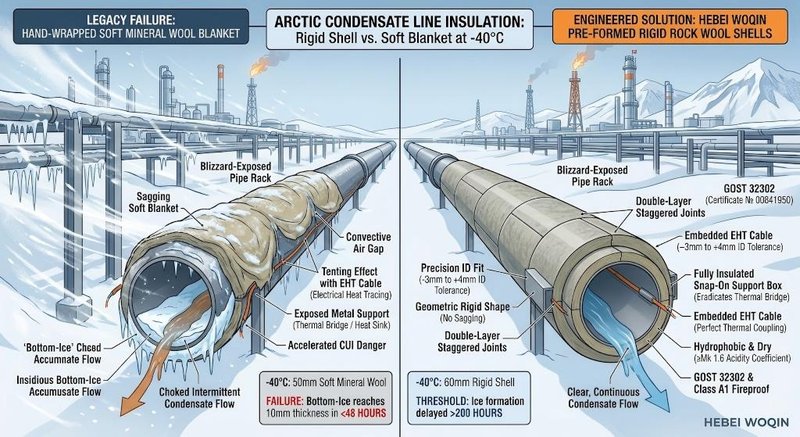
The destruction of a condensate line in extreme sub-zero environments rarely begins with a dramatic, instantaneous freeze. Instead, it starts with an insidious thermodynamic phenomenon known as the "Bottom-Ice" effect. Because condensate travels slowly and frequently rests between trap discharge cycles, gravity pulls the cooling water to the lowest invert of the pipe. In a -40°C ambient environment, heat is rapidly stripped from the bottom of the steel pipe, causing a microscopic layer of ice to form along the lower internal curvature.
[Visual Concept] Imagine a cross-section of a pipe at -40°C: Ice accumulates aggressively at the 6 o’clock position (the bottom), gradually growing upward and choking the flow capacity, much like dangerous plaque building up in an artery.
To understand the severity of this industrial venous thrombosis, we must look at the thermal mathematics of legacy insulation versus engineered solutions.
- Quantitative Example: Consider a standard 4-inch outdoor condensate line with intermittent flow (discharging 5 minutes every 30 minutes) at -40°C. When wrapped in 50mm of traditional soft mineral wool—which inevitably sags and loses contact with the pipe invert—bottom-ice can reach a 10mm thickness within just 48 hours, reducing flow capacity by over 60%. By upgrading to 60mm of a rigid, pre-formed rock wool shell, this critical freezing threshold is delayed to over 200 hours, granting maintenance teams a massive, facility-saving safety window.
This freezing process is drastically accelerated by thermal bridging at the mechanical pipe supports. Bare metal shoe supports and hangers act as highly efficient "heat sinks," actively drawing thermal energy away from the condensate and transferring it directly into the freezing atmosphere. These support locations become the epicenters of localized freezing, creating solid ice plugs that trap liquid condensate in the closed sections between valves.
Once water is trapped in a closed pipeline segment, the laws of physics become unforgiving. As the trapped condensate transitions from a liquid to a solid, it expands in volume by approximately 9%. This phase change generates an immense, inescapable hydrostatic pressure that acts like a hydraulic press from the inside out. Within minutes, this pressure can shatter high-tensile carbon steel and violently extrude flange gaskets, leading to catastrophic pipeline ruptures that require weeks of high-altitude, extreme-cold welding repairs.
Chapter 3: The Cascading Disaster: Water Hammer & Steam Trap Paralysis
The formation of a localized ice plug does not merely stop flow; it initiates a violent chain reaction. As the pipeline becomes partially choked, the delicate balance of the two-phase flow is disrupted. When high-velocity flash steam collides with static ice blocks or sub-cooled water pools, it triggers severe water hammer events. These thermodynamic shockwaves send immense mechanical vibrations tearing through the piping network.
Herein lies a critical failure point of traditional insulation. When subjected to continuous mechanical vibration, soft mineral wool blankets physically compress and degrade, creating permanent air gaps within the insulation layer that actively accelerate further freeze-ups. Conversely, engineered pre-formed shells maintain their geometric stability and structural rigidity, absorbing these vibrations without compromising their thermal profile.
If the vibration and freezing continue downstream, they ultimately paralyze the most complex components of the network: the steam trap assemblies. Acting as massive metallic heat sinks, steam traps will freeze solid if the upstream flow is choked. Once paralyzed, condensate rapidly backs up into upstream process equipment. This triggers critical high-pressure safety alarms, forcing an emergency, multi-million-dollar shutdown of the primary chemical production units.
Chapter 4: The "Wet Sponge" Trap and Accelerated CUI
Attempting to winterize a condensate line with soft mineral wool rolls introduces another fatal flaw: the moisture trap. In an Arctic blizzard, driving snow inevitably penetrates the poorly sealed seams of hand-wrapped insulation. As the intermittent condensate line cycles between 50°C and 100°C, this trapped snow melts. The soft insulation rapidly absorbs the moisture, instantly losing its thermal resistance and transforming into a heavy, freezing "wet sponge."
Weighed down by the absorbed ice and water, the soft blanket physically sags away from the pipe, leaving the lower invert—the exact area most susceptible to "Bottom-Ice"—completely exposed to the freezing wind.
Furthermore, this moisture trap initiates a silent killer. The 50°C to 100°C temperature band is universally recognized in industrial engineering as the ultimate danger zone for Corrosion Under Insulation (CUI). The trapped, oxygen-rich moisture acts as a continuous electrolyte against the carbon steel. It aggressively devours the pipe wall from the outside in, operating entirely undetected until a sudden, high-pressure leak cripples the facility.
Chapter 5: Engineered Armor: Precision Over Compromise
To permanently eradicate the "Bottom-Ice" effect and survive the violent thermodynamic shifts of an outdoor condensate line, EPC contractors must abandon soft, hand-wrapped blankets. The definitive solution for the CIS winter is rigid, structurally sound thermal armor: Hebei Woqin’s High-Density Pre-Formed Rock Wool Shells.
Unlike pliable blankets that sag and create air pockets, our pre-formed shells are manufactured using high-precision CNC technology, achieving a strict inner diameter tolerance of -3mm to +4mm. This microscopic precision ensures 100% thermal coupling with the condensate pipe and its mechanical supports, permanently eliminating the convective air gaps where bottom-ice originates.
Furthermore, Woqin’s rock wool features an exceptional Acidity Coefficient (Mk ≥ 1.6). This superior chemical stability guarantees that even under extreme wet/dry cycling and mechanical vibration from water hammer, the fibrous structure will not degrade, pulverize, or shift. It provides unwavering geometric rigidity, keeping the critical lower invert of the pipe shielded and fundamentally starving the CUI process of the moisture it needs to survive.
Selection Guide: When to Choose Rock Wool Shells vs. Aerogel
At Hebei Woqin, we engineer solutions for every thermal extreme. For optimal project ROI, we recommend:
- Pre-Formed Rock Wool Shells: The ultimate high-yield structural shield. Ideal for large-scale, long-distance outdoor condensate and steam networks (-40°C to +250°C) where budget is a primary constraint, space is not severely limited, and absolute GOST/A1 compliance is mandated.
- Aerogel Blankets: The ultimate tactical armor. Required for extreme space constraints (tight pipe racks, complex valve clusters), absolute zero-CUI performance (99.7% hydrophobicity), or deep cryogenic service like -162°C LNG. (Need extreme performance? Explore our Aerogel Solutions within the Woqin product portfolio).
Chapter 6: Defusing the CIS Compliance Bomb
In the high-stakes petrochemical sector, technical superiority means nothing without absolute legal compliance. Rostechnadzor enforces zero-tolerance policies for non-compliant or combustible materials. Hebei Woqin eliminates all bureaucratic risks for international EPCs:
- GOST 32302 Certified (Certificate № 00841950): Our pre-formed shells carry official Russian Federation certification, guaranteeing seamless customs clearance and frictionless technical audits across the CIS region.
- Class A1 Non-Combustible: Safety is non-negotiable. Under rigorous destructive testing, our rock wool recorded a Furnace Temperature Rise of ≤30°C and a Sustained Burning Time of 0 seconds. It acts as an absolute firebreak on your pipe rack.
Conclusion: Secure Your Uptime Today
In an Arctic condensate network, attempting to save a fraction of the CAPEX by specifying legacy soft insulation is a mathematical error. A single water hammer rupture or a frozen steam trap will vaporize those illusory savings instantly. Hebei Woqin’s GOST-certified pre-formed shells are not a consumable material—they are a high-yield insurance policy for your operational uptime.
Secure Your Condensate Lines - Contact Our Engineers:
- Request the CIS Compliance Pack: Need the paperwork for your next bid? Email [an@cn-aerogel.com] with the subject "CIS Compliance Pack" to receive our full suite of English/Russian GOST certificates and Class A1 Fire Test reports.
- Claim Your "CIS Project Sample Box": Are you an EPC managing a winterization project? Email us to request an exclusive physical sample kit. Test the structural rigidity and precision fit of our pre-formed shells in your own hands.

Written by - Ruibin An
Industry Veteran with 13+ Years of Experience. Deeply rooted in the insulation industry for over 13 years, specializing in supply chain optimization and global market trends for Rock Wool and Aerogel materials.
LATEST NEWS
High-Density Rigid PU Thermal Break Blocks: North American Code-Compliant Structural Solution
2026-07-01
Beyond Insulation: Why Structural Thermal Breaks Are Essential for Modern Industrial Infrastructure
2026-06-29
The Ultimate Guide: "Survival Rules" and System Defenses for Industrial Piping Insulation in Extreme Middle Eastern Environments
2026-06-25
Unlocking Aramco & SABIC Compliance: The Highly Secure Path to Mechanical Completion Sign-Off
2026-06-25
Cutting Pipeline Insulation Labor Costs by 40% in 50°C Middle East Heat
2026-06-18