
The -50°C Frontline: Armoring Arctic Vessel Piping on the Northern Sea Route
Navigating the Northern Sea Route exposes vessel deck piping to -50°C winds, brutal ice-breaking vibrations, and highly corrosive salt fog. Traditional soft insulation pulverizes and accelerates CUI under these conditions. Discover why Hebei Woqin’s Steel-Wired Mineral Wool Shells are the ultimate structural armor for extreme marine environments.
1. Introduction: The -50°C Frontline of the Northern Sea Route
As global shipping lanes pivot toward the Northern Sea Route (NSR), Icebreakers and Arctic Offshore Supply Vessels (OSVs) are operating in the most hostile marine environments on the planet. For the exposed deck piping—critical fire mains, hydraulic lines, and steam traces—surviving the Arctic is not merely a matter of thermal retention; it is a battle against a relentless composite of physical and chemical attacks.
In -50°C ambient temperatures and freezing gales, deploying traditional, hand-wrapped soft insulation blankets is a fatal engineering liability. The Arctic ocean does not just freeze insulation; it physically batters it into submission.
2. The 5 Marine Nightmares of Traditional Soft Insulation
When marine EPCs specify legacy soft mineral wool rolls for exposed Arctic deck piping, they unwittingly trigger a chain reaction of catastrophic failures:
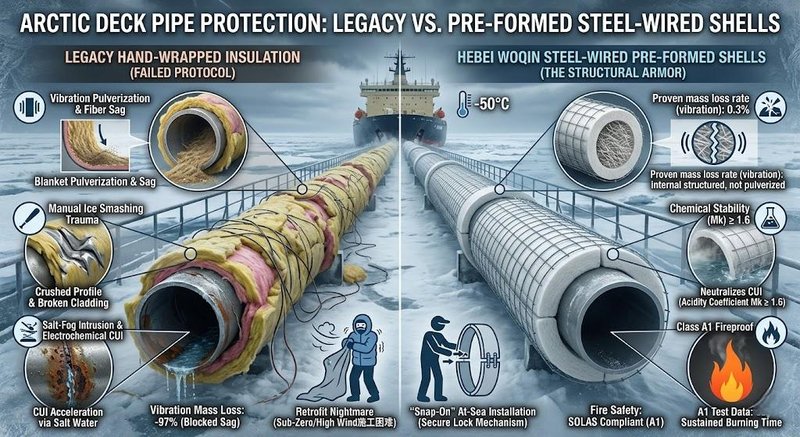
- Vibration-Induced Pulverization: A vessel navigating heavy ice endures massive, continuous kinetic shocks and low-frequency engine vibrations. Inside loosely wrapped insulation, these vibrations cause the soft fibers to aggressively rub together, fracture, and pulverize. Within months, the insulation turns into dust and settles at the bottom of the cladding, leaving the top of the pipe completely bare and exposed to the freezing air.
- Mechanical Trauma from Ice-Smashing: In the Arctic, freezing sea spray rapidly coats deck piping in thick layers of solid ice (Ice Accretion). To prevent the vessel from becoming top-heavy or the pipes from snapping, crews are forced to manually smash the ice with wooden mallets. Soft insulation absorbs these violent impacts by crushing flat, permanently destroying its thermal thickness and rupturing the outer cladding.
- Salt-Fog Intrusion & Electrochemical CUI: Gale-force Arctic winds drive high-concentration salt fog into the tiniest seams of the cladding. When low-quality, low-acidity mineral wool gets soaked, it releases corrosive chloride ions directly against the steel pipe. This creates a highly active micro-battery, triggering explosive Electrochemical Corrosion Under Insulation (CUI). On the open ocean, repairing a rusted-out, leaking pipe is a logistical nightmare.
- Wind Chill & Fire Main Flash-Freeze: An ambient temperature of -40°C combined with 50-knot winds creates a localized wind chill factor approaching -60°C. If the insulation profile has collapsed due to vibration or ice-smashing, static fire main lines will "flash-freeze" in minutes. A frozen fire system directly violates strict IMO (International Maritime Organization) and SOLAS safety regulations, risking immediate vessel detention at the next port.
- The "At-Sea" Retrofit Nightmare: When traditional insulation fails mid-voyage, crews must attempt emergency retrofits on a pitching deck in sub-zero blizzards. Asking a crew member wearing thick extreme-cold gloves to measure, cut, stretch, and wire-bind flimsy insulation rolls in 80 km/h winds guarantees a zero-quality installation.
3. The Paradigm Shift: Steel-Wired Mineral Wool Pre-formed Shells
The solution to the Arctic deck piping crisis is to abandon soft, hand-wrapped blankets entirely. The marine engineering paradigm must shift from flimsy insulation to "Structural Pre-formed Armor."
Hebei Woqin introduces the Steel-Wired Mineral Wool Pre-formed Shell—an ultra-dense, pre-engineered insulation cylinder reinforced with an external galvanized steel wire mesh, designed specifically to survive the brutal conditions of the Northern Sea Route.
4. Hard Data & Absolute Marine Compliance
In the marine and offshore sectors, survival is dictated by metallurgical and chemical data. Hebei Woqin’s pre-formed shells are backed by rigorous testing to guarantee deck pipe integrity:
- Defeating Vibration (0.3% Mass Loss): Unlike soft blankets that rub and disintegrate under heavy engine harmonics and ice-breaking impacts, our pre-formed shells are structurally bound. In destructive testing, they achieved a microscopic Vibration Mass Loss Rate of just 0.3%. They will not pulverize, sag, or settle, ensuring permanent thermal thickness even on an active icebreaker.
- Defeating Electrochemical CUI (Mk ≥ 1.6): To combat salt-fog intrusion, our mineral wool is engineered with extreme chemical purity. Boasting an Acidity Coefficient (Mk) of ≥ 1.6, it remains chemically inert even when soaked in saltwater. It refuses to release the corrosive chloride ions that trigger CUI, effectively neutralizing the micro-battery effect on your steel pipes.
- Class A1 Marine Fireproof: Protecting the vessel's hydraulic systems and fire mains is a SOLAS imperative. Our shells are certified Class A1 (Non-Combustible), recording a Furnace Temperature Rise of ≤30°C and 0 seconds of sustained burning. They provide an impenetrable, zero-smoke fire barrier on the open deck.
- "Snap-On" At-Sea Installation: Emergency mid-voyage retrofits in -40°C gales are now viable. The rigid two-piece shells simply "snap" around the pipe, while the integrated steel wire mesh allows crews wearing heavy extreme-cold gloves to lock them in place in seconds. No measuring, no cutting, and no chaotic wire-binding in the wind.
5. Conclusion & High-Value CTA: Secure Your Arctic Fleet
Navigating the Northern Sea Route demands materials that fight back against the ice. Continuing to specify soft mineral wool rolls for exposed deck piping is an active investment in flash-freezing, aggressive CUI, and potential IMO compliance violations.
Upgrade to Hebei Woqin’s Steel-Wired Mineral Wool Shells and armor your deck piping for the harshest oceans on Earth. Stop fighting the Arctic wind with soft blankets.
- Request Marine-Grade Technical Data: Email [an@cn-aerogel.com] to receive the complete Technical Data Sheet (TDS), Acidity Coefficient reports, and official Class A1 Fire Safety documentation for your naval architects.
- Claim Your "Arctic Vessel Sample Box": Are you a shipowner, marine EPC, or shipyard planning an NSR operation? Request a physical sample of our steel-wired shell. We want you to smash it, shake it, and test its structural integrity with your own hands.

Written by - Ruibin An
Industry Veteran with 13+ Years of Experience. Deeply rooted in the insulation industry for over 13 years, specializing in supply chain optimization and global market trends for Rock Wool and Aerogel materials.
LATEST NEWS
High-Density Rigid PU Thermal Break Blocks: North American Code-Compliant Structural Solution
2026-07-01
Beyond Insulation: Why Structural Thermal Breaks Are Essential for Modern Industrial Infrastructure
2026-06-29
The Ultimate Guide: "Survival Rules" and System Defenses for Industrial Piping Insulation in Extreme Middle Eastern Environments
2026-06-25
Unlocking Aramco & SABIC Compliance: The Highly Secure Path to Mechanical Completion Sign-Off
2026-06-25
Cutting Pipeline Insulation Labor Costs by 40% in 50°C Middle East Heat
2026-06-18