
The Desert’s Billion-Dollar Blockage: How Smart Insulation Ends Wax Deposition Nightmares
This is not a product brochure. It is a strategic roadmap for upstream oilfield managers and EPC leads to end production paralysis and hidden costs from extreme desert temperature swings. Traditional insulation fails catastrophically in 50°C-to-0°C cycles, draining millions in unnecessary expenses. Backed by third-party testing, Woqin’s prefabricated glass wool pipe shells eliminate wax crystallization at the source, cut operating costs by 50%+, slash timelines by 30%, and deliver measurable ESG-aligned emission reductions.
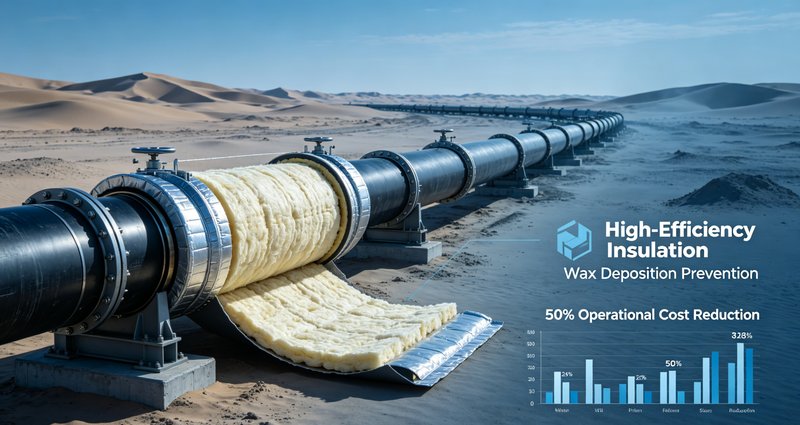
Introduction: The Extreme Desert Temperature Swing and the Pipeline "Blockage" Crisis
Beneath the vast desert hinterlands of the Middle East lie the world’s richest oil and gas reserves—and also the industry’s most expensive silent killer. There are no gentle seasonal transitions here, only an unforgiving daily assault: daytime surface temperatures scorch above 50°C, baking metal pipelines until they glow; as night falls, temperatures plummet to near freezing in just 4 hours, creating a globally unique "thermal shock" that no traditional insulation was engineered to withstand.
For crude oil gathering lines, this is not an environmental inconvenience—it is a billion-dollar drain on production. When crude oil temperature drops below the Wax Appearance Temperature (WAT, typically 35-45°C) overnight, paraffin molecules crystallize instantly and bond to pipe walls like concrete. A 1mm wax layer reduces flow capacity by 5-8%; a few millimeters of wax can choke flow capacity by double-digit percentages, rapidly escalating to complete blockage. And since 90% of desert single-well gathering lines are dendritic with zero redundancy, one blockage means an immediate full well shutdown.
In the Middle Eastern desert, controlling heat loss is not an engineering afterthought. It is the single most important factor determining your production uptime and profitability.
Pain Point Analysis: Five Fatal Flaws That Make Traditional Insulation a Liability
1. Technical Pain Point: Pulsed Wax Deposition and Desert Adaptation Failure
The desert’s cliff-like cooling rate (4-5°C per hour) triggers an irreversible cumulative wax cycle that conventional materials cannot stop. Worse, temperature swings also cause asphaltene flocculation, creating a rock-hard "asphalt-wax composite scale" that standard pigging tools cannot scrape clean—requiring costly chemical treatments or emergency pipeline excavation.
Traditional insulation fails on three fundamental levels in this environment:
Thermal degradation: Calcium silicate and rock wool rely on organic binders that break down after 1-2 years of 50°C+ exposure, causing shrinkage, powdering, and penetrating thermal bridges that increase heat loss by 30-50%.
Moisture failure: In the dead of night, traditional rock wool acts like a sponge, absorbing every drop of condensation. By dawn, its thermal conductivity has doubled, rendering it completely useless while wax quietly crystallizes inside the pipeline it was supposed to protect.
Inadequate thermal inertia: Conventional materials cannot store daytime heat to buffer nighttime cooling, leaving crude oil vulnerable to sudden temperature drops.
Woqin Solution: Precision-Engineered Thermal Shield
Think of it as a stationary air fortress for your pipelines. Woqin glass wool’s 3D interconnected porous structure creates a stable, inert insulation layer that dramatically slows heat transfer. With industry-leading thermal conductivity (≤0.034 W/m·K at 25°C, ≤0.040 W/m·K at 75°C), it possesses exceptional thermal inertia that slows crude oil cooling rates by over 60%. When correctly specified using our customized thermal-fluid simulation model, it creates an unbreakable thermal lock that keeps your crude safely above the WAT throughout the critical nighttime hours. We don’t just slow wax formation—we eliminate the conditions that allow it to occur.
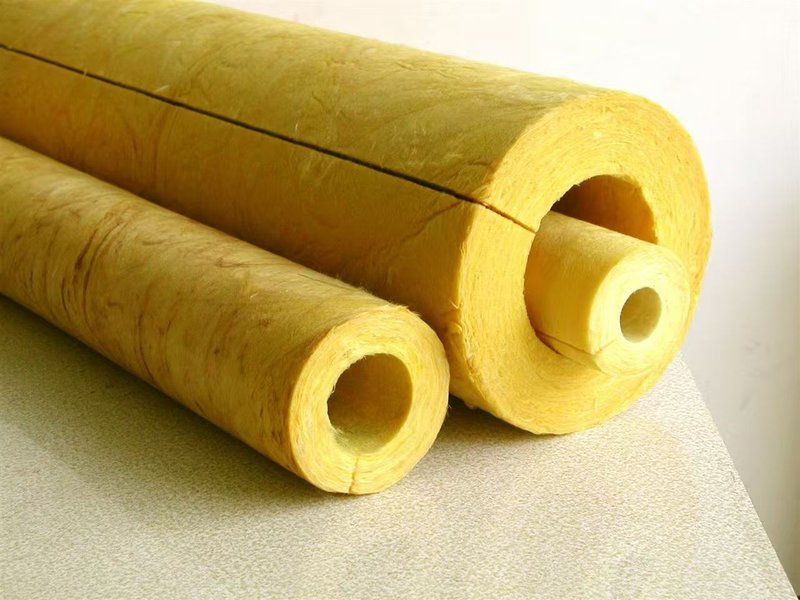
Made from 100% inorganic glass with zero organic binders, our pipe shells have a heat load shrinkage temperature ≥250°C—far exceeding the maximum desert surface temperature. They experience zero shrinkage, zero powdering, and zero thermal bridge formation, guaranteeing stable thermal performance for 20 years.
(For Production Manager) Stop scheduling pigging as a recurring operational expense. Start planning it as a forgotten maintenance relic.
2. Operational Pain Point: The Bottomless Money Pit of Pigging and Hidden Energy Drain
Pigging operations in desert regions cost 3-5 times more than in plain areas, with direct costs ranging from $15,000 to $50,000 per well per operation. Transportation alone accounts for 40% of this cost, as crews and equipment must be trucked hundreds of kilometers across unforgiving terrain.
But indirect costs are where the real damage is done. Middle Eastern single wells typically produce 500-2,000 barrels per day, meaning a single day of shutdown results in losses of $40,000 to $160,000 at current oil prices. Frequent pigging also scratches pipeline inner walls, reducing service life by 30-40% and creating corrosion hotspots.
Business Impact Translation
For a medium-sized gathering station with 20 wells, even if only 30% of wells require monthly pigging due to wax deposition, annual direct operational costs alone will consume over $1.5 million in net profits. This does not include the tens of thousands of barrels of lost production or the $500,000+ cost of excavating a stuck pig. In contrast, the one-time investment in Woqin glass wool insulation is equivalent to only 3-5 full-field pigging operations, with an investment return period typically less than 6 months.
To compensate for poor insulation, most oil fields passively increase crude oil outlet temperatures from 60°C to above 80°C, increasing fuel consumption by 30-50% and creating an invisible energy drain that costs millions annually. Wax layers also cause "under-deposit corrosion" by isolating anti-corrosion coatings and promoting sulfate-reducing bacteria (SRB) growth, significantly increasing pipeline leakage risk.
Woqin Solution: Cut Fuel Costs by 30%+ Overnight
After adopting Woqin glass wool pipe shells, crude oil outlet temperatures can be safely reduced from 80°C to 60°C or lower, directly cutting heating furnace fuel consumption by more than 30%. For a medium-sized gathering station, this alone saves over $2 million in fuel costs annually. Additionally, since wax deposition is fundamentally resolved, pipeline inspection frequency can be reduced by 50%, slashing labor maintenance costs.
(For Operations Director) Your heating furnace budget doesn’t have to fund the desert’s temperature swings. Take back control of your energy costs.
3. Project Delivery Pain Point: Sky-High Logistics Costs and Schedule Penalty Nightmares
The weight of traditional insulation materials is the single biggest curse of desert EPC projects. Calcium silicate pipe shells have a bulk density of 200-300 kg/m³, rock wool pipe shells 80-150 kg/m³, while Woqin glass wool pipe shells have a bulk density of only 24-96 kg/m³—50% lighter than rock wool and 70% lighter than calcium silicate.
This weight difference translates directly into massive transportation savings: a 10-ton desert off-road truck can carry approximately 33 m³ of calcium silicate, 66 m³ of rock wool, or 166 m³ of Woqin glass wool. Transporting 1,000 m³ of insulation requires 30 trips for calcium silicate, 15 trips for rock wool, and only 6 trips for Woqin glass wool. At approximately $500 per 100-kilometer desert trip, Woqin glass wool saves $12,000 per 1,000 m³ in transportation costs alone.
Business Impact Translation
For a 100-kilometer gathering pipeline project requiring 5,000 m³ of insulation, Woqin glass wool saves over $60,000 in transportation costs. More importantly, reducing transportation trips by 70% means a 70% reduction in supply chain risk—eliminating costly project shutdowns caused by sandstorms, vehicle breakdowns, or border delays.
Middle Eastern summer daytime temperatures exceed 50°C, limiting outdoor work to just 4-6 hours per day. Traditional materials require heavy lifting equipment that is expensive and difficult to deploy in the desert, plus extensive on-site cutting and splicing that wastes material and compromises insulation integrity. In contrast, Woqin prefabricated glass wool pipe shells allow a single worker to install 50-80 meters per day, compared to 20-30 meters for rock wool and only 10-15 meters for calcium silicate.
EPC projects typically carry penalty clauses of 0.1-0.5% of contract value per day of delay. For a $100 million pipeline project, this means $100,000 to $500,000 in penalties per day.
Woqin Solution: 3x Faster Installation, Zero Schedule Risk
Woqin glass wool pipe shells are factory-prefabricated to your exact pipeline specifications, requiring zero on-site cutting or splicing. Their lightweight design allows single-person handling and installation without any heavy lifting equipment. Construction efficiency is 30-50% higher than traditional materials, shortening project schedules by more than 30% and completely eliminating schedule penalty risks.
(For EPC Project Manager) Deliver your next project on time—or even ahead of schedule—with a logistics-light solution that frees you from the nightmare of desert transport.
4. Safety and Compliance Pain Point: Pipeline Ruptures and Regulatory Reckoning
Wax deposition reduces pipeline cross-sectional area and increases operating pressure, creating a ticking time bomb for pipeline rupture and crude oil leakage. Crude oil spill remediation costs in desert environments are 10 times higher than in other regions, with environmental fines and restoration costs often exceeding $10 million per incident. Compounding this problem, emergency response teams take 3-6 hours to reach remote desert locations, allowing small leaks to escalate into catastrophic environmental disasters.
Woqin Solution: Class A1 Non-Combustible, Meeting the Highest Global Oilfield Standards
Woqin glass wool pipe shells meet GB 8624-2012 Class A1 non-combustible standards, with a total calorific value ≤2.0 MJ/kg, furnace temperature rise ≤30°C, and zero sustained burning time. They do not participate in combustion, release no toxic fumes, and will not act as a flame spread pathway even in the event of a pipeline leak and fire. This provides critical extra time for emergency response teams to contain incidents before they escalate.
In recent years, Saudi Arabia, the UAE, and other Gulf states have significantly strengthened environmental regulations, with crude oil spills resulting in mandatory facility shutdowns and license revocation. International oil companies also impose increasingly strict HSE requirements on suppliers, and using substandard insulation materials can lead to failed HSE audits and disqualification from future projects.
5. ESG and Decarbonization Pain Point: The Hidden Carbon Tax Liability
This is the most critical emerging pain point for all International Oil Companies (IOCs) and Middle Eastern National Oil Companies (NOCs)—and a competitive blue ocean that 99% of insulation suppliers have completely ignored.
The additional fossil fuel combustion required to increase crude oil outlet temperatures to prevent wax deposition generates massive Scope 1 carbon emissions. These emissions are no longer just an environmental concern—they are a direct financial liability. Many oil companies now impose internal carbon taxes of $50-$100 per tonne of CO₂, and the EU’s Carbon Border Adjustment Mechanism (CBAM) will soon impose tariffs on carbon-intensive imports. Over the full project lifecycle, these hidden carbon costs may far exceed the purchase and installation costs of the insulation material itself.
ESG ratings have also become core determinants of oil companies’ financing costs, market valuations, and access to international capital. A single ESG downgrade can increase borrowing costs by hundreds of basis points, costing millions in additional interest payments annually.
Woqin Solution: Insulation Equals Decarbonization
Adopting Woqin glass wool insulation solutions minimizes outlet heating requirements, directly reducing Scope 1 emissions by more than 30%. This is not just an insulation project—it is a high-return carbon reduction project that delivers immediate financial and strategic benefits:
Lower internal carbon tax liabilities
Improved ESG ratings and reduced financing costs
Compliance with CBAM and future carbon regulations
Tangible carbon reduction data for investor and stakeholder reporting
We provide professional third-party verified carbon emission reduction calculation reports that can be used directly in your official ESG disclosures.
(For ESG Director) Turn your pipeline insulation budget into a strategic ESG investment that delivers measurable carbon reductions.
Call to Action
Stop letting the desert’s extreme temperatures control your production, your profits, and your ESG performance. Take the first step toward ending wax deposition nightmares today.
Contact us now to receive your exclusive, no-obligation package:
A customized thermal-fluid simulation analysis specifically for your desert gathering pipelines, accurately determining the optimal insulation thickness to maintain crude temperatures above the WAT while minimizing project costs
Free samples of Woqin glass wool pipe shells to personally test their lightweight design and thermal performance
A 1-on-1 consultation with our Middle East technical team to address your specific project challenges

Written by - Ruibin An
Industry Veteran with 13+ Years of Experience. Deeply rooted in the insulation industry for over 13 years, specializing in supply chain optimization and global market trends for Rock Wool and Aerogel materials.
LATEST NEWS
The Desert’s Billion-Dollar Blockage: How Smart Insulation Ends Wax Deposition Nightmares
2026-06-01
Securing Flare Gas Networks: A1 Non-Combustible Shells for Extreme Heat
2026-05-30
EHT Pipe Insulation: Eliminate Tenting Effect with Grooved Pre‑Formed Shells
2026-05-29
SRU Pipe Insulation: Prevent Liquid Sulfur Freeze & Viscosity Surge
2026-05-28
Defeating Coastal CUI in Middle East Refineries: Low-Chloride Rock Wool Shells
2026-05-28