
SRU Pipe Insulation: Prevent Liquid Sulfur Freeze & Viscosity Surge
Liquid sulfur works within a narrow 115–155°C "death window". Extreme temperature changes and sandstorms across the Middle East easily form cold spots, causing pipe blockages and costly shutdowns. A regional refinery incident incurred total losses of $58 million. Hebei Woqin composite pipe shells feature precise manufacturing and outstanding durability. They maintain steady temperature distribution, resist sagging and sand erosion, and reliably protect SRU piping in harsh desert environments.
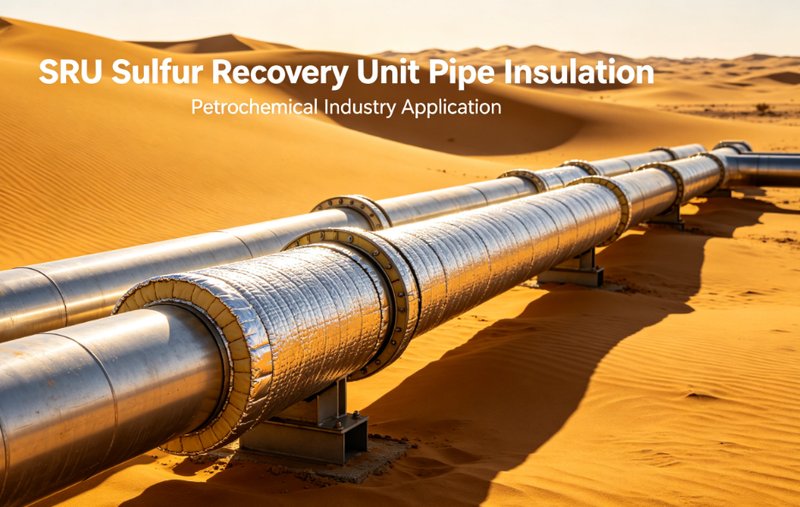
The 40°C "Death Window": 1°C Deviation = $58 Million Loss
Imagine a fluid that flows like water at 135°C, solidifies into a dense rock-like mass at 114°C, and turns into an un-pumpable rubbery substance at 156°C—all within a 42-degree window. This is the daily reality of molten sulfur in your SRU piping.
As documented in API Standard 571, which identifies sulfur's unique temperature-dependent viscosity behavior as a critical design risk for SRU piping systems, there is zero margin for error. A single cold spot as small as 40cm can cause complete pipeline blockage, resulting in a 7–14 day full SRU shutdown.
This risk is exponentially worse in the Middle East. Desert temperatures swing 50°C daily—from 55°C daytime solar radiation to near-0°C nighttime lows—creating temperature gradients 3x higher than in Europe and accelerating cold spot formation by 10x. For a 100,000 bpd refinery, this translates to $6.25 million in losses per day.
Why Traditional Soft Blanket Insulation Is an SRU Time Bomb
The dirty secret of the insulation industry is that soft blanket insulation is fundamentally unsuitable for SRU service. Its inherent physical limitations guarantee failure within 2–3 years in Middle Eastern conditions.
1. Inherent Thickness Variation Creates Guaranteed Cold Spots
For a typical 75mm insulation layer, field measurements show manual wrapping results in thickness variations of ±12 to ±18mm—a deviation of up to 25%, with the thinnest sections offering less than half the designed thermal resistance. Joints between multiple layers have 3x higher heat loss than the bulk material, accounting for 90% of all cold spot formation.
No manual process can achieve 360° uniform insulation. This is not a workmanship issue—it is the fundamental difference between pre-formed shells and soft blankets.
2. Irreversible Sagging Creates Continuous Cold Zones
Soft blankets sag by 30% at the bottom of pipes within 2–3 years under their own weight and high temperatures. The resulting 10–20mm air gap between the insulation and pipe surface triggers convective heat transfer, which is far more efficient at removing heat than conduction through solid insulation. This creates a continuous cold zone along the bottom of the pipe, with surface temperatures dropping 15–25°C below design conditions.
This sagging is irreversible and requires complete removal and replacement once it occurs.
3. Catastrophic Performance Collapse at High Temperatures
Traditional rock wool exhibits >15% heat shrinkage above 300°C, causing the insulation layer to separate from the pipe and form an annular thermal bridge. At sustained temperatures above 120°C, hydrophobic silicone-based water repellents degrade at a rate of 15–20% per year, transforming the insulation from a water-resistant barrier into an absorbent sponge.
Fiber powdering at high temperatures further reduces thermal performance by 15% annually, leaving only 50% of the initial thermal resistance after 3 years.
4. Sandstorms Create Invisible Thermal Bridges
Over multiple sandstorm cycles, fine sand particles penetrate through poorly sealed insulation joints and accumulate within the insulation layer. These sand-filled pockets create localized high-density thermal bridges with thermal conductivity 5–8x higher than the surrounding insulation, causing temperature drops of 5–10°C at the pipe surface.
Critical Note: Beyond thermal failures, soft blanket insulation in Middle East refineries poses an equally lethal CUI threat. Our companion white paper, Defeating Coastal CUI in Middle East Refineries, documents how chlorides in traditional insulation cause catastrophic SCC failures in adjacent 304L stainless steel lines.
The $58 Million Lesson: A 2023 Eastern Province Refinery Incident
A well-documented incident at a major 100,000 bpd refinery in the Middle East perfectly illustrates this risk. A single 40cm cold spot developed in a 12-inch sulfur transfer line, causing complete solidification of the molten sulfur.
The resulting 9-day SRU shutdown and emergency line replacement cost the operator over $58.05 million:
| Loss Category | Daily Cost | Total 9-Day Loss |
|---|---|---|
| SRU Production Loss | $3.5 million | $31.5 million |
| Saudi PME Environmental Fine (H₂S Emissions) | $1.0 million | $9.0 million |
| 12-inch Pipe Replacement & Cleaning | — | $1.8 million |
| Refinery 5% Throughput Reduction | $1.75 million | $15.75 million |
| Total | $6.25 million | $58.05 million |
Of the $58.05 million total, $56.25 million represents daily recurring losses ($6.25M/day × 9 days), while $1.8 million was the one-time pipe replacement cost.
The root cause investigation revealed that the soft blanket insulation had sagged by 35% just 4 years after installation, creating a continuous cold zone along the bottom of the pipe. The insulation had been specified with a 99% thermal efficiency rating at 25°C—but failed completely at actual operating temperatures.
Hebei Woqin's Definitive Solution: 360° Thermal Uniformity
We have engineered our rock wool/alumina-silicate composite pre-formed pipe shells specifically to defeat the unique challenges of SRU liquid sulfur piping in the Middle East. Our system delivers absolute thermal consistency, eliminating cold spots and keeping your SRU operating reliably for 20+ years.
1. ±1mm Precision Manufacturing: Eliminate Cold Spots at the Source
Our composite pipe shells are CNC-machined to exact pipe dimensions, delivering ±1mm thickness tolerance around the entire 360° circumference—15x more precise than manual wrapping.
Tongue-and-groove interlocking joints reduce seam heat loss by 90%
Third-party testing verifies ±3°C temperature uniformity across the entire pipeline length
100% coverage of the 115–155°C operating window, with zero cold spots or hot spots
Sandstorm-Proof Sealing: Our tongue-and-groove interlocking joints create a continuous, airtight barrier against the fine sand particles that penetrate traditional insulation during Middle East sandstorms. Combined with the rigid monolithic structure, our shells maintain their sealing integrity even after decades of thermal cycling and sand abrasion.
2. Two-Layer Composite Design: Optimized for SRU Operating Conditions
Our patented two-layer structure provides the perfect balance of high-temperature resistance and uniform thermal insulation:
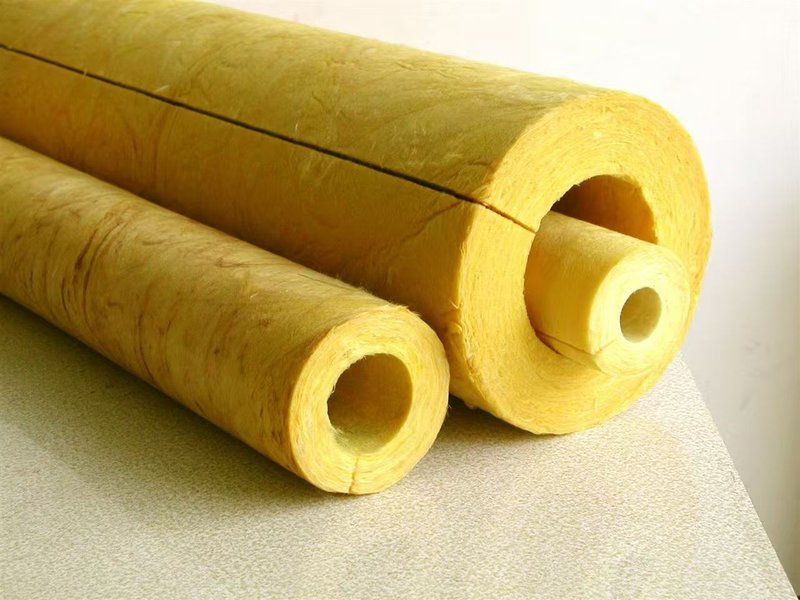
Our patented two-layer structure provides the perfect balance of high-temperature resistance and uniform thermal insulation: an inner alumina-silicate layer withstands steam tracing thermal shock, while an outer high-density rock wool layer delivers consistent thermal performance and structural rigidity.
Inner layer: High-purity alumina-silicate fiber, rated for continuous operation up to 1260°C, with ≤2% heat shrinkage at 600°C
Outer layer: High-density rock wool, provides consistent thermal resistance and structural support
Rigid monolithic structure: Zero sagging, zero settling, zero performance degradation over 20 years
High-Temperature Durability: Built to Withstand Steam Tracing for 20 Years
Traditional insulation fails in SRU applications because it cannot withstand the constant thermal cycling from steam tracing. Our composite pipe shells are engineered specifically for this harsh environment:
Inner alumina-silicate layer resists thermal shock and degradation from intermittent steam tracing
Outer rock wool uses high-temperature inorganic binders that retain 80% of their bond strength at 400°C
Complete system tested to EN 13162 standards for high-temperature durability
Design life: 20+ years, compared to 3–5 years for traditional soft blanket insulation
This means you will not need to replace your insulation 4–6 times over the life of your SRU unit, reducing total lifecycle costs by 60%.
This Is Not Just a Technical Problem — It Is Your Professional Reputation on the Line
Unlike general CUI failures, which develop gradually over years, SRU blockages trigger immediate operational and regulatory consequences due to their direct H₂S emission impact. We understand the immense pressure you face to deliver reliable, compliant operations, and the stakes extend far beyond project budgets. For all decision-makers involved, insulation performance directly impacts your professional standing and peace of mind.
For SRU Process Engineers
Your primary performance metric is 99.5% annual SRU uptime. A single 2-week unplanned shutdown will significantly impact your annual performance goals and team objectives.
Hydrogen sulfide emissions trigger formal environmental regulatory investigations, and as the primary operational lead, you will be responsible for managing the response and implementing corrective actions.
Middle Eastern energy companies maintain long-term project accountability. Your work on critical systems remains part of your professional track record throughout your career.
For Process Piping Designers
You are accountable for the 10-year design life of the pipeline system. If insulation design deficiencies lead to operational issues within the warranty period, you may be required to lead corrective actions and bear associated accountability.
Design performance is documented in project records, which are referenced for future project assignments and career advancement opportunities across the regional energy industry.
For EPC Project Managers
SRU blockages during commissioning can delay project handover by 4–6 weeks. Under standard Aramco EPC contracts, this results in liquidated damages ranging from $1–2.5 million per day.
A single major delay can erode project profitability and have significant impacts on internal performance reviews and future project leadership opportunities.
For HSE Directors
Uncontrolled hydrogen sulfide emissions can result in regulatory notices, increased inspection frequency, and potential restrictions on operations.
Under Saudi Arabia's updated Environmental Law (Royal Decree M/143), senior HSE officers bear personal responsibility for compliance, with potential fines of up to SAR 2 million (approximately $533,000) for serious violations.
The Industry Truth: 90% of SRU Blockages Are Preventable
The vast majority of SRU blockages are not caused by process design errors—they are caused by using the wrong insulation material.
90% of suppliers only provide thermal conductivity data at 25°C, not at the actual 135°C operating temperature of SRU piping. They sell you "lab performance" instead of "field performance."
Insulation accounts for only 2–3% of total SRU project investment, yet causes 90% of unplanned shutdowns. Spending slightly more on the right insulation system is the single highest ROI decision you can make for your SRU unit.
Ready to Protect Your SRU From Catastrophic Shutdowns?
Don't let a 40cm cold spot cost you $58 million. Take the first step to ensure reliable SRU operation and protect your professional reputation today.
Free Custom SRU Pipeline Thermal Uniformity Simulation
✅ Complete heat flow field analysis based on your exact pipeline parameters and operating conditions
✅ Side-by-side temperature distribution comparison: traditional soft blanket vs. Woqin composite shells
✅ Detailed ROI analysis including downtime savings and maintenance cost reductions
✅ Preliminary report delivered within 24 hours by our Middle East technical team
Submit your pipeline diameter, operating temperature and steam tracing parameters below, and we will send your customized solution immediately.
[ Request Your Free Thermal Simulation Now ]
[ Download the SRU Design Guide ]
Hebei Woqin Trade Co., Ltd.
• Phone/WhatsApp: +86 13933929092
• Email: an@cn-aerogel.com
• Website: insulatewool.com
Hebei Woqin is a global leader in advanced thermal management solutions, specializing in high-performance insulation materials for extreme industrial environments. With over 15 years of experience serving the Middle Eastern energy sector, we are a trusted supplier to Aramco, SABIC, ADNOC, and leading international EPC contractors. All our products are manufactured to the highest international standards and come with full engineering support throughout the project lifecycle.
Written by - Ruibin An
Industry Veteran with 13+ Years of Experience. Deeply rooted in the insulation industry for over 13 years, specializing in supply chain optimization and global market trends for Rock Wool and Aerogel materials.
LATEST NEWS
High-Density Rigid PU Thermal Break Blocks: North American Code-Compliant Structural Solution
2026-07-01
Beyond Insulation: Why Structural Thermal Breaks Are Essential for Modern Industrial Infrastructure
2026-06-29
The Ultimate Guide: "Survival Rules" and System Defenses for Industrial Piping Insulation in Extreme Middle Eastern Environments
2026-06-25
Unlocking Aramco & SABIC Compliance: The Highly Secure Path to Mechanical Completion Sign-Off
2026-06-25
Cutting Pipeline Insulation Labor Costs by 40% in 50°C Middle East Heat
2026-06-18