
Defeating Coastal CUI in Middle East Refineries: Low-Chloride Rock Wool Shells
Corrosion Under Insulation (CUI) is the single largest maintenance cost for Middle Eastern refineries, causing $10 billion in annual losses and 6x higher failure rates in Jubail and Yanbu. A 2024 SCC failure cost one facility $120 million due to high-chloride insulation. Hebei Woqin's pre-formed rock wool shells feature independently verified Cl⁻+F⁻ ≤0.0112% (34% below Aramco limits), delivering a closed-loop CUI defense and 20+ year service life.
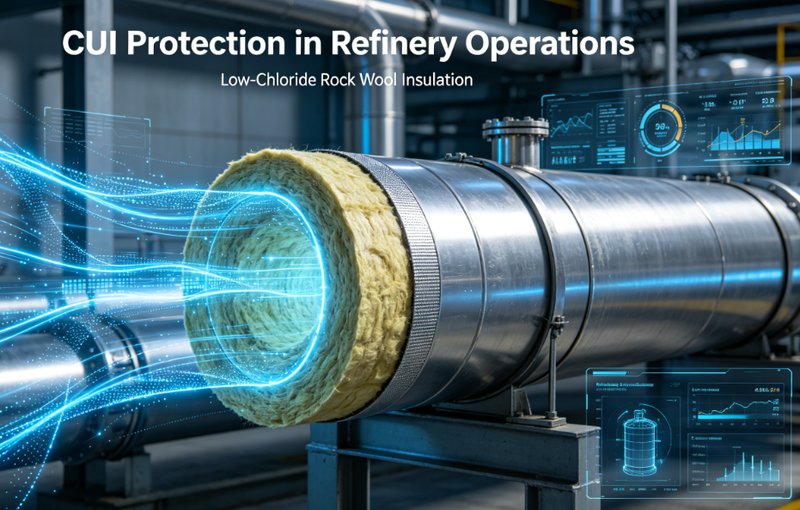
The Persian Gulf Salt Fog Meat Grinder: The $10 Billion CUI Crisis
Corrosion Under Insulation (CUI) is not a global problem—it is a Persian Gulf problem. Nowhere else on Earth do the three most destructive forces for steel converge with such intensity: 55°C summer temperatures, 90% relative humidity, and the highest marine salt fog levels in the world.
According to Aramco Engineering Standard 30-SAMSS-007 and field monitoring data from the Jubail Industrial City Authority, salt spray deposition rates in peak summer months reach 140–160 mg/m²·d — 5–8 times higher than typical European coastal environments and 3–5 times higher than East Asian coastlines.
NACE International estimates that the global cost of corrosion exceeds $2.5 trillion annually, with CUI accounting for a disproportionate share—over $10 billion per year in the Middle Eastern refining sector alone, according to a 2023 Aramco internal assessment cited at the NACE Middle East Conference.
This is why refineries in Jubail and Yanbu experience CUI failure rates 6x higher than the global average. What takes 15 years to develop in Houston happens in just 2–3 years on the Arabian Gulf.
Why Soft Blanket Insulation + High Chlorides Are a Slow Poison for Your Piping
The dirty secret of the insulation industry is that most CUI failures are not caused by external corrosion—they are caused by the insulation material itself actively attacking the steel pipe from the inside out.
1. Endogenous Chlorides: The Hidden Time Bomb
Cheap rock wool is manufactured using chlorine-based binders, resulting in bulk chloride contents of 0.1–0.5% in most commercial products. These chlorides are not inert impurities:
Under the combined effect of 60–120°C operating temperatures (standard for refinery process piping) and inevitable moisture ingress, chlorides migrate to the stainless steel surface and break down the protective passive oxide film.
As documented in NACE Middle East Corrosion Conference 2025 proceedings, under cyclic wet-dry conditions, chloride ions concentrate in micro-crevices at the pipe-insulation interface, reaching localized concentrations 10–100 times higher than the bulk material.
Multiple failure analyses conducted by SABIC's Central Corrosion Laboratory confirm that endogenous chlorides alone can initiate Stress Corrosion Cracking (SCC) in 304L stainless steel within as little as 2–3 years.
SCC is the most dangerous form of corrosion: it is brittle, transgranular, and occurs without any visible warning. A pipe that appears perfectly intact from the outside can suddenly rupture at normal operating pressure.
2. The Sponge Effect: Turning Insulation Into a Corrosion Accelerator
Traditional soft blanket insulation has a water absorption rate of 200–300% by weight. A single rainstorm can turn your insulation system into a saturated saltwater sponge wrapped tightly around your pipe.
Water acts as the electrolyte for galvanic corrosion, while dissolved chlorides act as the catalyst. Together, they increase corrosion rates by more than 100x.
Wet insulation loses all thermal performance, causing pipe surface temperatures to drop below the dew point. This creates a self-sustaining cycle of condensation, further accelerating corrosion.
CUI: The Invisible Bomb That Is Discovered Too Late
The greatest nightmare for any refinery corrosion engineer is that CUI is 100% hidden from view. Conventional visual inspections are completely useless, and advanced detection methods are prohibitively expensive.
Prohibitive Inspection Costs: Ultrasonic testing requires complete removal of the insulation layer, costing $50–80 per linear meter. A medium-sized refinery with 1,000 km of insulated piping would face a total inspection bill of over $50 million.
Economic Undetection: Due to these prohibitive costs, even well-funded refineries typically inspect less than 10% of insulated piping in any given turnaround cycle, leaving over 90% of CUI risks undetected.
Catastrophic Repair Costs: Refineries operate 24/7, and non-scheduled shutdowns cost millions of dollars per day. Hot tapping and in-service repairs cost 10x more than planned maintenance.
Hazardous Waste Disposal: Insulation materials contaminated with oil and chlorides are classified as hazardous waste. Disposal costs in Saudi Arabia exceed $2,000 per ton.
The Financial Cost of Cutting Corners on Insulation
A single CUI failure can erase the entire profit margin of a multi-billion dollar project. The table below shows the typical costs associated with a medium-sized refinery CUI incident in the Eastern Province of Saudi Arabia:
| Loss Category | Typical Cost Range |
|---|---|
| Non-scheduled Shutdown | $8–15 million per day |
| Pipeline Replacement (Material + Labor + Scaffolding) | $12,000 per linear meter |
| Regulatory Fines (Aramco 2025 Safety Standards) | $5 million minimum per major incident |
| Hazardous Waste Disposal | $2,000 per ton of contaminated insulation |
| Insurance Premium Increase | 30–50% for 3+ years following an incident |
A well-documented case presented at the 2024 NACE Middle East Corrosion Conference illustrates this perfectly. A medium-sized refinery in the Eastern Province suffered a catastrophic 304L pipeline SCC failure, resulting in a 12-day full plant shutdown and direct economic losses exceeding $120 million. The root cause investigation confirmed that the insulation material used had a bulk chloride content of 0.32%.
This Is Not Just a Technical Problem — It Is a Career Problem
The consequences of a CUI failure extend far beyond financial losses. For the decision-makers involved, it is a direct threat to their professional reputation and job security.
For Aramco/SABIC Corrosion Engineers
Your annual performance review is directly tied to "zero unplanned outages due to corrosion." A single major CUI incident can result in immediate demotion or termination.
Middle Eastern energy companies enforce project lifetime accountability. Even if you leave the company, you can still be held responsible for failures in projects you supervised.
You will be the first person blamed for any insulation-related failure, not the purchasing department or the supplier.
For EPC Procurement Directors
Aramco's vendor approval system is zero-tolerance. If your supplied materials fail compliance testing, your company will be blacklisted from all future Aramco projects — permanently.
Contract clauses typically require EPCs to bear 100% of the costs for any failures caused by non-conforming materials during the warranty period.
For EPC Project Managers
A single CUI-triggered leak during commissioning can delay project handover by 4–8 weeks. Under standard Aramco EPC contracts, liquidated damages for late delivery are $1–2.5 million per day for large refinery projects.
This means a single insulation-related failure can completely erase the profit margin of a $500 million project.
The Industry's Best-Kept Secret: The Certification Gap
A critical challenge highlighted in recent Aramco vendor audits is the widespread practice of "sample-based certification."
Many suppliers provide impressive "low-chloride" test reports based on specially prepared laboratory samples. However, their mass-produced materials often fail batch testing by a wide margin. This creates a dangerous disconnect between what is written on paper and what is actually installed on your pipelines.
Hebei Woqin's Definitive Solution: Low-Chloride Pre-Formed Rock Wool Shells
We have engineered our rock wool pipe shells specifically to defeat CUI in the extreme conditions of the Persian Gulf. Our solution addresses both the endogenous and exogenous corrosion pathways that traditional insulation cannot.
1. Industry-Leading Low Chloride Content: Cut the Corrosion Reaction at the Source
Hebei Woqin's low-chloride rock wool shells feature independently verified total chloride + fluoride content ≤0.0112% — tested according to ASTM C1226 standard.
This is:
9–45x lower than standard commercial rock wool products (0.1–0.5%)
34% lower than the strict Aramco 30-SAMSS-007 limit of 0.015%
For context: the catastrophic $120 million Jubail refinery shutdown was caused by insulation with a chloride content of 0.32%. Our material is 28x purer than that failure benchmark.
By eliminating the source of corrosive ions from the insulation material itself, we break the electrochemical reaction that causes SCC. Even if moisture penetrates the system, there are no harmful ions present to attack the steel pipe.
Every batch of our product is tested before shipment, and we provide full batch traceability and original test reports for every order. No sample-based certifications — only real, production-verified data.
Chloride Content Comparison Table
| Product/Standard | Total Chloride + Fluoride | vs. Hebei Woqin |
|---|---|---|
| Typical Commercial Rock Wool | 0.1–0.5% | 9–45x higher |
| Jubail Refinery Failure Case | 0.32% | 28x higher |
| Aramco 30-SAMSS-007 Maximum | ≤0.015% | 34% higher |
| Hebei Woqin Low-Chloride Shells | ≤0.0112% | Baseline |
2. Seamless Fit Design: Block External Salt Fog Ingress
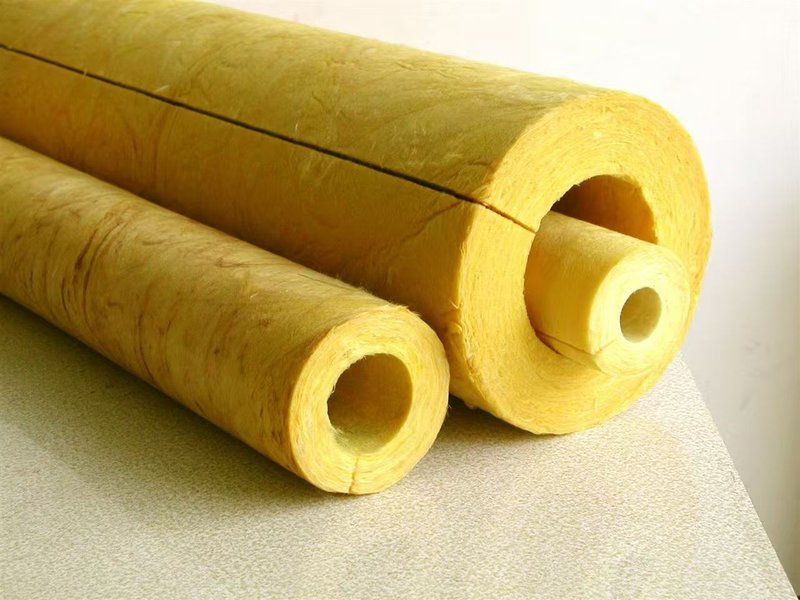
Unlike soft blanket insulation that requires multiple layers of hand-wrapping and leaves thousands of gaps and seams, our pre-formed pipe shells are precision-manufactured to exact pipe dimensions.
Perfect 360° Contact: The rigid shell fits tightly around the pipe, eliminating air gaps that can trap moisture and salt.
Interlocking Joints: Our tongue-and-groove joint design creates a continuous, airtight barrier against external salt spray and humidity.
Wind Resistance: The rigid structure withstands the strong desert winds and sandstorms common in the Middle East, preventing insulation displacement and damage.
Critical Synergy: Even with ultra-low chloride content, external salt fog ingress can still initiate corrosion over time. Our seamless fit design ensures that the low-chloride core material remains protected from external contamination, maintaining its integrity for decades. The combination of endogenous purity and exogenous protection creates a truly closed-loop defense against SCC.
Measurable Benefits for Your Refinery
By specifying Hebei Woqin's low-chloride rock wool shells, you will achieve:
✅ 20+ Year Piping Service Life: Extend the time between insulation replacements from 2-3 years to 20+ years
✅ 90% Reduction in CUI-Related Shutdowns: Eliminate the root cause of catastrophic SCC failures
✅ 70% Lower Lifecycle Costs: The initial investment is recouped in less than 2 years through reduced maintenance and downtime
✅ 100% Aramco Compliance: Meets and exceeds all requirements of Aramco 30-SAMSS-007 and SABIC standards
✅ Faster Installation: Pre-formed shells install 40% faster than traditional soft blanket insulation, reducing labor costs and project timelines
Ready to Protect Your Refinery From CUI?
Don't let a $120 million shutdown happen because of bad insulation. Take the first step to protect your project, your budget, and your career today.
We are offering:
✅ Third-Party Verified Batch Test Report Package: Including ASTM C1226 test results, Aramco compliance documentation, and material safety data sheets — not lab samples, but your actual production batch
✅ Middle East CUI Prevention Sample Kit: Containing samples of our low-chloride rock wool shells and installation demonstration materials
✅ Complimentary Initial CUI Risk Assessment: Our corrosion engineers will review your project specifications and provide a customized risk mitigation plan
All inquiries will be responded to within 24 hours by our Middle East technical support team.
Hebei Woqin Trading Co., Ltd.
Tel: +86 13933929092
Email: an@cn-aerogel.com
Website:insulatewool.com
[ Request Your Free Batch Test Report & Sample Kit Now ] (Primary CTA)
[ Schedule a 30-Minute Technical Call With Our CUI Specialist ] (Secondary CTA)
Hebei Woqin is a global leader in advanced thermal management solutions, specializing in high-performance insulation materials for extreme industrial environments. With over 15 years of experience serving the Middle Eastern energy sector, we are a trusted supplier to Aramco, SABIC, ADNOC, and leading international EPC contractors. All our products are manufactured to the highest international standards and come with full engineering support throughout the project lifecycle.
Written by - Ruibin An
Industry Veteran with 13+ Years of Experience. Deeply rooted in the insulation industry for over 13 years, specializing in supply chain optimization and global market trends for Rock Wool and Aerogel materials.
LATEST NEWS
High-Density Rigid PU Thermal Break Blocks: North American Code-Compliant Structural Solution
2026-07-01
Beyond Insulation: Why Structural Thermal Breaks Are Essential for Modern Industrial Infrastructure
2026-06-29
The Ultimate Guide: "Survival Rules" and System Defenses for Industrial Piping Insulation in Extreme Middle Eastern Environments
2026-06-25
Unlocking Aramco & SABIC Compliance: The Highly Secure Path to Mechanical Completion Sign-Off
2026-06-25
Cutting Pipeline Insulation Labor Costs by 40% in 50°C Middle East Heat
2026-06-18