
Desert Sandstorms: The Hidden Killer of Amine Line Stability in Gas Processing
This is not a product brochure. It is a strategic roadmap to eliminate $6M+ per shutdown losses from desert wind chill. Traditional soft-wrap insulation turns into sand-filled heat dissipators, triggering amine crystallization. Backed by third-party testing, Woqin’s pre-formed shells lock amine temps within ±2°C, cut lifecycle costs by 60%, and deliver 15+ years of stable performance.
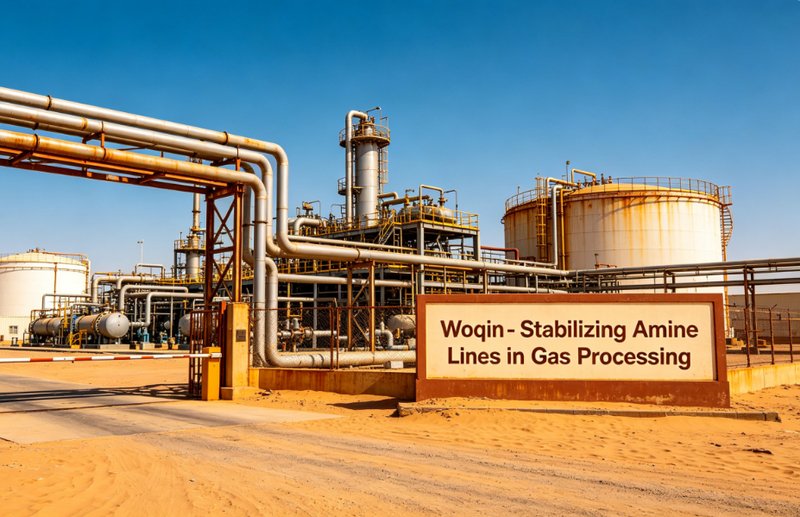
Introduction: The Temperature Lifeline of Middle Eastern Gas Purification
Beneath the vast deserts of the Arabian Peninsula lies the world’s largest natural gas reserves—and also the industry’s most underrecognized production threat. Amine sweetening is the heart of every gas processing plant: it removes hydrogen sulfide and carbon dioxide to produce pipeline-quality natural gas. Yet this critical process operates on a knife-edge: amine solutions require a precise 38-45°C temperature window to function optimally. A single degree deviation cuts desulfurization efficiency by 3-5%; a 5°C drop renders product gas unmarketable.
The Middle East desert does not respect this precision. With over 100 days of 8+ magnitude winds annually and extreme 12-magnitude sandstorms, high-speed sand particles act like microscopic bullets, tearing through traditional soft-wrap insulation and creating a devastating "wind chill effect" that increases heat loss by 3-5 times. What begins as a minor temperature fluctuation quickly escalates into amine crystallization, pipeline blockages, and full plant shutdowns.
In gas processing, controlling amine temperature is not an engineering detail—it is the difference between profitable operations and catastrophic losses.
Pain Point Analysis: Why Soft-Wrap Insulation Fails Catastrophically in Desert Winds
1. The Fatal Flaw: Airtightness Collapse and the Sand-Filled Heat Dissipator
If you’ve ever walked down an amine line during a sandstorm and felt hot air leaking through the seams, you’ve witnessed this firsthand. Traditional glass wool and rock wool blankets are installed by on-site wrapping, leaving hundreds of linear feet of inherent gaps. These seams are the Achilles’ heel of desert insulation:
10-magnitude sandstorms penetrate gaps in as little as 2-3 hours, creating through-air channels that carry away massive amounts of heat
After 6 months of repeated sand scouring, seams that started at 1mm yawn open to 5-10mm, increasing heat loss by 30-40%
After 12 months, the insulation layer is completely packed with sand. What was designed to be a heat-insulating winter coat has transformed into a heat-dissipating armor filled with sand, increasing thermal conductivity by 60% or more
This gradual degradation is insidious. Most plants attribute declining process efficiency to amine aging or equipment wear, never realizing their insulation has become the single biggest cause of production losses.
2. The Chain Reaction: Wind Chill Effect and Process Collapse
The wind chill effect is not just a comfort issue—it is a process killer. When sand-laden winds blow across poorly insulated pipelines, the actual heat transfer rate increases 3-5 times compared to static conditions. This triggers a devastating sequence of events:
Amine temperature drops 5-10°C overnight, desulfurization efficiency plummets 20-40%, and product gas fails quality specifications
When temperatures fall below 30°C, MDEA and other common amines crystallize into hard salts that block pipelines, heat exchangers, and reactor packing
A single crystallization event requires a full plant shutdown for 3-7 days of chemical cleaning and manual dredging
For a medium-sized 100 MMscfd gas plant, this translates to **$2-3 million in lost revenue per day**—plus $500,000-$1 million in cleaning costs and potential downstream contract penalties.
3. The Hidden Costs: Corrosion, Energy Waste, and Repeated Investment
The damage goes far beyond occasional shutdowns:
Accelerated corrosion: Temperature fluctuations cause acidic gases to precipitate, forming condensate under damaged insulation that triggers severe under-deposit corrosion. Pipeline wall thickness decreases by 0.5-1mm annually, cutting service life from 20 years to just 8-10 years
Skyrocketing energy costs: To compensate for heat loss, plants increase amine outlet temperatures from 45°C to 55°C+, boosting heating furnace fuel consumption by 30-40% and adding over $2 million in annual fuel expenses
Amine degradation: Temperature swings accelerate thermal and oxidative amine breakdown, increasing annual amine replenishment rates from 5-10% to 25-35%. At $3,000 per ton, this costs a medium plant over $1.5 million annually
Repeated replacement trap: Soft-wrap insulation lasts only 2-3 years in desert conditions. Over a 20-year project lifecycle, you will replace it 7-8 times, with total costs 3 times higher than pre-formed pipe shells—plus the cost of repeated shutdowns
Woqin Solution: Airtight Pre-formed Shells That Defy 10-Level Sandstorms
Precision Engineering for Perfect Thermal Lock
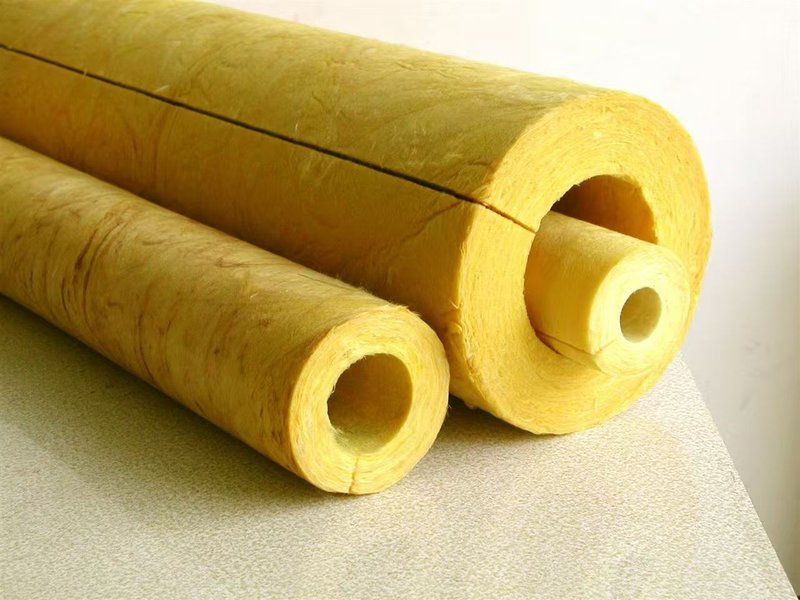
Woqin’s pre-formed pipe shells are factory-manufactured to exact pipeline specifications, eliminating the inherent flaws of on-site wrapped insulation:
Perfect geometric fit: Molded to within ±1mm of your pipeline’s outer diameter, ensuring 100% surface contact with zero gaps
Interlocking tongue-and-groove joints: Combined with our high-temperature silicone sealant, creates a continuous, airtight barrier that completely blocks sand penetration
Proven wind resistance: Third-party testing confirms our pre-formed shells maintain >95% of their thermal performance in 12-magnitude winds, compared to just 40% for traditional soft-wrap insulation
The result? Amine temperature fluctuations are held to within ±2°C 24/7, 365 days a year—even during the worst sandstorms. Desulfurization efficiency remains consistently above 95%, eliminating product quality issues and crystallization risks entirely.
> No more turning a blind eye to seams that breathe. With zero-gap interlocking, you are no longer installing "insulation" that transforms into a heat-dissipating armor within a year. You are locking in process certainty and guaranteeing you never cross the "unplanned shutdown" red line.
(For Process Engineer) Stop chasing temperature fluctuations and reacting to crystallization events. Start operating your amine unit with predictable, stable performance.
Optimized Material Selection for Every Amine Line
We offer both rock wool and glass wool pre-formed shells, precisely matched to your operating conditions:
Rock wool pre-formed shells: Ideal for rich amine lines and regenerator overheads operating at 100-600°C. Offers superior high-temperature stability and A1 non-combustible performance
Glass wool pre-formed shells: Perfect for lean amine lines and reflux systems operating below 100°C. Delivers lower thermal conductivity (≤0.034 W/m·K at 25°C) and lighter weight for easier installation
Durability Physics: Built to Withstand 20 Years of Desert Assault
Triple-Layer Protection System
Woqin’s insulation system is engineered from the inside out to resist every aspect of the desert environment:
Inner core: Rigid pre-formed rock wool/glass wool shell with uniform density and structural integrity. Will not deform, collapse, or settle under sand impact
Vapor barrier: High-performance aluminum foil facing prevents moisture ingress and corrosion
Outer protection: 0.5mm thick aluminum or galvanized steel jacket with smooth, aerodynamic surface. Sand particles bounce off rather than abrading the surface, and UV resistance prevents degradation from intense desert sunlight
15-20 Year Service Life Guarantee
Unlike soft-wrap insulation that requires replacement every 2-3 years, Woqin’s pre-formed pipe shells deliver consistent performance for 15-20 years with minimal maintenance:
No annual patching or repairs required
No sand infiltration or thermal performance degradation
No repeated shutdowns for insulation replacement
Business Impact Translation
Over a 20-year project lifecycle, Woqin’s solution delivers 60% lower total costs compared to traditional soft-wrap insulation. For a typical 100 MMscfd gas plant, this translates to over $20 million in cumulative savings—including avoided shutdown losses, reduced energy costs, and eliminated replacement expenses.
> No more budgeting for the same job, every 3 years. This is not about buying a cheaper material. It’s about drawing a line under the repeated replacement trap, and guaranteeing your project hits its 20-year ROI without touching the insulation OPEX.
(For Facilities Project Manager) Stop planning annual insulation overhauls. Make a single strategic investment that delivers returns for decades.
Call to Action
Don’t guess how much your insulation is costing you. See the exact number.
Request your no-obligation Wind Chill Loss Audit now. We’ll deliver a customized thermodynamic report that maps your annual losses down to the dollar, free samples to verify performance, and a guaranteed ROI timeline—so your next budget meeting writes itself.
Your exclusive package includes:
A site-specific sandstorm-resistant insulation calculation with wind chill heat loss analysis and optimal material/thickness recommendations
Free samples of Woqin’s pre-formed rock wool and glass wool pipe shells to test their airtightness and structural durability firsthand
A 1-on-1 consultation with our Middle East gas processing insulation specialist
A written ROI guarantee showing exactly when your investment will pay for itself

Written by - Ruibin An
Industry Veteran with 13+ Years of Experience. Deeply rooted in the insulation industry for over 13 years, specializing in supply chain optimization and global market trends for Rock Wool and Aerogel materials.
LATEST NEWS
Desert Sandstorms: The Hidden Killer of Amine Line Stability in Gas Processing
2026-06-02
The Desert’s Billion-Dollar Blockage: How Smart Insulation Ends Wax Deposition Nightmares
2026-06-01
Securing Flare Gas Networks: A1 Non-Combustible Shells for Extreme Heat
2026-05-30
EHT Pipe Insulation: Eliminate Tenting Effect with Grooved Pre‑Formed Shells
2026-05-29
SRU Pipe Insulation: Prevent Liquid Sulfur Freeze & Viscosity Surge
2026-05-28