
Beyond 1000°C: Why 44 kPa Tensile Strength is the Structural Standard for Flare Stacks
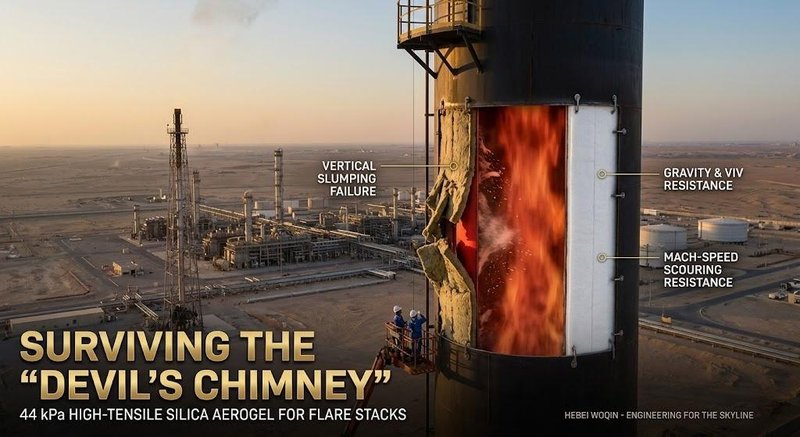
Flare stacks and industrial chimneys in Middle Eastern petrochemical hubs are subjected to the most violent mechanical and thermal stresses in the industry. Beyond the 1000°C+ operating temperatures, these vertical structures face continuous Vortex-Induced Vibration (VIV) and near-sonic gas velocities during emergency blowdowns. Traditional low-density insulation often fails due to "vertical slumping" or surface scouring, leading to catastrophic shell exposure. This white paper introduces a structural-grade insulation approach, leveraging Hebei Woqin’s 44 kPa high-tensile ceramic fiber blankets to eliminate slumping and resist aerodynamic erosion in the world’s most demanding "Devil’s Chimneys."
1. The "Final Line of Defense" in Petrochemical Safety
In the massive petrochemical complexes of Jubail, Ruwais, and Yanbu, the flare stack is more than just a chimney; it is the facility’s ultimate safety valve. Rising up to 150 meters into the desert skyline, these structures must remain operational 24/7 to manage emergency gas releases.
However, for refractory engineers, the interior of a flare stack is often referred to as the "Devil’s Chimney." It represents a convergence of four extreme physical forces: high-frequency vibration, intense gravity-driven loads, near-sonic gas scouring, and rapid thermal whiplash. When the internal insulation lining fails, the cost is not measured in material price, but in the millions of dollars required for 100-meter scaffolding rentals and unplanned plant shutdowns.
2. The 100-Meter Challenge: Gravity and VIV (Vortex-Induced Vibration)
Traditional insulation materials are designed for horizontal or static environments. In a vertical flare stack, gravity is a constant enemy. But the real "silent killer" is Vortex-Induced Vibration (VIV). As high-velocity desert winds strike the cylindrical tower, they create alternating low-pressure vortices, causing the entire stack to vibrate at specific frequencies.
Standard mineral wool or low-grade ceramic fibers lack the internal structural bond to survive this constant shaking. Over months of operation, the fibers fracture and lose their "spring-back" tension. Under the relentless pull of gravity, the insulation undergoes "Vertical Slumping"—shifting downward and leaving the upper sections of the steel shell completely uninsulated and vulnerable to 1200°C flame impingement.
- The Woqin Engineering Solution: To combat VIV and gravity, structural integrity is paramount. Hebei Woqin’s High-Purity Ceramic Fiber Blankets are manufactured using an advanced double-sided cross-needling process, achieving a verified Tensile Strength of 44 kPa. This isn't just an insulator; it is a "reinforced matrix" that acts like a structural armor. It grips the anchoring system with immense resilience, ensuring that even at heights of 100+ meters, the lining remains monolithic and refuses to slump or tear.
3. The Blowdown Storm: Resisting Near-Sonic Scouring
An emergency blowdown event is a violent aerodynamic crisis. Within seconds, massive volumes of waste gas are forced through the stack at velocities approaching Mach 0.5 to 0.8. This creates a "sandblasting" effect on the internal refractory lining.
Low-density fibers (under 96 kg/m³) with high slag ball content are prone to Surface Scouring. The turbulent gas flow literally "peels" the fibers away from the lining, creating a "Fiber Snow" event in the atmosphere and thinning the insulation until it fails.
- The Woqin Engineering Solution: Following API 521 guidelines for pressure-relieving systems, we prioritize surface density. By maintaining a strictly controlled 107 kg/m³ Bulk Density, our blankets provide a high-energy surface barrier. With a Slag Ball Content of ≤11.6%, there are no heavy impurities to act as fracture points. The result is a smooth, high-density armor that maintains laminar flow stability and resists scouring even during the most aggressive emergency discharge events.
4. Thermal Cycling and the "Silent Killer" of Anchors
Flare stacks do not operate at a constant temperature. They undergo violent thermal cycles—from ambient desert temperatures to over 1000°C during a discharge, then back down as steam is injected for cooling. This constant expansion and contraction create immense stress on the internal stainless steel or Inconel 601 anchoring systems.
The failure of a flare lining often starts at the seams. If the insulation blanket has a high linear shrinkage (typically >3.5% in low-grade products), the joints between blankets open up during peak heat. These gaps act like thermal chimneys, allowing 1200°C gas to bypass the insulation and strike the anchors directly. This leads to Anchor Fatigue and oxidation, eventually causing the entire lining section to fall off.
- The Woqin Engineering Solution: We mitigate thermal bypass through superior dimensional stability. Hebei Woqin’s blankets exhibit a Linear Shrinkage of ≤-1.5% (@1000°C). By maintaining tight, interlocking joints even at maximum flare intensity, our material keeps the heat away from the mechanical fixings. This prevents the "zipper effect" of seam opening and significantly extends the service life of the expensive alloy anchors.
5. The Sour Gas Challenge: Acid Dew Point and Corrosion
Many flares in the Middle East handle "Sour Gas" containing high levels of H2S. When the flare is idle or during low-load periods, the temperature inside the stack can drop below the Acid Dew Point. Sulfur oxides combine with moisture to form sulfuric acid droplets.
Low-quality blankets with a High Slag Ball Content act like a sponge for these acids. The impurities (un-fiberized shots) react with the acid, causing the fibers to crystallize and become brittle. This leads to "Capillary Corrosion" where the acid is held against the steel shell, accelerating Corrosion Under Insulation (CUI).
- The Woqin Engineering Solution: Our blankets are refined to a Slag Ball Content of ≤11.6%, ensuring maximum chemical inertness. For extreme sour gas environments, we recommend a Hybrid Shielding Strategy: A base layer of our hydrophobic Silica Aerogel Blanket against the steel shell for 100% moisture protection, topped with our high-tensile Ceramic Fiber for fire resistance. This dual-layer system is the ultimate defense against chemical attack.
6. The Maintenance Math: Why Quality is the Only Budget-Friendly Choice
In the world of flare stacks, the cost of the insulation material is the smallest part of the invoice. The real "Money Pit" is the Scaffolding and Downtime.
In Saudi Arabia or the UAE, erecting and renting scaffolding for a 100-meter vertical tower can cost 5 to 10 times the price of the refractory lining itself. Every time a low-grade lining slumps or scours away, you aren't just buying more cotton—表 are paying for weeks of high-risk labor and lost production revenue.
- The ROI of 44 kPa Resilience: By choosing a structural-grade material with 44 kPa tensile strength and 107 kg/m³ density, you aren't just buying insulation; you are buying Maintenance-Free Cycles. Extending the relining interval by just 24 months can save a refinery millions in O&M (Operations and Maintenance) expenditure.
7. Conclusion: Engineering for the Skyline
At Hebei Woqin, we don't just manufacture materials; we design survival systems for the "Devil's Chimneys" of the Middle East. Our 44 kPa High-Tensile Ceramic Fiber is specifically engineered to defy gravity, resist Mach-speed scouring, and protect the structural integrity of your flare systems.
Don't let a low-bid material choice lead to a high-cost failure. Safeguard your facility with the structural standard of the industry.
Written by - Ruibin An
Industry Veteran with 13+ Years of Experience. Deeply rooted in the insulation industry for over 13 years, specializing in supply chain optimization and global market trends for Rock Wool and Aerogel materials.
LATEST NEWS
The Ultimate Guide: "Survival Rules" and System Defenses for Industrial Piping Insulation in Extreme Middle Eastern Environments
2026-06-25
Unlocking Aramco & SABIC Compliance: The Highly Secure Path to Mechanical Completion Sign-Off
2026-06-25
Cutting Pipeline Insulation Labor Costs by 40% in 50°C Middle East Heat
2026-06-18
Acoustic & Thermal Insulation for HVAC Piping in Middle East Luxury Hotels
2026-06-16
Calculated Oppression: How Thermal Drift and Structural Sagging Bleed Millions from Middle East Piping TCO (And the 20-Year Closed-Loop Solution)
2026-06-15