The Billion-Dollar Blind Spot in DRI Steel Plants: Why Gas Reformer Roofs Fail (And How to Fix It)
In the Middle East's booming Direct Reduced Iron (DRI) steel industry, the gas reformer furnace is the beating heart of production. However, relying on commercial-grade ceramic fiber modules for the massive 1000°C+ roof insulation often leads to catastrophic "gas bypass," anchor burnout, and red shell failures. This technical whitepaper explores the physical and chemical failure mechanisms of reformer roofs and details how Hebei Woqin’s 1260°C/1430°C high-purity ceramic fiber—engineered with -1.5% linear shrinkage and 44 kPa tensile strength—provides a seamless, permanent defense against thermodynamic collapse and costly plant downtime.
1. The Heart of the DRI Process: A High-Stakes Environment
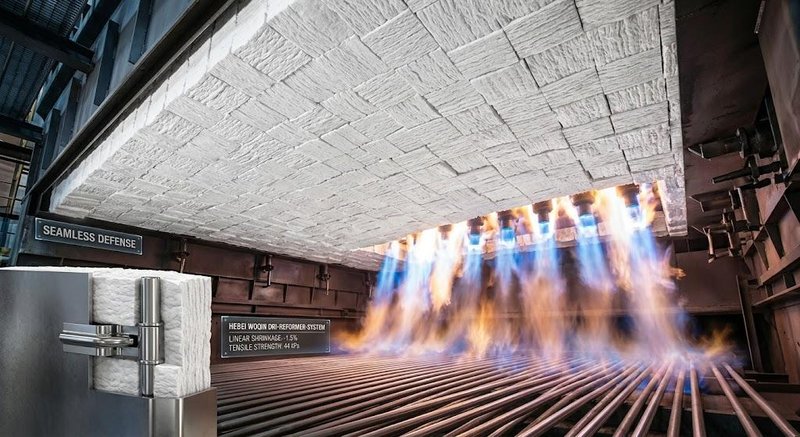
Leveraging abundant natural gas reserves, the Middle East has become the undisputed global leader in Direct Reduced Iron (DRI) steelmaking, utilizing advanced technologies like Midrex and ENERGIRON. At the absolute core of these mega-facilities lies the Gas Reformer Furnace.
This colossal structure is a thermodynamic beast, operating continuously at internal temperatures exceeding 1000°C. Inside, hundreds of highly expensive nickel-alloy catalyst tubes hang suspended in the firebox. To minimize the immense dead weight on the structural steel overhead, the reformer's roof and upper sidewalls rely almost 100% on Ceramic Fiber Modules for insulation.
However, this critical weight-saving design creates a billion-dollar blind spot. When EPC contractors or plant managers compromise on the quality of these refractory modules, the reformer furnace becomes vulnerable to catastrophic failure. Here is a technical breakdown of the four primary failure modes destroying DRI gas reformer roofs, and how Hebei Woqin’s High-Purity Ceramic Fiber System neutralizes them.
2. The "Gas Bypass" Crisis and the Red Roof Nightmare
The most immediate threat to a gas reformer roof is Linear Shrinkage. Commercial-grade ceramic fiber modules cannot withstand prolonged 1000°C+ baking without shrinking—often by as much as 3% to 5%.
As these inferior modules shrink, massive thermal gaps tear open between the folded blocks. Superheated furnace gases (1000°C to 1100°C) violently channel through these gaps, bypassing the insulation layer entirely and striking the carbon steel roof casing. This creates localized "Hot Spots" (or Red Shells), severely warping the structural steel and forcing an emergency plant shutdown.
The Woqin Defense: Thermodynamic stability is non-negotiable. Hebei Woqin’s high-purity ceramic fiber modules are subjected to specialized thermal treatments, delivering an exceptionally low Linear Shrinkage of just -1.5% (@ 800°C × 24h). When installed with our engineered pre-compression calculations, the modules do not shrink under extreme heat; instead, they expand to lock tightly against one another. This creates a permanent, Seamless Monolithic Roof that entirely eradicates the risk of gas bypass.
3. Anchor Burnout and the "Module Drop-Off" Disaster
Once gas bypass occurs, a lethal chain reaction begins. The superheated gases directly attack the internal stainless-steel anchoring hardware (the brackets securing the modules to the roof).
Standard anchors quickly exceed their yield temperature, oxidize, and melt. When an anchor snaps, the heavy ceramic module (often weighing tens of kilograms) drops directly into the firebox. This "Module Drop-Off" not only destroys the insulation integrity but causes falling modules to smash into the fragile, million-dollar catalyst tubes below, halting the entire DRI production line.
The Woqin Defense: By completely sealing the gaps with our low-shrinkage fiber, the heat is locked inside the firebox. Furthermore, our highly dense fiber matrix acts as an ultimate thermal shield, boasting a verified Thermal Conductivity of just 0.134 W/(m·K) at 500°C. This ensures the internal anchoring hardware remains safely insulated at a cool working temperature, permanently eliminating the risk of anchor burnout and roof collapse.
4. Surviving the "Burner Hurricane": High-Velocity Scouring
A DRI gas reformer is not a quiet oven; it is a hurricane of fire. With dozens of heavy-duty burners firing from the top or bottom, the internal atmosphere is subjected to extreme aerodynamic turbulence.
Low-density, loosely needled fiber modules lack surface integrity. The high-velocity swirling gases continuously scour the module faces, tearing individual fibers away. Over time, this wind shear (scouring) literally peels the insulation away layer by layer, reducing a 300mm thick lining to 200mm and severely degrading the furnace's thermal efficiency.
The Woqin Defense: To survive the burner hurricane, you need extreme mechanical strength. Hebei Woqin’s 107 kg/m³ density blankets undergo an advanced double-needling process, resulting in an incredible Tensile Strength of 44 kPa. This ultra-tough, tightly interlocked fiber surface acts as aerodynamic armor, effortlessly resisting high-velocity gas scouring without dusting, tearing, or peeling.
5. Chemical Poisoning by Reducing Gases
While the reformer firebox primarily contains flue gas, the complex nature of the DRI process means trace amounts of reducing gases (such as Carbon Monoxide or Hydrogen) frequently leak or accumulate near the roof.
When these reducing gases interact with low-grade ceramic fibers containing high levels of impurities (like iron oxide, Fe2O3, or "slag balls"), a disastrous catalytic reaction occurs. The impurities cause the flexible fibers to rapidly crystallize, become brittle, and disintegrate into a useless, powdery glass-like slag.
The Woqin Defense: Chemical immunity requires absolute material purity. Through our precision-controlled centrifugal spinning technology, Hebei Woqin drastically reduces impurities, guaranteeing an ultra-low Slag Ball Content of ≤11.6% (Φ>0.212mm). This exceptional Alumina-Silicate purity grants our modules outstanding Chemical Inertness. Our fibers refuse to act as catalysts for reducing gases, ensuring the modules remain resilient and highly insulative for years in unpredictable chemical atmospheres.
6. The Economics of Uptime: Secure Your Reformer
For a DRI mega-plant producing millions of tons of steel annually, a single day of unplanned downtime caused by a collapsed reformer roof can easily cost over $1,000,000 in lost revenue.
Do not gamble the heart of your steel plant on commercial-grade insulation. When you upgrade to Hebei Woqin’s 1260°C and 1430°C High-Purity Ceramic Fiber Modules, you are investing in verified 44 kPa tensile strength and -1.5% shrinkage stability—an insurance policy for continuous, uninterrupted steel production.
Are you planning a turnaround for your DRI gas reformer? Contact Hebei Woqin’s engineering team today for custom-calculated module designs, Class A1 fire-rated Technical Data Sheets (TDS), and direct-from-factory pricing.

Written by - Ruibin An
Industry Veteran with 13+ Years of Experience. Deeply rooted in the insulation industry for over 13 years, specializing in supply chain optimization and global market trends for Rock Wool and Aerogel materials.
LATEST NEWS
The Ultimate Guide: "Survival Rules" and System Defenses for Industrial Piping Insulation in Extreme Middle Eastern Environments
2026-06-25
Unlocking Aramco & SABIC Compliance: The Highly Secure Path to Mechanical Completion Sign-Off
2026-06-25
Cutting Pipeline Insulation Labor Costs by 40% in 50°C Middle East Heat
2026-06-18
Acoustic & Thermal Insulation for HVAC Piping in Middle East Luxury Hotels
2026-06-16
Calculated Oppression: How Thermal Drift and Structural Sagging Bleed Millions from Middle East Piping TCO (And the 20-Year Closed-Loop Solution)
2026-06-15