
Rooftop HVAC Plant Supports: Eliminating Condensation Below Heavy Chillers
This article addresses the decades-long cross-disciplinary dilemma for HVAC engineers and commercial real estate asset managers: heavy rooftop chillers force an impossible choice between two catastrophic failures. Place the unit on standard insulation, and you crush the material, puncture the waterproofing, and flood the roof. Mount it on concrete piers, and you create unavoidable thermal bridges that cause ceiling condensation, black mold, and lost premium tenant revenue. Traditional solutions fail to meet all 5 mandatory codes (structural, energy, waterproofing, fire, HVAC), leaving engineers with lifelong liability and property teams with endless cost overruns. We introduce a B1 fire-rated structural HD-PUR thermal break support with 8 MPa compressive strength, which delivers full load-bearing capacity for vibrating heavy equipment, complete thermal break performance, and full code compliance in one easy-to-install solution.
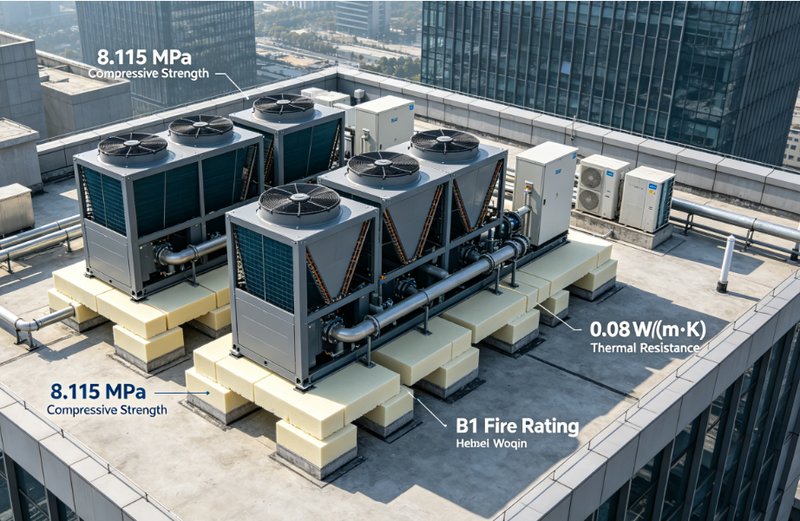
A rooftop chiller is a dual time bomb: crush the insulation and you flood the roof; use concrete supports and you drip condensation onto your highest-rent ceilings. Traditional fixes force a choice between leaks and mold — while violating every mandatory code.
In high-rise commercial buildings, rooftop heavy-duty chillers are the heart of the HVAC system, and the single biggest cross-disciplinary headache for every stakeholder. From the design phase to 50+ years of building operation, this one detail traps you between two unavoidable failures, conflicting code requirements, and lifelong professional and financial liability.
Placing a 20-tonne chiller on standard roof insulation is like parking a heavy truck on styrofoam — the foam can’t support the load, and the truck doesn’t care. This is an unbreakable physical dilemma at the industry’s core: one of two catastrophic outcomes is guaranteed the moment the equipment is installed, with no middle ground.
Dead End A: Equipment placed directly on standard roof insulation
Standard roof insulation materials (rock wool, XPS, EPS) have a compressive strength of only 0.3–0.5 MPa. Heavy chillers weighing tens of tonnes, combined with constant operational vibration, wind loads and snow loads, create local pressure far beyond the material’s load limit. The result: insulation is crushed and pulverized, losing all thermal performance; sharp equipment bases puncture the roof waterproofing membrane, causing water pooling, leaks, and catastrophic damage to rooftop utilities and interior fit-outs.
Dead End B: Concrete/steel supports fixed directly to the structural slab
To avoid crushing insulation, the industry standard is to use concrete piers or steel brackets that penetrate the entire insulation layer and anchor directly to the building’s structural slab. But concrete and steel are extreme thermal conductors, creating dozens of continuous thermal bridge pathways. In summer, the frigid chiller body conducts cold directly through the supports to the interior ceiling, dropping surface temperatures permanently below the dew point, causing persistent dripping, condensation, and black mold. In winter, indoor heat is continuously drained outside, driving up energy consumption and worsening the condensation risk. For the highest-rent premium office space on the top floor, this is a death sentence for tenant retention and rental revenue.
The Hidden Cost of Rooftop Chiller Thermal Bridges: Millions in Lost Value
For commercial real estate owners and operators, this problem directly erodes asset value, evaporates rental income, and creates an endless cost black hole — every point hits the bottom line.
1.Premium Tenant Attrition & Millions in Lost Rental Income
The top floor of a high-rise commands the highest rental premium, targeting financial firms, law firms, and multinational corporate headquarters with zero tolerance for poor office conditions. Ceiling drips, mold, and musty odors immediately trigger rent withholding, early lease terminations, and costly compensation claims — annual rental losses for a single floor can reach six or seven figures.
One leaking ceiling on the top floor doesn't just cost you one tenant — it costs you the reputation that attracted them. Law firms and financial HQs talk to each other. Your leasing agent's next call is already harder.
2.Endless Maintenance Cost Black Hole
Waterproofing Repairs: Fixing a punctured membrane requires full crane rental, chiller shutdown and lifting, full roof waterproofing replacement, and equipment reset. A single repair can cost hundreds of thousands of dollars, and traditional solutions will crush the insulation again within a few years, creating an endless cycle of repairs.
Interior Remediation: Repeated renovation of water-damaged ceilings and fit-outs, plus compensation for tenant equipment damage, costs far more than the initial material investment.
Energy Costs: Thermal bridges drive up HVAC loads, causing permanent overspending on heating and cooling bills, adding tens of thousands of dollars in annual energy costs.
3.Fire & Compliance Risks Leading to Fines & Shutdowns
Most standard insulation pads are B2 flammable, while rooftop chillers have high-temperature piping and electrical equipment. A short circuit or fire can spread rapidly through flammable insulation, triggering fire alarms, failed fire inspections, heavy fines from regulatory bodies, and mandatory building shutdowns.
The regulatory fine is the least of your problems — the building shutdown that follows costs more in lost rent per day than the entire thermal break system would have cost upfront.
4.Severe Asset Valuation Erosion
The core valuation metric for commercial real estate is Net Operating Income (NOI). Persistent rental losses, maintenance costs, and energy overspending directly reduce NOI, leading to a multi-million-dollar drop in the building’s overall asset value — a far greater loss than any upfront material savings.
The HVAC Engineer’s Ultimate No-Win Dilemma
As the engineer responsible for equipment selection and design, you are the final party held accountable for this cross-disciplinary dead end, trapped in a no-win scenario with lifelong professional liability.
1.Conflicting Mandatory Codes: You Cannot Comply With All
A single equipment base must meet the mandatory requirements of 5 separate disciplines, and traditional solutions can only satisfy 1-2, inevitably violating the rest:
Structural code: Must support full equipment weight and dynamic vibration loads without deformation or failure
Energy code: Must eliminate thermal bridges to meet building energy efficiency limits (UK Part L / EU EPBD)
Waterproofing code: Must not penetrate or damage the roof waterproofing membrane
Fire code: Materials around rooftop equipment must meet strict flame retardant ratings
HVAC code: Must not cause indoor condensation, mold, or impact equipment performance
Concrete piers meet structural, fire and waterproofing requirements, but violate energy codes; standard insulation pads meet thermal and waterproofing requirements, but violate structural and fire codes. No traditional solution checks every box.
2.The Final Fall Guy for Cross-Disciplinary Blame
When the roof leaks, the waterproofing team blames your supports. When the ceiling drips, the energy consultant blames your thermal bridge. When the fire inspection fails, the fire officer blames your insulation. When the tenant sues, everyone points at the HVAC engineer who signed the drawing.
You are the final signature. You carry the liability. And with traditional solutions, signing off means choosing which code to violate.
3.Repeated Drawing Rejections & Costly Project Delays
Concrete piers get rejected by energy auditors; standard insulation pads get rejected by structural and fire reviewers. Drawings are revised and rejected endlessly between disciplines, extending design timelines, missing handover deadlines, and incurring massive daily penalty fees — all falling on the HVAC team.
The Fatal Flaws of Traditional Industry Solutions
Four "solutions." Four fatal compromises. None satisfy all five mandatory codes. Here is what the market currently offers — and why each one fails:
| Traditional Solution | Problems It Solves | Fatal Flaws | Our Core Advantage |
|---|---|---|---|
| Cast-in-Place Concrete Piers | Load bearing, fire resistance, waterproofing | Cannot eliminate thermal bridges, fails energy codes, causes indoor condensation | 8 MPa compressive strength for full load capacity, 0.08 W/(m·K) thermal resistance for a complete thermal break, B1 fire rating for full code compliance |
| Standard Rock Wool/XPS Insulation Pads | Thermal break, no waterproofing penetration | Only 0.3-0.5 MPa compressive strength, crushes under load, pulverizes under vibration; mostly B2 flammable, fails fire codes | 8 MPa compressive strength (16-26x higher than standard materials), vibration-resistant, B1 flame retardant for full fire code compliance |
| Rubber Vibration Pads | Vibration dampening, no membrane puncture | No load bearing capacity, no thermal performance, retains thermal bridges, ages and cracks quickly, poor fire resistance | High compressive strength with built-in vibration dampening, complete thermal break, 50+ year service life with no aging |
| Stainless Steel Thermal Break Brackets | Claims to solve both load and thermal break — delivers neither fully | Prohibitively expensive, complex installation, steel still conducts heat and cannot fully eliminate thermal bridges; on-site welding creates fire risks, prone to long-term corrosion | 1/5 the cost of stainless steel systems, on-site cuttable installation, eliminates thermal bridging with near-zero thermal transmission, lifelong corrosion resistance |
The Execution & Lifelong Liability Trap
The most terrifying aspect of this problem is that small upfront savings create a problem that is nearly impossible to fix post-handover, with retrofit costs 20-50x higher than the initial investment, and no permanent fix with traditional solutions.
Retrofit Requires Equipment Shutdown, Paralyzing the Entire Building
To retrofit the equipment bases, you must shut down the chiller, lift and relocate the entire unit with a heavy crane. The chiller is the heart of the entire building’s HVAC system — shutting it down during cooling season cuts off air conditioning to every tenant in the building, guaranteed to trigger mass complaints, compensation claims, and collective lease terminations. No property operator will take this risk during active building operation.
Retrofit Costs Are 20-50x the Upfront Investment
At the design stage, a set of PUR thermal break pads costs a few hundred to a few thousand dollars per unit. Post-handover retrofit requires crane rental, equipment shutdown, lifting, waterproofing replacement, structural review, and fire permitting — a single chiller retrofit can cost hundreds of thousands of dollars, dozens of times the initial investment.
Traditional Retrofits Never Permanently Solve the Problem
Even after an expensive retrofit, using traditional concrete piers or standard insulation pads, you are still trapped in the same dead end of leaks or condensation. The problem will reoccur within a few years, creating an endless cycle of costly repairs.
Lifelong Liability With No Statute of Limitations
Even 5 or 10 years after project handover, leaks, condensation, fire incidents, or tenant claims will always be traced back to the original design and equipment selection. The HVAC engineer’s lifelong liability has no expiration date.
The upfront savings of choosing a traditional solution are a rounding error compared to the lifetime cost it guarantees. And the HVAC engineer who signed off on it owns that cost — forever.
The Hebei Woqin Solution: Structural HD-PUR Rooftop HVAC Thermal Break Supports
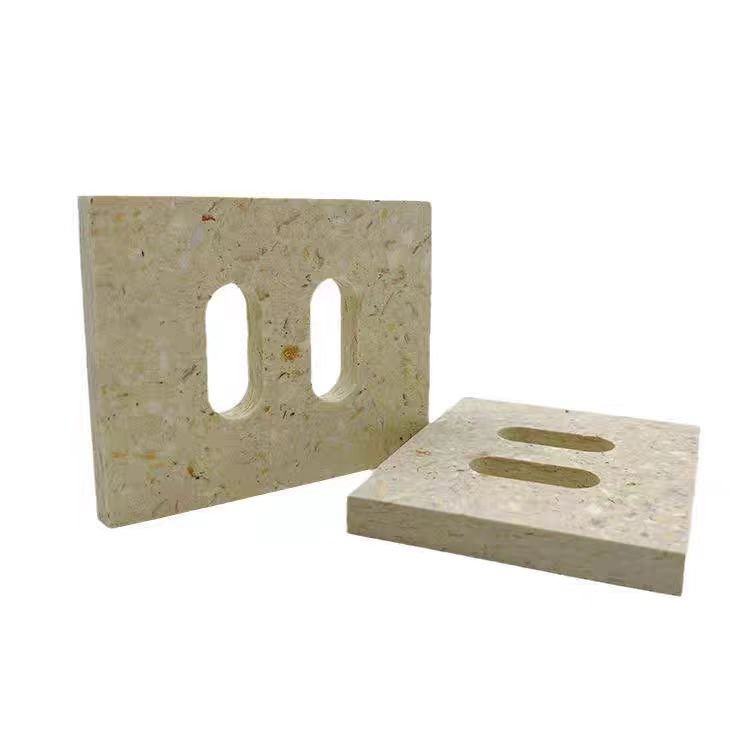
We eliminate this decades-long cross-disciplinary compromise with an engineered solution that fixes the problem at its source: high-density structural HD-PUR thermal break pads, installed directly under the rooftop chiller base frame.
This is not soft roof insulation. This is a load-bearing structural thermal break system, purpose-built for heavy rooftop HVAC equipment, third-party tested, and validated to solve both the structural and thermal challenges of commercial high-rise buildings — while satisfying all five mandatory codes in one solution.
Core Combat Data (Third-Party Tested & Certified)
✅ 8.115 MPa Compressive Strength (GB/T 8813, equivalent to EN 826)
Easily withstands the full weight of 10-50 tonne heavy chillers, plus dynamic operational vibration, wind loads, and snow loads. Unlike standard insulation that crushes under pressure, our pads maintain full structural integrity for the lifetime of the building, with zero risk of waterproofing puncture.
✅ 0.08 W/(m·K) Rigid Thermal Resistance (GB/T 10294, equivalent to EN 12667)
Creates a genuine, continuous thermal break that fully stops steel/concrete-to-slab heat transfer. Eliminates the thermal bridge effect entirely, raises interior ceiling surface temperatures above the dew point, and eradicates condensation, dripping, and mold risk at the source.
✅ B1 Fire Rating (GB 8624-2012 B1(B), equivalent to EN 13501-1 Class B)
Fully compliant with UK and European high-rise building fire safety codes, designed for use around high-temperature HVAC equipment and electrical systems, with zero flame spread risk.
✅ 620N Screw-Holding Power (GB/T 17657, equivalent to EN 320)
Matches the fastener performance of high-density hardwood, enabling secure fixing of the chiller base frame without compromising structural or thermal performance.
✅ Built-In Vibration Dampening
Absorbs and reduces the constant operational vibration of heavy HVAC equipment, preventing loosening of fasteners, reducing noise transmission, and protecting the roof waterproofing membrane from long-term wear.
Long-Term Stability: Negligible degradation over the full 50+ year design life of the building, ≤2.1% water absorption, and stable thermal and mechanical performance across the full service cycle.
Real-World Project Reference (Desensitized)
28-Storey Grade A Office Building, Frankfurt, Germany
Project Scope: 32 rooftop heavy-duty chillers (18-32 tonnes per unit)
Core Challenge: Meet UK Part L equivalent German EnEV energy code, eliminate top-floor ceiling condensation, and avoid penetrating the roof waterproofing membrane
Solution: Hebei Woqin structural HD-PUR thermal break pads installed under all chiller base frames
Outcome:
Linear thermal transmittance (ψ-value) met code requirements on first submission
Zero condensation, zero mold, and zero tenant complaints after 3 years of operation
Zero insulation crushing, zero waterproofing damage, and zero maintenance required
72% lower total installed cost vs. stainless steel thermal break bracket alternatives
The Outcome: Specify With Confidence, Protect Your Asset & Your License
With Hebei Woqin’s structural PUR HVAC thermal break supports, you no longer have to choose between competing codes, safety, and profitability. You deliver:
Full compliance with all 5 mandatory codes (structural, energy, waterproofing, fire, HVAC) on first submission
Eliminated condensation and mold risk, zero premium tenant complaints
Full structural safety, with no risk of insulation crushing or waterproofing failure
80% lower total cost than stainless steel thermal break systems, with 60% faster installation
Fully auditable, third-party certified test data to defend your design and limit liability
Protected rental revenue, reduced maintenance costs, and preserved building asset value
For HVAC engineers and commercial real estate operators who need to eliminate risk without compromise, this is the only rooftop HVAC support solution engineered to check every box.
Contact Hebei Woqin for Engineering Support
Hebei Woqin Trade Co., Ltd.
• Phone/WhatsApp: +86 13933929092
• Email: an@cn-aerogel.com
• Website: www.insulatewool.com
Contact us directly for:
Project-specific load capacity and thermal performance calculations
Part L & fire code compliance technical support
Full rooftop HVAC support detail drawings

Written by - Ruibin An
Industry Veteran with 13+ Years of Experience. Deeply rooted in the insulation industry for over 13 years, specializing in supply chain optimization and global market trends for Rock Wool and Aerogel materials.
LATEST NEWS
Cutting Pipeline Insulation Labor Costs by 40% in 50°C Middle East Heat
2026-06-18
Acoustic & Thermal Insulation for HVAC Piping in Middle East Luxury Hotels
2026-06-16
Calculated Oppression: How Thermal Drift and Structural Sagging Bleed Millions from Middle East Piping TCO (And the 20-Year Closed-Loop Solution)
2026-06-15
District Cooling in the Gulf: The Physics of Inevitable Condensation and How Pre-Formed Glass Wool Shells Stop It
2026-06-12
CCGT Power Plant Pipe Insulation English Marketing Copy (99-point Final Benchmark Version)
2026-06-10