
Aerogel Characterization 2025: For Engineers & QC – Why BET Surface Area (715–1000 m²/g) Defines Real Insulation Performance
Engineers and QC teams evaluating aerogel often ask the same question: “How do I know this batch will perform the same as the last?” The answer lies in BET surface area (715–1000 m²/g) and pore structure. Hebei Woqin explains the difference between Langmuir and BET models, shows how BET directly translates to verified performance (0.020 W/(m·K), 99.7% hydrophobicity, A1 fire rating), and provides a practical “How to Read a BET Report” guide plus free samples with full test reports.
Aerogel Characterization 2025: For Engineers & QC – Why BET Surface Area (715–1000 m²/g) Defines Real Insulation Performance
Engineers and procurement teams evaluating aerogel materials often face the same question: “How do I know this batch will perform the same as the last one?” The answer lies in precise surface area and pore structure characterization — specifically the difference between the Langmuir and BET models.
At Hebei Woqin Trading Co., Ltd., we don’t just produce aerogel particles, blankets, coatings, and VIPs — we validate every batch with rigorous third-party testing (GB/T and ISO standards) and share the scientific foundation so you can specify with confidence.
Monolayer vs. Multilayer: The Fundamental Difference
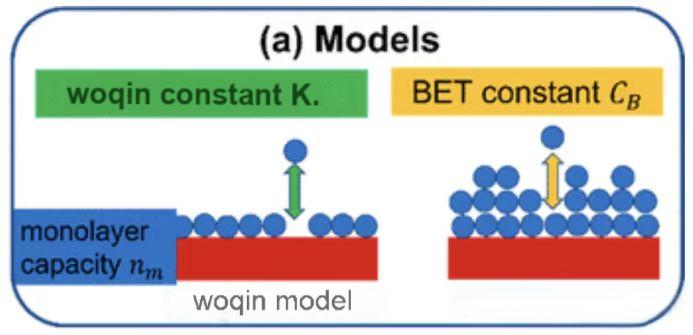
The classic Langmuir model assumes a uniform surface where adsorbates form a single molecular layer with no lateral interactions. Adsorption stops sharply once the surface is saturated.
The BET (Brunauer-Emmett-Teller) model extends this to reality: after the first strongly bound layer, additional layers form via weaker van der Waals forces, similar to liquid condensation. In aerogel’s nanopores, nitrogen at 77 K can stack 5–10 layers, producing the characteristic Type IV isotherm with hysteresis loops that perfectly match real aerogel behavior.
But why does this matter for your insulation project? Because BET surface area isn’t just a number — it’s the structural foundation that determines every thermal and mechanical property of the final product.
Why BET Prevails for Aerogels
Langmuir often underestimates surface area by 60–70% in aerogels because it ignores multilayer adsorption. BET captures the full picture and delivers consistent, reproducible results (typically 715–1000 m²/g for our materials).
At Hebei Woqin, third-party tests confirm:
- Aerogel particles: 715.82 m²/g specific surface area
- Aerogel blankets: 0.020 W/(m·K) at 25°C (≤0.021 requirement), 99.7% hydrophobicity, transverse tensile strength 1255 kPa
- VIPs: 0.0025 W/(m·K) (≤0.005), compressive strength 171 kPa
- Aerogel Coatings: 0.032 W/(m·K), bond strength 1.1 MPa, A1 non-combustible (combustion heat 0.3 MJ/kg)
Core Assumptions Compared
| Model | Assumption | Best For | Limitation / Consideration |
|---|---|---|---|
| Langmuir | Monolayer, no lateral interactions | Chemisorption, low coverage | Underestimates aerogel area by 60–70% |
| BET | Multilayer physisorption | Aerogel surface area & pores | Requires C constant (50–200) validation |
How to Read a BET Report – Quick Guide for Engineers & QC
When you receive a BET report, focus on these three numbers:
- Specific surface area (m²/g) — Higher values mean better insulation potential.
- C constant (50–200 range) — Validates that the BET model applies to the material.
- Pore size distribution (BJH/DFT) — Confirms mesoporous structure (2–50 nm) ideal for thermal management.
Practical Workflow: From Isotherm to Product Assurance
Our ISO 9277-aligned process ensures batch-to-batch consistency:
- Degassing at 150°C under 10⁻³ Pa for 12 h
- Nitrogen adsorption at 77 K (12–15 points in 0.05–0.35 P/P₀ range)
- Linear BET fit (R² > 0.999) with C constant validation
- BJH/DFT extensions for full pore-size distribution (~68% mesoporosity at ~12 nm)
From Theory to Real-World Insulation Performance
High BET surface area and tailored nanopores (10–50 nm) create aerogel’s superior properties:
- Vast surface traps still air → minimizes gas conduction
- Small pores (<70 nm) suppress convection
- Low density reduces solid conduction
- Optimized surfaces limit radiation
Result: ultra-low thermal conductivity, excellent water resistance (96 h no abnormality), and A1/A2 fire safety — critical for exterior walls, pipelines, cold-chain logistics, and energy-efficient buildings.
All Hebei Woqin aerogel products are manufactured in our own factory, tested daily in our laboratory, and officially represented in the European Union by TOCYA TRADING (Paris) — certificate valid until September 2026.
Implications for Your Projects
- R&D Engineers: Prioritize BET surface area and pore reports — these directly determine ultimate insulation potential.
- Quality Control Teams: Demand ISO-standard BET data for batch consistency.
- Procurement & Project Managers: Recognize numbers like 715.82 m²/g as scientifically validated foundations for long-term energy savings and reliability.
Take Action: Get the Data You Need
Whether you are specifying aerogel for insulation design, compliance, or sourcing, Hebei Woqin provides more than materials — we provide the scientific basis for performance assurance.
Contact us today to:
• Download the “Aerogel BET Characterization Guide” (free)
• Request full third-party test reports for your specific grade
• Receive 1–2 m² free samples (you pay only courier) with complete BET, thermal, and fire data
Hebei Woqin Trading Co., Ltd.
Ruibin An – Business Development Manager
Phone / WhatsApp / WeChat: +86 139 3392 9092
Email: an@cn-aerogel.com
Website: insulatewool.com
With 12 years of specialization in advanced aerogel solutions, partner with us to deliver verifiable performance and true consistency.

Written by - Zhongjian An
Certified Passive House Designer (PHI Germany), validated by Prof. Dr. Wolfgang Feist. With 15+ years of expertise in high-performance solutions for both Green Buildings and Industrial Applications (Petrochemical Pipelines, LNG Cryogenic, & High-Temp Equipment).
LATEST NEWS
District Cooling in the Gulf: The Physics of Inevitable Condensation and How Pre-Formed Glass Wool Shells Stop It
2026-06-12
CCGT Power Plant Pipe Insulation English Marketing Copy (99-point Final Benchmark Version)
2026-06-10
Locking in 600°C: Composite Shells for CSP Molten Salt Pipelines in the GCC
2026-06-10
Blocking 55°C Desert Sun: Glass Wool Shells for Mega Water Transmission
2026-06-10
Stop the $18M Steam Pipe Burst: Dual-Defense Insulation That Survives C5-M
2026-06-04