
District Cooling in the Gulf: The Physics of Inevitable Condensation and How Pre-Formed Glass Wool Shells Stop It
Gulf chilled water pipes at 6°C face a 35.8°C dew point — condensation is guaranteed when insulation fails. Rubber foam and PU foam both fail within 5–8 years across tunnels, buried, and exposed installations. Woqin's glass wool shells hold <0.02 perm for 20+ years, cutting TCO by 3–5×.
The Dew Point Doesn’t Negotiate: Why Gulf District Cooling Networks Lose the Battle Against Condensation
Thermodynamics leaves no room for negotiation.
In Dubai, Abu Dhabi, and Doha, district cooling operators deliver chilled water at 5–7°C through dozens of kilometers of pipeline networks, installed above and below ground across some of the world’s most humidity-saturated urban environments. Meanwhile, ambient air temperatures surrounding these pipelines reach 35–42°C, with relative humidity consistently hitting 85–95% during summer months.
At 35°C and 90% relative humidity, the dew point stands at approximately 33°C. The surface temperature of inadequately insulated chilled water pipes ranges from 8–12°C, more than 20°C below the ambient dew point.
This is not a potential risk — it is a mathematical certainty. As soon as insulation systems suffer aging damage, gaps, or joint failure, water vapor in the ambient air will condense on pipe surfaces as inevitably as water boils at 100°C. The only variables are the speed of condensation accumulation and the extent of hidden damage before visible deterioration appears.
For Gulf district cooling operators managing hundreds of thousands of refrigeration tons (RT) of cooling capacity and serving thousands of end users under strict Service Level Agreements (SLAs) and uptime guarantees, systemic insulation failure is not a theoretical issue. Its financial impacts are clearly reflected in rising energy bills, swelling maintenance budgets, and frequent customer complaints.
This article provides a technical breakdown of how condensation compromises district cooling infrastructure across three core installation scenarios: underground utility tunnels, direct-buried pipelines, and above-ground exposed facilities. For each environment, we analyze specific thermodynamic failure mechanisms, common failure modes of two mainstream competing insulation materials, and the engineered solutions of Woqin factory pre-formed glass wool shells with integrated vapor barriers that eliminate all condensation failure pathways.
Condensation Physics Every District Cooling Engineer Must Master
Before analyzing on-site failure scenarios, it is critical to establish the thermodynamic baseline that governs all chilled water insulation performance in the Gulf.
Dew Point Calculation
The Magnus approximation formula calculates dew point temperature (Td) based on ambient temperature (T, °C) and relative humidity (RH, %):
$$Td = \frac{243.04 \times [ln(RH/100) + \frac{17.625 \times T}{243.04 + T}]}{17.625 - [ln(RH/100) + \frac{17.625 \times T}{243.04 + T}]}$$
Calculated for peak summer conditions typical of GCC coastal cities (July–August): 38°C ambient temperature and 88% relative humidity.
Calculated dew point (Td): ≈ 35.8°C
Chilled water pipe surface temperature: 8–10°C
Temperature gradient between dew point and pipe surface: ≥25°C
This is not a marginal operational condition that standard moisture-resistant insulation can handle. The extreme condensation-driven temperature gradient demands a fully impermeable vapor barrier system — not materials that only perform well under standard 25°C laboratory moisture resistance tests.
The Wet Conductivity Multiplier Effect
A widely underestimated thermodynamic principle dictates that the thermal conductivity of insulation materials rises sharply once moisture penetrates the material matrix, crippling insulation performance.
| Insulation Material | Dry λ (W/m·K) | Wet λ (10% moisture content) (W/m·K) | Performance Multiplier |
|---|---|---|---|
| Glass wool (dry, intact vapor barrier) | 0.034 | — (vapor barrier prevents moisture ingress) | — |
| Rubber foam (Armaflex-type closed-cell foam) | 0.036 | 0.090–0.120 (after micro-crack formation) | 2.5–3.3× |
| On-site sprayed PU foam (no independent vapor barrier) | 0.030 | 0.075–0.100 | 2.5–3.3× |
| Unprotected glass wool (wet, no vapor barrier) | 0.034 | 0.200–0.260 | 5.9–7.6× The core takeaway from this data: unprotected glass wool delivers the worst thermal performance when saturated with moisture. This is why the vapor barrier is not an optional accessory for Woqin glass wool shells — it is a core engineered component. The glass wool core provides stable thermal resistance in dry conditions, while the integrated vapor barrier permanently locks out moisture to sustain long-term performance. Rubber foam and PU foam appear to offer inherent moisture resistance without dedicated vapor barriers for the first 2–3 years of service. Beyond this period, material properties degrade rapidly, triggering irreversible failure modes in Gulf extreme environments. |
Scenario 1: Underground Utility Tunnels — The Invisible Moisture Accumulation Trap
On-Site Environmental Conditions
Gulf urban district cooling networks extensively adopt shared underground utility tunnels (UUTs) — enclosed concrete corridors housing chilled water pipelines, power cables, telecommunication ducts, and water mains. These tunnels serve as standard infrastructure for both mature commercial districts and newly planned developments across GCC cities.
Underground tunnel environments feature unique thermal and humidity conditions far harsher than above-ground installations:
Ambient Temperature: 28–36°C (combined geothermal heat and heat dissipation from adjacent electrical equipment)
Relative Humidity: 85–95% (groundwater seepage through concrete walls + self-generated moisture from chilled pipe operation)
Ventilation: Minimal — code-specified ventilation only maintains basic air quality and fails to reduce high humidity levels
Inspection Frequency: Quarterly or semi-annual visual inspections only
The infrequent inspection cycle is the biggest hidden risk. Tunnel insulation failures develop gradually over months and remain undetected until severe damage accumulates.
Self-Reinforcing Humidity Loop Mechanism
Enclosed tunnel environments create a self-accelerating humidity cycle unique to chilled water pipeline systems. Even marginally defective insulation allows minor cold leakage, cooling surrounding tunnel air below the dew point. Moisture condenses on the outer insulation surface rather than the pipe itself, then evaporates back into the enclosed tunnel atmosphere during system load fluctuations.
Over time, chilled pipe operation continuously elevates tunnel humidity, creating a far damper microclimate than the surrounding soil environment. Insulation systems qualified for standard humidity conditions at installation quickly become inadequate for the self-generated extreme humid tunnel environment.
Rubber Foam Failure Mode in Tunnel Environments
Closed-cell elastomeric rubber foam (Armaflex-type) is the most widely specified insulation for Gulf district cooling pipelines, as its inherent closed-cell structure theoretically eliminates the need for a separate vapor barrier. While new rubber foam performs reliably, long-term exposure degrades its molecular structure irreversibly.
Sustained exposure to temperatures above 30°C and humidity above 80% triggers gradual oxidative and hydrolytic degradation of rubber foam’s polymer cell walls. Micro-cracks form within 3–5 years of tunnel service — invisible to visual inspection but verifiable via water vapor transmission rate (WVTR) testing. Field studies confirm that rubber foam removed from high-humidity chilled water systems after 6–8 years exhibits a 300–600% increase in WVTR compared to new material.
Once micro-cracks develop, humid tunnel air penetrates the foam matrix, and the cold pipe surface induces internal condensation. The foam transitions from a moisture-resistant barrier to a moisture reservoir, trapping water directly against the pipe surface. Its thermal conductivity surges from 0.036 W/m·K to 0.090–0.120 W/m·K, widening the dew point temperature gradient and accelerating condensation in a self-reinforcing failure cycle.
The most dangerous characteristic of rubber foam tunnel failure is hidden deterioration: the outer surface remains intact while the inner core becomes fully saturated. Quarterly inspections detect no anomalies, while chiller energy consumption rises by 8–15% within 5 years — a issue commonly misattributed to increased network load rather than insulation degradation. Severe failure is only discovered during scheduled replacement or visible dripping, by which time pipe support brackets have suffered years of concealed corrosion damage.
Sprayed PU Foam Failure Mode in Tunnel Environments
On-site sprayed PU foam is often specified for complex tunnel geometries such as valves, fittings, and transition joints where pre-formed shells are difficult to install. It delivers excellent initial thermal performance (λ ≈ 0.030 W/m·K) and strong pipe adhesion but suffers from mechanical failure rather than chemical degradation in tunnel conditions.
Chilled water pipes undergo repeated thermal cycling: 6°C pipe surface temperature during full operation and near-ambient temperature during shutdown or low-load periods. PU foam has a thermal expansion coefficient 5 times higher than steel, creating persistent differential expansion stress between the rigid foam matrix and steel pipe. After 3–5 years of daily cycling, invisible delamination occurs at the foam-pipe interface, creating unobstructed vapor ingress pathways. Pipeline vibration from pumping systems further accelerates delamination failure.
Woqin Tunnel Solution: Mechanically Stable Vapor Lock System
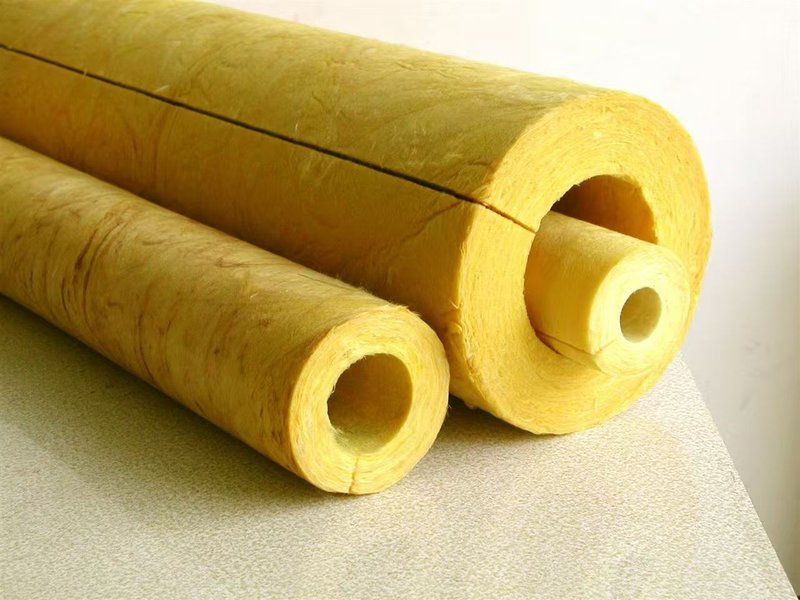
Woqin pre-formed glass wool pipe shells for tunnel applications are engineered around one core principle: complete vapor barrier integrity under long-term thermal cycling, high humidity, and aging conditions.
Inert Glass Wool Core: With a thermal conductivity ≤0.034 W/m·K at 25°C, the inorganic glass wool core relies on stable fiber structure and trapped air for thermal resistance. It features no polymer cell walls, eliminating aging, cracking, and rising WVTR issues. It maintains 100% thermal performance after 20 years of service when paired with an intact vapor barrier.
Factory-Bonded ASJ Vapor Barrier: The integrated aluminum foil composite (ASJ/FSK) facing delivers a permanent WVTR of <0.02 perms — far superior to aged rubber foam’s WVTR of >1.0 perm. As a factory-bonded structural component rather than a field-applied coating, it avoids on-site construction defects.
Coastal Corrosion Resistance: Gulf tunnel groundwater contains 5,000–20,000 ppm dissolved chlorides, forming a saline microclimate that corrodes unprotected metal components and low-grade foil facings. Woqin’s triple-layer ASJ composite (aluminum-fiberglass scrim-kraft) provides dual-sided protection, delivering a 20+ year service life in C3 coastal corrosion environments and preventing vapor barrier oxidation or delamination.
Mechanical Interlocking Joints: Tongue-and-groove shell joints sealed with high-temperature factory aluminum tape create a continuous vapor barrier. Unlike adhesive-bonded rubber foam joints that fail under thermal cycling, Woqin’s mechanical lock design maintains full sealing integrity regardless of pipe thermal movement.
The end result: After 7 years of tunnel service, rubber foam retains only 55–65% of its original thermal performance, while properly installed Woqin glass wool shells maintain 93–97% of designed performance with zero vapor barrier failure.
20-Year TCO Comparison: Underground Utility Tunnel (500m DN200 Supply & Return Pipeline)
| Parameter | Rubber Foam System | Woqin Glass Wool Shell System |
|---|---|---|
| Initial Installed Cost (Material + Labor) | Baseline | +12–18% Premium |
| Thermal Performance (Year 1) | 100% | 100% |
| Thermal Performance (Year 7) | 55–65% | 93–97% |
| Re-Insulation Cycle | Every 8–10 Years | 20+ Years |
| Additional Chiller Energy Cost (Year 3–10) | $180,000–$280,000 | <$15,000 |
| Bracket Corrosion Repair Cost (Year 5–10) | $40,000–$90,000 | Negligible |
| 20-Year Total Cost of Ownership | 3.2–3.8 × Initial Cost | 1.1–1.2 × Initial Cost *Based on 500 RT chiller system, $0.12/kWh energy cost, 8% performance degradation causing 12% additional compressor energy consumption |
Scenario 2: Direct-Buried Pipelines — Salt Contamination, Soil Pressure and Exorbitant Excavation Costs
On-Site Environmental Conditions
Direct-buried pipelines connect central cooling plants, tunnel networks, and building entry points, forming the majority of district cooling infrastructure in Gulf coastal reclamation areas including Dubai Marina, Palm Jumeirah, Saadiyat Island, and Lusail City. Buried pipeline environments feature unique harsh conditions distinct from tunnel and above-ground installations:
Soil Temperature: 22–30°C at 1.0–1.5m burial depth (stable year-round)
Moisture Source: High-salinity groundwater (8,000–35,000 ppm chloride, exceeding standard seawater’s 19,000 ppm)
Soil Pressure Load: 15–25 kPa vertical static load from overlying soil
Inspection Access: Zero — all inspections require costly excavation
Coastal Reclamation Soil Penalty
Gulf coastal reclaimed land is constructed from dredged seabed sediment with permanently high salt content, unlike natural inland soil that gradually leaches salt via rainfall. Soil resistivity in these areas is only 2–8 Ω·m (compared to >100 Ω·m for inland soil), triggering two critical risks: accelerated galvanic corrosion of all metallic pipeline components and severe chloride pitting corrosion if insulation failure exposes pipes to saline groundwater.
Rubber Foam Failure Mode in Buried Applications
Standard rubber foam is not engineered for direct burial mechanical loads. With a compressive strength of only 25–40 kPa, it barely resists static soil pressure and offers no safety margin for point loads from backfill stones, pipe thermal displacement, or construction equipment loads.
Micro-deformation under soil load triggers two irreversible failure pathways. First, deformed foam creates non-drainable air gaps between insulation and pipe surfaces, trapping highly corrosive saline groundwater and causing localized chloride pitting. Second, mechanical compression fractures foam cell structures, drastically increasing local WVTR. This permanent deformation leads to concealed pipe corrosion that is only detected after pipeline leakage occurs, requiring emergency excavation and repairs costing 5–8 times more than scheduled maintenance.
Pre-Insulated PU Pipe Failure Mode in Buried Applications
Factory pre-insulated PU pipes feature high compressive strength (>300 kPa) suitable for soil loads but suffer from fatal joint integrity defects. Standard 6–12m pipe sections require on-site PU foam injection and heat-shrink sleeve sealing, a temperature-sensitive process easily compromised by Gulf summer heat (>35°C).
High-temperature on-site injection causes excessive foam expansion, void formation, and reduced density, lowering joint insulation performance by 15–30%. Factory PU sections achieve ≥92% closed-cell content for reliable vapor resistance, while summer field joints only reach 70–80% closed-cell content, boosting WVTR by 3–5 times. Every field joint becomes a vapor barrier discontinuity and condensation initiation point, with no non-destructive detection method other than costly thermal imaging surveys.
Woqin Buried Solution: Compression-Rated Shells with Continuous Vapor Integrity
Woqin supplies high-density glass wool shells (100–150 kg/m³ bulk density) for buried district cooling applications, with compressive strength exceeding 80 kPa to fully resist soil static loads and backfill point loads. The rigid inorganic fiber structure eliminates creep and cold flow under long-term soil pressure, maintaining the original 50mm design thickness and thermal resistance for 20+ years.
The factory-bonded ASJ aluminum foil facing forms a continuous, mechanically independent vapor barrier, unaffected by core material conditions. For buried environments, an optional HDPE outer jacket provides secondary mechanical protection against backfill abrasion and dual moisture exclusion.
Standardized Joint Sealing System: Factory self-adhesive aluminum tape achieves full adhesion across 15–50°C, delivering consistent joint quality even in 45°C summer heat. This eliminates the performance gap between factory pipe sections and field joints — the primary failure cause of PU pipe systems.
20-Year TCO Comparison: Direct-Buried Pipeline (1km DN300 Supply & Return Pipeline, Reclaimed Land)
| Cost Item | Field-Applied Rubber Foam | Pre-Insulated PU Pipe | Woqin Glass Wool Shell + HDPE Jacket |
|---|---|---|---|
| Initial Installed Cost | Baseline | +20–30% | +25–35% |
| Planned Thermal Imaging Inspection | $18,000–$25,000 | $18,000–$25,000 | $8,000–$12,000* |
| Emergency Excavation & Pipe Repair (Per Event) | $280,000–$450,000 | $180,000–$320,000 | — |
| Corrosion Repair at Failure Points | $40,000–$120,000 | $25,000–$80,000 | <$8,000 |
| Re-Insulation Cycle | 8–12 Years | 12–15 Years | 20+ Years |
| Estimated Emergency Events (20 Years) | 2–4 | 1–3 | 0–1 |
| 20-Year Total Cost of Ownership | 4.5–6.0 × Initial Cost | 2.8–4.0 × Initial Cost | 1.2–1.4 × Initial Cost *Reduced inspection frequency enabled by stable, failure-free long-term performance The core cost disparity stems from exorbitant Gulf urban excavation expenses. Road restoration, traffic management, utility coordination, and permit fees cost $120,000–$200,000 per excavation event before any pipe or insulation repairs. This makes upfront investment in 20-year durable insulation systems the only financially rational choice for buried district cooling networks. |
Scenario 3: Above-Ground Exposed Installations — The Daily Night Humidity Pump Cycle
On-Site Environmental Conditions
Above-ground district cooling pipelines (building interconnections, roof headers, plant room piping, and facade risers) endure the most extreme thermal cycling of all installation types in the Gulf:
Daytime: Intense solar radiation heats insulation surfaces to 65–80°C, creating a 60–74°C temperature differential with 6°C internal chilled water
Nighttime: Ambient temperature drops to 25–30°C, while relative humidity surges to 80–92%, drawing moist air toward cold pipe surfaces
Nightly Humidity Pump Failure Mechanism
A daily vapor pressure gradient cycle acts as a natural humidity pump. Daytime solar heating pushes residual moisture out of permeable insulation systems. Nighttime high humidity and cooling temperatures reverse the gradient, sucking moist air inward to condense on cold pipe surfaces. Each 24-hour cycle accumulates moisture within the insulation matrix, completely degrading thermal performance within 2–3 summer seasons for unprotected systems.
Visible Reputational & Operational Risks
Unlike concealed tunnel and buried failures, above-ground condensation damage is fully visible and high-risk. A failed DN300 chilled water pipeline in a hotel mechanical corridor produces 0.8–1.4 liters of condensate per linear meter hourly. A 20m pipeline section generates 16–28 liters of dripping water every hour, triggering a cascade of consequences: structural steel bracket corrosion within 18 months, architectural finish water damage, public slip hazards, customer complaints, and emergency insulation replacement at 3–4 times the cost of scheduled maintenance, plus potential operational disruption.
Rubber Foam Failure Mode in Exposed Above-Ground Conditions
Above-ground Gulf environments combine UV radiation, extreme heat cycling, and high humidity — a synergistic failure trifecta that destroys rubber foam within 3–5 years. Continuous UV exposure hardens and cracks foam surfaces, breaking polymer chain bonds and creating micro-infiltration pathways. High temperatures accelerate oxidative degradation, while nightly humidity pumping drives persistent internal condensation.
Supplemental PVC or aluminum UV jackets only shift failure points to jacket joint gaps, which open and close under thermal cycling to allow moisture ingress. Rubber foam cannot simultaneously serve as thermal insulation, vapor barrier, UV shield, and aesthetic finish — no single polymer material can sustain all four functions for 20 years in Gulf extreme conditions.
Sprayed PU Foam Failure Mode in Exposed Above-Ground Conditions
On-site sprayed PU foam delivers the fastest failure rate in exposed above-ground scenarios. Without dedicated UV coatings, PU foam surfaces powder and degrade within 6–18 months of Gulf solar exposure. Thermal cycling causes consistent foam shrinkage, creating persistent gaps at pipe interfaces and joints. These gaps trap nightly condensed moisture with no drainage path, leading to rapid, irreversible insulation failure.
Woqin Above-Ground Solution: Solar Reflective Armor System
Woqin above-ground glass wool shells feature high-reflectance composite aluminum foil facings (≥0.95 solar reflectivity) bonded to reinforced scrim backing, solving above-ground failure mechanisms at the source:
Solar Heat Rejection: 95%+ solar radiation reflection reduces jacket surface temperatures to 38–45°C (compared to 65–80°C for standard dark-jacketed systems), cutting the humidity pumping driving force by over 70%.
Permanent Vapor Integrity: Retains <0.02 perm WVTR performance, blocking all vapor ingress regardless of nightly humidity gradient fluctuations.
Mechanical & UV Durability: Optional factory pre-formed 0.5mm/0.8mm aluminum cladding provides impact resistance and aesthetic consistency, mechanically fastened to avoid adhesive failure under UV and thermal cycling.
Consistent Joint Sealing: Standard tongue-and-groove interlocking joints with aluminum tape sealing maintain continuous vapor barrier integrity through decades of thermal pipe movement.
20-Year TCO Comparison: Above-Ground Exposed Installations
| Parameter | Rubber Foam + PVC Jacket | PU Spray + Aluminum Jacket | Woqin Glass Wool Shell + Aluminum Cladding |
|---|---|---|---|
| Initial Installed Cost | Baseline | -5% | +15–20% |
| First Re-Insulation Year | 6–8 Years | 4–6 Years | 20+ Years |
| Emergency Repair Incidents (20 Years) | 2–4 | 3–5 | 0–1 |
| Structural Corrosion Repair Cost | $25,000–$60,000 | $30,000–$75,000 | <$5,000 |
| 20-Year Total Cost of Ownership | 3.5–4.2 × Initial Cost | 4.0–5.0 × Initial Cost | 1.1–1.3 × Initial Cost |
Three-Environment Failure Matrix: One Core Metric Defines Long-Term Performance
Water Vapor Transmission Rate (WVT, measured in perms) is the decisive parameter governing insulation service life in Gulf district cooling systems. It determines whether an insulation system acts as a protective vapor barrier or a moisture ingress pathway leading to catastrophic condensation failure.
| Material & Service Condition | WVT (Perms) | Effective Year 1 | Effective Year 7 | Primary Failure Mechanism |
|---|---|---|---|---|
| Woqin ASJ-Faced Glass Wool Shell (Factory Sealed Joints) | <0.02 | Yes | Yes | No degradation — inorganic core + inert aluminum vapor barrier |
| New Rubber Foam | 0.10–0.20 | Yes | Marginal | Polymer micro-cracking under heat & humidity (3–6× WVTR increase) |
| Aged Rubber Foam (7-Year Tunnel Service) | 0.60–1.20 | — | No | Foam converts to moisture reservoir, severe internal condensation |
| Factory-Made PU Foam Section | 0.05–0.10 | Yes | Marginal | Thermal cycling delamination creates vapor ingress gaps |
| Field-Injected PU Joint (Summer Installation) | 0.25–0.50 | Marginal | No | Low closed-cell content (70–80%) causes excessive vapor penetration |
| UV-Aged PU Foam (5-Year Exposed Service) | 0.40–0.80 | — | No | Surface cracking creates unobstructed moisture pathways All competing materials deliver acceptable WVT performance when new but degrade to ineffective levels within 5–8 years under Gulf operating conditions via distinct failure modes, all culminating in condensation, energy waste, and infrastructure damage. Woqin’s integrated system maintains <0.02 perm vapor barrier performance for 20+ years, as its inorganic glass wool core and chemically inert aluminum barrier resist oxidation, hydrolysis, UV damage, and mechanical degradation — a fundamental material physics advantage, not merely a quality claim. |
The Right Specification Decision: What District Cooling Operators Truly Invest In
Traditional procurement focuses solely on upfront per-meter material cost — a flawed metric for Gulf extreme environments. The correct specification question is: Which insulation system guarantees 20-year vapor barrier integrity across tunnel, buried, and above-ground installations, despite thermodynamic forces that make condensation inevitable once barriers fail?
The answer redefines project specification logic:
Rubber Foam: Delivers temporary vapor resistance but degrades in tunnels, fails under buried soil loads, and requires additional UV protection for exposed use. A 5–8 year solution mis-specified for 20-year lifecycles.
PU Foam: Offers excellent initial thermal performance but suffers tunnel delamination, buried joint failure, and rapid UV degradation. A 4–6 year solution for Gulf field conditions.
Woqin Pre-Formed Glass Wool Shells: A complete engineered vapor barrier system rather than a basic thermal insulation material. Factory prefabrication eliminates field workmanship variability, while inert materials resist all Gulf-specific degradation mechanisms. Stable vapor integrity and thermal performance are guaranteed for 20+ years.
Measurable Operational Benefits for Gulf District Cooling Operators
Specifying Woqin vapor-barrier glass wool shells for Gulf district cooling networks delivers verifiable long-term advantages:
Full condensation elimination across all three installation scenarios with sustained <0.02 perm vapor barrier performance for 20+ years
20–35% reduction in chiller energy consumption compared to aged rubber foam systems (Year 7–10 operation)
Zero structural bracket corrosion in tunnel and above-ground facilities, eliminating hidden progressive infrastructure damage
Unified single-material specification for all installation types, simplifying procurement, worker training, and quality control
Third-party verified factory performance: GB/T 13350-2017 compliant, ≤0.034 W/m·K thermal conductivity, Class A1 non-combustible, and certified low vapor permeability
Start Building a Condensation-Free District Cooling Network
Gulf high humidity and chilled water thermodynamics are unchangeable. The only variable is whether your insulation system is engineered to withstand these extreme forces for your network’s full service life — or if your operation will be trapped in a costly cycle of repeated insulation failure, repairs, and energy waste.
Woqin provides tailored technical support for Gulf district cooling operators and EPC contractors:
Free Site Condensation Risk Assessment: Thermal engineer calculations of on-site dew point conditions, minimum insulation thickness requirements, and customized vapor barrier specifications for your tunnel, buried, and above-ground pipeline configurations
20-Year Custom TCO Analysis: Detailed lifecycle cost comparison between Woqin glass wool shells and your current specification, based on your actual network parameters and local Gulf energy pricing
Full Product Sample Kit: Physical samples of tunnel-grade, buried-grade, and above-grade shell systems, including joint sealing materials, cladding options, and installation guides
Hebei Woqin Trading Co., Ltd.
Tel: +86 13933929092
Email: an@cn-aerogel.com
Website: insulatewool.com
About Woqin
Hebei Woqin Trading Co., Ltd. is a professional supplier of pre-engineered thermal insulation systems tailored for extreme climate industrial and infrastructure applications. With 15+ years of dedicated experience serving Gulf energy, utility, and construction sectors, Woqin delivers high-performance insulation solutions for district cooling operators, water authorities, and EPC contractors across Saudi Arabia, UAE, Qatar, and Kuwait. All products are manufactured to international standards and backed by comprehensive technical engineering support.
¹ Condensation rate calculation basis: Vapor pressure at 38°C/90% RH = 47.8 mbar; saturation vapor pressure at 8°C pipe surface = 10.7 mbar; vapor pressure differential = 37.1 mbar. Mass transfer coefficient derived from heat transfer analogy (Lewis relation) under natural convection conditions. Calculated 0.8–1.4 L/m·hr condensate yield for DN300 pipelines (450mm outer diameter with insulation) with a heat transfer coefficient of 8–12 W/m²·K. Actual rates vary based on on-site airflow and environmental conditions.

Written by - Ruibin An
Industry Veteran with 13+ Years of Experience. Deeply rooted in the insulation industry for over 13 years, specializing in supply chain optimization and global market trends for Rock Wool and Aerogel materials.
LATEST NEWS
District Cooling in the Gulf: The Physics of Inevitable Condensation and How Pre-Formed Glass Wool Shells Stop It
2026-06-12
CCGT Power Plant Pipe Insulation English Marketing Copy (99-point Final Benchmark Version)
2026-06-10
Locking in 600°C: Composite Shells for CSP Molten Salt Pipelines in the GCC
2026-06-10
Blocking 55°C Desert Sun: Glass Wool Shells for Mega Water Transmission
2026-06-10
Stop the $18M Steam Pipe Burst: Dual-Defense Insulation That Survives C5-M
2026-06-04