
Crossing the 250°C Watershed: When to Use Aerogel vs. Traditional Insulation | Hebei Woqin
Is aerogel worth the cost? Discover the 250°C watershed rule revealed by top materials scientists. Learn when to use rock wool and when aerogel is the only solution for high-temp piping and CUI prevention. Get a free "Mixed Insulation Plan" from Hebei Woqin.
Crossing the 250°C Watershed: The Truth About Industrial Insulation Selection
In industrial procurement and engineering design, a common dilemma arises: The thermal conductivity of Aerogel at room temperature (approx. 0.020 W/(m·K)) seems only marginally better than premium fiberglass or polyurethane (approx. 0.034 W/(m·K)). Yet, the price difference is significant.
Is Aerogel just an overhyped "luxury" material?
The truth behind the physics and the commercial value was perfectly illustrated by Professor Shen Xiaojun, a leading Chinese materials scientist and top expert in aerogel technology, during a recent industry summit. He presented a critical chart: The Thermal Conductivity Curve of Various Insulation Materials Across Temperatures.
As Hebei Woqin (insulatewool.com), a comprehensive manufacturer producing the full spectrum of insulation materials—from Glass Wool and Rock Wool to VIPs and Aerogel Blankets—we want to give you an objective, factory-direct truth: There is no perfect material, only the right material for the specific condition. Using aerogel in ambient, spacious environments is overkill. Its true dominance begins after 250°C.
Here is how to make the smartest insulation choice without wasting your budget.
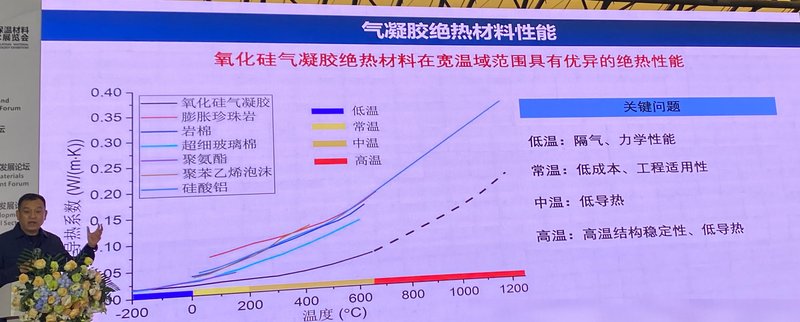
⚫ Black Dotted Line (Bottom): Silica Aerogel Blanket 🔵 Blue Line: Aluminum Silicate
🟣 Dark Blue Line: Rock Wool 🩵 Light Blue Line: Ultra-fine Glass Wool
🔴 Red Line: Expanded Perlite 🟪 Purple Line: Polyurethane (PU)
🟡 Yellow Line: Polystyrene Foam (EPS/XPS)
1. The "Comfort Zone" (<250°C & Ample Space): Stick to Traditional Materials
The Rule: If your equipment or piping operates below 200°C and your facility has plenty of space with no strict thickness restrictions.
Do not waste your budget on Aerogel! In this temperature range, traditional fibrous materials offer an overwhelming cost-to-performance advantage. Based on our latest CNAS laboratory test reports:
- Our premium Glass Wool Board delivers a K-value of ≤0.034 W/(m·K) at 25°C.
- Our heavy-duty Rock Wool Pipe Shells (with density ≥120kg/m³) deliver a K-value of ≤0.043 W/(m·K) at 70°C.
Procurement Advice: For standard HVAC systems, low-pressure steam pipes, or standard building envelopes, our traditional mineral wools will perform excellently while saving you significant initial capital expenditure.
2. The "Extreme Zone" (>250°C): The Aerogel Watershed
When we look at the right side of Professor Shen’s chart (the high-temperature zone), the harsh physical reality kicks in.
Once the operating temperature crosses the 250°C watershed, thermal radiation and air convection inside traditional fibrous materials increase drastically. Their thermal conductivity skyrockets exponentially. For example, our extreme-limit tests show that traditional Aluminum Silicate spikes to a K-value of 0.134 W/(m·K) at 500°C. Furthermore, organic binders burn off, causing the material to sag and collapse, leading to massive heat loss.
Now, look at the "dotted black line" representing Silica Aerogel. Thanks to its nano-porous structure (with pores smaller than the mean free path of air molecules), it completely traps thermal radiation.
Our test reports prove it: Even at a continuous 300°C, Hebei Woqin's Aerogel Blanket maintains an incredibly stable thermal conductivity of 0.039 W/(m·K). This is the exact reason why refineries and petrochemical plants invest in aerogel—it permanently locks in high-value thermal energy without structural degradation.
3. The "Constraint Zone": When Space and Corrosion are Dealbreakers
Beyond extreme heat, if your project faces either of the following constraints, Aerogel becomes the undeniable solution:
The Space Assassin (Dense Pipe Racks & Vessels):
In crowded petrochemical pipe racks, underground networks, or marine vessels, space is money. Aerogel achieves the same thermal resistance at 1/2 to 1/3 the thickness of traditional rock wool.
(Note: If you require absolute minimum thickness for ambient or cold-chain applications under 100°C, we also manufacture Vacuum Insulation Panels (VIP) with a staggering K-value of 0.002 W/(m·K). Contact us to learn more about VIP solutions).
The CUI (Corrosion Under Insulation) Terminator:
In humid or offshore environments, traditional mineral wool absorbs water when the cladding is damaged, turning into a "wet sponge" that severely corrodes the steel pipe.
Our Aerogel Blankets feature a 99.7% hydrophobic rate. They actively repel liquid water while remaining vapor-permeable, allowing moisture to escape. This keeps your pipes bone-dry and fundamentally eliminates the risk of CUI.
4. The ROI Reality: Calculating the Total Cost of Ownership (TCO)
Looking purely at the price per square meter, Aerogel is expensive. But top-tier engineers calculate the Total Cost of Ownership (TCO):
- Massive Savings on Metal Cladding: By cutting the insulation thickness in half, the surface area of the expensive stainless steel or aluminum cladding is reduced by 30% to 50%, saving heavily on both materials and sheet-metal labor.
- Global Logistics Advantage: Thinner material means shipping significantly more "insulation power" per container, drastically cutting ocean freight costs for international EPC projects.
- Reusable & Zero Waste: Traditional rock wool crumbles to dust during pipe inspections. Hebei Woqin’s Aerogel Blankets can be removed like a jacket and reinstalled flawlessly, ensuring zero material waste during maintenance.
Conclusion: "Mixed Insulation" is the Smartest Strategy
Professor Shen’s curve teaches us one thing: Industrial insulation is not one-size-fits-all. As a factory producing the full spectrum of insulation materials, Hebei Woqin’s ultimate advice is: Use Rock Wool/Glass Wool for spacious, lower-temp environments; switch to Aerogel the moment you cross 250°C, face severe space limits, or battle CUI.
Not sure how to specify your upcoming project?
Stop guessing. Send us your operational parameters (Operating Temperature, Pipe Diameter, Environmental Conditions, and Budget). Our engineering team at insulatewool.com will provide you with a customized solution.
[ Submit Your Parameters for a Free "Mixed Insulation Plan" & TCO Diagnosis ]

Written by - Ruibin An
Industry Veteran with 13+ Years of Experience. Deeply rooted in the insulation industry for over 13 years, specializing in supply chain optimization and global market trends for Rock Wool and Aerogel materials.
LATEST NEWS
Stop the $18M Steam Pipe Burst: Dual-Defense Insulation That Survives C5-M
2026-06-04
Desert Node Armor: Crush-Resistant Pipe Shells for Cross-Country Pipelines
2026-06-03
Desert Sandstorms: The Hidden Killer of Amine Line Stability in Gas Processing
2026-06-02
The Desert’s Billion-Dollar Blockage: How Smart Insulation Ends Wax Deposition Nightmares
2026-06-01
Securing Flare Gas Networks: A1 Non-Combustible Shells for Extreme Heat
2026-05-30