
The 2026 EPC Insulation Whitepaper: Optimizing BOQs for Hot, Cryogenic, and Mega-Projects
Mega-projects demand flawless thermal management. This engineering whitepaper analyzes how high-density rock wool (128 kg/m³), rigid PU pipe supports, and aerogel blankets optimize EPC BOQs by eliminating vibration slump, pipe shoe cold bridges, and triple-layer (TL) installations in extreme hot and cryogenic LNG services, cutting installed costs by 30%.
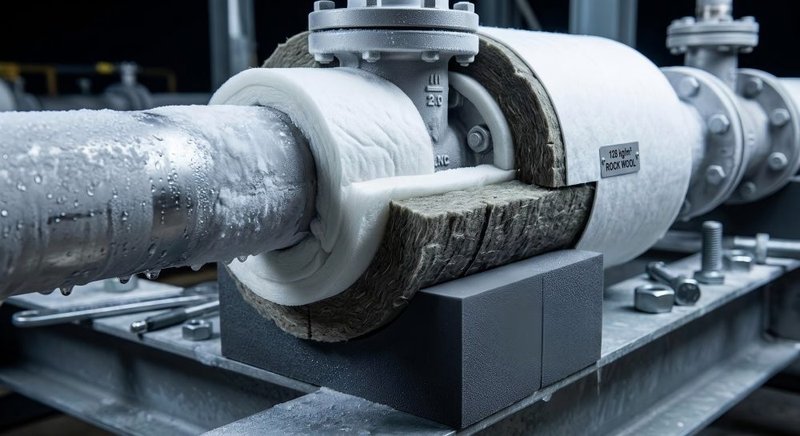
Managing the Bill of Quantities (BOQ) for multi-billion-dollar EPC mega-projects—such as large-scale LNG receiving terminals and expansions—is a monumental financial and logistical challenge. From superheated steam lines operating at 600°C to cryogenic networks plunging to -162°C, the sheer volume of insulation materials and the exponentially rising on-site labor costs ruthlessly erode contractor margins.
At Hebei Woqin, we understand that advanced procurement is not merely about price comparison; it is about architecting a system that slashes field installation man-hours while ensuring decades of operational stability. This whitepaper deconstructs the three core phases of industrial thermal management and demonstrates how our data-driven manufacturing delivers ultimate BOQ optimization.
Chapter 1: The Hot Service Baseline — Why 128 kg/m³ is the Golden Standard
In high-temperature industrial piping networks, the primary culprit behind insulation failure is not the baseline thermal conductivity, but rather "Insulation Slump" induced by continuous mechanical vibration.
To reduce initial material costs, EPC contractors often specify low-density mineral wool (typically below 100 kg/m³) in their BOQs. However, under the constant dynamic loads from compressors, pumps, and fluid transport, the organic binders in low-density materials rapidly degrade at high temperatures. This causes the fibrous structure to fracture and settle at the bottom of the metal cladding due to gravity, leaving the top of the pipe virtually exposed. This fatal slump triggers massive heat loss and a severe chimney effect.
The Engineering Solution:
BOQ optimization must be built upon structural integrity. Hebei Woqin manufactures High-Density Rock Wool Pipe Sections strictly at 128 kg/m³ and above—vs. the industry typical 80-100 kg/m³ which inevitably settles under vibration. This 128 kg/m³ golden density provides a highly rigid, non-combustible (Class A1) inorganic matrix that physically defies gravity and vibration. It guarantees zero settling, offering a rock-solid 10-year performance guarantee to ensure the thermal resistance on day 3,650 is identical to day 1.
Chapter 2: The Cryogenic Achilles' Heel — Eradicating Pipe Support Cold Bridges
In LNG networks operating at -162°C, the success of the entire thermal envelope hinges on its mechanically weakest links: the pipe supports (pipe shoes).
A fully loaded cryogenic pipeline exerts tons of downward pressure. If standard or low-compressive-strength cold insulation is used at these nodes, it is instantly crushed upon contact. This structural collapse not only causes pipe displacement but instantly ruptures the vapor barrier, forging a direct thermal bridge to the -162°C core. Atmospheric water vapor aggressively drives inward, condensing and freezing into massive, destructive "ice balls" that threaten the structural safety of the pipe racks.
The Engineering Solution:
To permanently lock down energy leaks in cryogenic networks, we engineer High-Density Rigid Polyurethane (PU) Pipe Supports. Purpose-built for extreme cold and heavy-load conditions, these supports boast an industry-leading 8.1 MPa compressive strength.
This indestructible physical rigidity ensures near-zero deformation under full LNG load. Simultaneously, its highly closed-cell microstructure maintains a stable thermal conductivity of ≤0.08 W/(m·K). It builds an impassable thermodynamic wall between the pipe and the steel structure, permanently eliminating the root cause of cryogenic icing.
Chapter 3: Ending the "TL" Chaos — Rewriting BOQ Economics with Aerogel
Review any insulation specification for a mega petrochemical or LNG project, and you will find a rigid mandate: when required insulation thickness exceeds 150mm, contractors must use Double Layer (DL) or Triple Layer (TL) staggered joint installations to prevent direct heat leakage.
In reality, a Triple Layer installation is a major cost driver, often doubling or tripling the total installed cost. TL construction means endless scaffolding rentals and forces workers to perform three times the cutting, fitting, and joint sealing. Crucially, as insulation layers stack up, the outer diameter of the pipe expands exponentially, causing aluminum cladding procurement budgets to skyrocket.
The Engineering Solution:
This is exactly where Hebei Woqin’s Aerogel Blankets fundamentally disrupt EPC economics. With an ambient thermal conductivity of just 0.020 W/(m·K), a mere 10mm to 20mm single layer of aerogel thermodynamically outperforms 100mm+ of traditional multi-layered bulk materials. By collapsing complex TL or DL specifications into a minimalist Single Layer (SL) wrap, EPC contractors can slash field installation man-hours by over 50% and vastly reduce the volume footprint in crowded pipe racks.
Conclusion: Your Total Insulation Systems Partner
Evaluating a mega-project BOQ requires looking far beyond the unit price of basic materials. True "lifecycle optimization" is achieved by integrating the enduring reliability of 128 kg/m³ heavy-duty rock wool, the cryogenic defense of 8.1 MPa rigid PU supports, and the labor-slashing efficiency of aerogel.
Stop letting complex field installations and premature material failures drain your project budget.
Submit your BOQ to the Hebei Woqin engineering team for a free 'BOQ Compression Analysis'—we’ll show you exactly where to cut 30% of your installed cost.

Written by - Ruibin An
Industry Veteran with 13+ Years of Experience. Deeply rooted in the insulation industry for over 13 years, specializing in supply chain optimization and global market trends for Rock Wool and Aerogel materials.
LATEST NEWS
Stop the $18M Steam Pipe Burst: Dual-Defense Insulation That Survives C5-M
2026-06-04
Desert Node Armor: Crush-Resistant Pipe Shells for Cross-Country Pipelines
2026-06-03
Desert Sandstorms: The Hidden Killer of Amine Line Stability in Gas Processing
2026-06-02
The Desert’s Billion-Dollar Blockage: How Smart Insulation Ends Wax Deposition Nightmares
2026-06-01
Securing Flare Gas Networks: A1 Non-Combustible Shells for Extreme Heat
2026-05-30