
Cryogenic Pipe Shoes in LNG Terminals: Replacing Wood with 8 MPa High-Density PUR
In mega-LNG terminals, cryogenic pipe shoes face immense point loads and -196°C (-320°F) temperatures. Traditional High-Density Wood (HDW) absorbs moisture, leading to freeze-thaw shattering and recurring replacement costs every 5-8 years. Discover how Hebei Woqin’s 8.115 MPa High-Density Structural PUR blocks engineer out these catastrophic risks, providing isotropic strength, extreme thermal resistance, and a 30-year design life.
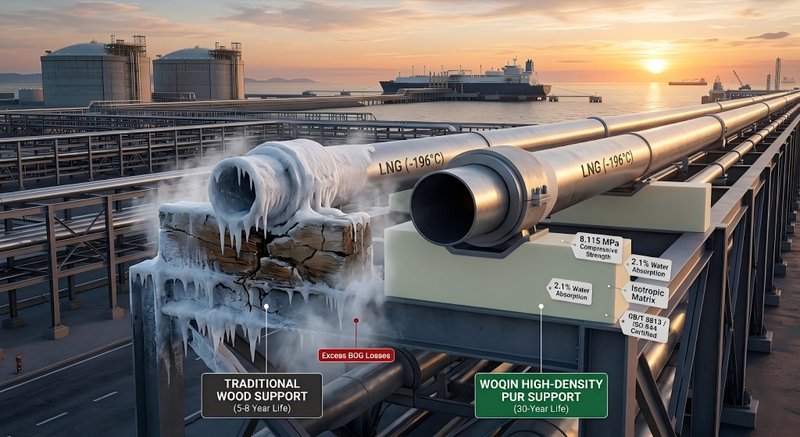
Introduction: The Hidden Bomb Under Your LNG Piping
Picture a multi-billion-dollar Liquefied Natural Gas (LNG) terminal. The engineering is flawless: miles of premium 304L stainless steel piping, state-of-the-art cryogenic valves, and thick layers of advanced insulation. Yet, at the most critical stress points—where thousands of tons of dynamic weight transfer to the steel pipe racks—engineers have historically relied on a fundamental compromise: High-Density Wood (HDW).
For decades, HDW was the only accessible material offering a somewhat acceptable balance between load-bearing capacity and thermal resistance. But as LNG mega-modules grow heavier and Life Cycle Cost (LCC) scrutiny intensifies, the physical limits of organic timber have been shattered. Subjecting natural wood to -196°C (-320°F) cryogenic liquids and harsh coastal environments creates a ticking time bomb of structural failure, massive Boil-Off Gas (BOG) losses, and crippling turnaround maintenance costs.
It is time for a paradigm shift. Unlike generic PUR foams used in commercial building insulation, Hebei Woqin’s High-Density Structural Grade PUR is heavily cross-linked and engineered specifically for multi-ton cryogenic point loads. Here is exactly why relying on wood is a liability, and why our 8 MPa PUR is the future of cryogenic pipe supports.
1. The Freeze-Thaw Paradox vs. Closed-Cell Waterproofing
The Flaw of HDW: Internal Ice Expansion
Wood, regardless of how densely it is compressed or chemically treated, remains a porous, organic material. In the coastal environments where LNG terminals are typically located, HDW inevitably absorbs ambient moisture (often exceeding 15% water content).
When the pipeline drops to cryogenic temperatures (-196°C), the moisture trapped inside the wood matrix instantly freezes. Because water expands by about 9% when turning into ice, this relentless Freeze-Thaw Cycle creates immense internal stress. Over time, it leads to micro-cracking and the eventual catastrophic pulverization of the wooden shoe.
The Woqin PUR Edge: 2.1% Water Absorption
Hebei Woqin engineered our High-Density PUR to completely eliminate moisture ingress. Featuring a highly cross-linked, >95% closed-cell structure, our PUR blocks boast an aggressively low water absorption rate of just 2.1% (Tested according to GB/T 8810, 24h immersion).
By stopping water at the molecular level, Woqin PUR blocks are physically immune to freeze-thaw shattering. They remain perfectly dry and structurally sound, maintaining pipeline integrity even in the most brutal offshore environments.
2. Anisotropic Roulette vs. Absolute Isotropic Strength
The Flaw of HDW: Unpredictable Density
Wood is grown, not engineered. It contains grain directions, knots, and hidden voids. In material science, this makes wood anisotropic—meaning its physical strength changes drastically depending on the direction of the load. Compressing wood parallel to the grain yields a entirely different strength than compressing it perpendicular to the grain.
When supporting a 50-ton section of LNG piping, relying on an anisotropic material is an engineering game of Russian roulette. If a hidden knot or weak grain fails under an extreme point load, the pipe shoe cracks, shifting massive weight onto adjacent supports and risking a domino effect.
The Woqin PUR Edge: 8.115 MPa Isotropic Power
You cannot afford "blind boxes" in cryogenic load-bearing. Hebei Woqin’s High-Density PUR is a strictly controlled, isotropic synthetic material. Its internal structural matrix is perfectly uniform, delivering the exact same devastating load-bearing capacity from every single angle.
Backed by rigorous testing, our PUR matrix achieves a staggering 8.115 MPa Compressive Strength (Tested according to GB/T 8813 / ISO 844 at 10% deformation). To put that into perspective, our material can bear a static load of ~828 tons per square meter.
More importantly, under sustained cryogenic loads, our PUR exhibits negligible creep (≤0.5% after 10 years, tested to ASTM D2990 standards). It acts like a block of solid steel, easily absorbing extreme point loads and ensuring the pipeline elevation remains perfectly within design tolerance.
3. Dimensional Instability & Weld Shear Stress vs. Near-Zero Deflection
The Flaw of HDW: Pipe Sagging and Containment Risks
Wood is notoriously unstable in its dimensions. Under the constant, immense weight of heavy pipeline modules, wood is prone to significant "creep" (gradual deformation over time). Furthermore, as it absorbs and releases moisture, its thickness fluctuates unpredictably.
In a linear LNG pipe rack spanning several kilometers, if even a few wooden pipe shoes compress or shrink unevenly, it results in localized Pipe Sagging. This millimeter-level misalignment generates extreme shear stress at the flanges and welded joints. In a zero-tolerance cryogenic containment system, weld shear stress is a direct precursor to catastrophic LNG leaks.
The Woqin PUR Edge: Negligible Creep and Elevation Control
Hebei Woqin’s 8 MPa High-Density PUR guarantees near-zero deflection. Because it is a heavily cross-linked synthetic matrix, it does not suffer from the wet-expansion or dry-shrinkage associated with organic timber.
More critically, under sustained cryogenic heavy loads, our PUR exhibits negligible creep (≤0.5% after 10 years, tested to ASTM D2990 standards). When you set your pipeline elevation on a Woqin PUR shoe, it stays exactly at that elevation for decades, completely eliminating mechanically induced shear stress on your welds.
4. BOG Mitigation: Thermal Degradation vs. The Ultimate Thermal Barrier
The Flaw of HDW: The Ice Bridge Effect
While dry wood offers marginal insulation, wet wood is a severe liability. Water and ice are excellent conductors of heat. Once a wooden pipe shoe absorbs moisture and freezes at -196°C, its thermal conductivity spikes exponentially. It transforms into a massive Structural Thermal Bridge, acting as a highway for ambient heat to rush directly into the pipeline.
This heat ingress causes the liquid natural gas to prematurely vaporize, creating Boil-Off Gas (BOG). Managing excess BOG requires the plant to burn it off (flaring) or spend massive amounts of energy re-liquefying it—a massive financial drain known as the "liquefaction penalty."
The Woqin PUR Edge: 0.08 W/(m·K) Constant Resistance
Hebei Woqin’s PUR blocks deliver a constant, ultra-low thermal conductivity of 0.08 W/(m·K). Because our closed-cell matrix rejects water (2.1% absorption), this thermal resistance does not degrade over time or under extreme weather conditions. By placing our structural PUR blocks between the cryogenic pipe and the external steel rack, you create an impenetrable thermodynamic firewall, locking the cold energy inside the pipe and saving EPCs millions in BOG-related energy losses over the plant's lifecycle.
The Ultimate Comparison: HDW vs. 8 MPa High-Density Structural PUR
When engineering for Asset Integrity and Life Cycle Cost (LCC), the data speaks for itself. Here is why global EPCs are rewriting their specifications to replace High-Density Wood with Hebei Woqin's High-Density PUR:
| Performance Metric | Traditional High-Density Wood (HDW) | Woqin High-Density Structural PUR | Engineering Standard & LCC Impact |
| Compressive Strength & Creep | Highly variable; prone to sagging under sustained loads | 8.115 MPa (~828 tons/m²) | GB/T 8813 / ASTM D2990 |
| Water Absorption | High (Often >15%); swells & cracks internally | Extremely Low (Tested 2.1%) | Ensures perfect pipe elevation alignment, eliminating weld shear stress. |
| Thermal Conductivity | ~0.15 W/(m·K) (Worsens exponentially when wet/frozen) | 0.08 W/(m·K) (Highly stable) | Severs structural cold bridges, drastically reducing Boil-Off Gas (BOG) vaporization losses. |
| Material Matrix | Organic, porous, anisotropic | Inorganic closed-cell, isotropic | Engineered specifically for cryogenic point loads; delivers uniform strength from every angle. |
| Screw Holding Power | Good (but pilot holes allow moisture ingress) | Surface 620N / Edge 610N | Enables robust mechanical fastening without compromising the overall vapor barrier seal. |
| Lifespan & Replacement | 5 to 8 Years (Highly susceptible to marine rot and fungi) | 30 Years (Matches pipe design life) | Eliminates massive Turnaround (T/A) scaffolding and crane costs. "Install and forget." |
5. Coastal Biological Decay vs. 100% Immunity (Zero Rot)
The Flaw of HDW: The Reality of Marine Rot
Mega LNG terminals are almost exclusively coastal or offshore facilities. This exposes the pipe racks to a relentless barrage of high-salinity salt spray, marine fungi, and extreme humidity. Even when High-Density Wood is chemically treated (preservative-impregnated), its organic nature means it will eventually biologically degrade.
When wooden pipe shoes rot and turn soft, the pipeline loses its structural support. To fix this, plant operators are forced into highly expensive Turnaround Maintenance (T/A)—requiring scaffolding, heavy lifting cranes, and severe downtime just to replace rotting blocks of wood every 5 to 8 years.
The Woqin PUR Edge: "Install and Forget" Lifespan
Hebei Woqin’s High-Density Structural PUR is a highly cross-linked synthetic polymer. It is 100% inorganic and biologically inert. Our PUR blocks are completely immune to marine fungi, salt corrosion, and biological decay. They do not rot, rust, or degrade. By upgrading to PUR, EPCs achieve an "Install and Forget" solution, ensuring the pipe supports easily outlast the standard 30-year design life of the LNG terminal itself, effectively wiping out future replacement LCC.
6. Vapor Barrier Damage vs. 620N Engineering Fastening Power
The Flaw of HDW: Compromising the Seal
In cryogenic insulation systems, maintaining the integrity of the Vapor Retarder (Vapor Barrier) is paramount. If punctured, ambient moisture is sucked into the cold insulation system, leading to rapid ice formation. When subcontractors install wooden pipe shoes, they often use metal bands or drill mechanical fasteners that can easily crush, pierce, or compromise this vital vapor seal due to the wood's inconsistent density and swelling.
The Woqin PUR Edge: Hardwood-Level Fastening
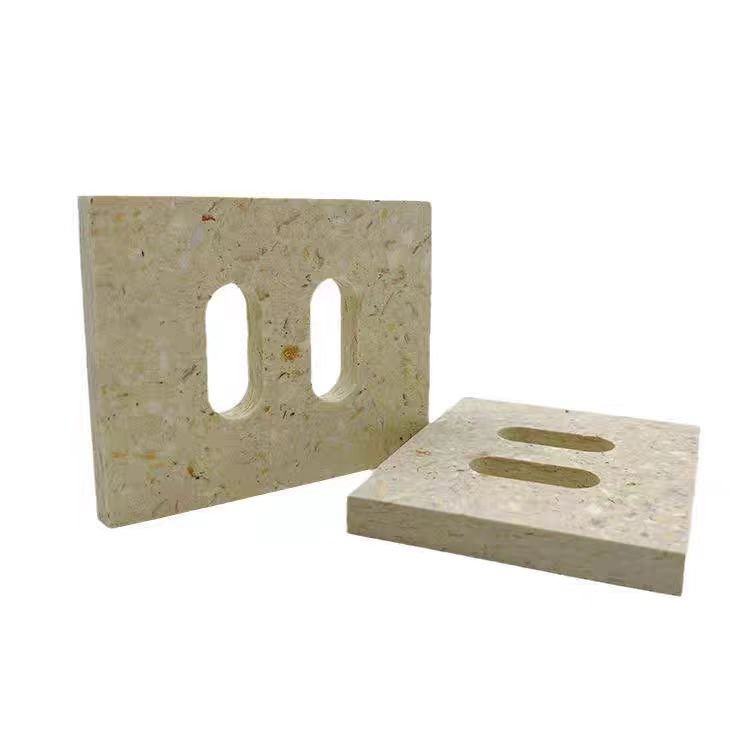
You need the workability of wood without its physical drawbacks. Hebei Woqin’s 8 MPa PUR blocks feature an extraordinary Screw Holding Power of 620 N on the surface and 610 N on the edge.
This means construction crews can drive heavy-duty mechanical fasteners, bolts, or lag screws directly into the PUR matrix just as they would with premium hardwood. The dense, rigid core grips the fasteners securely without cracking or splintering, ensuring the mechanical connection is rock-solid while perfectly maintaining the vapor-tight integrity of the surrounding insulation envelope.
Conclusion: The EPC Choice for the Next Generation
In the zero-tolerance world of cryogenic heavy engineering, continuing to rely on High-Density Wood is a compromise that modern LNG infrastructure can no longer afford.
Whether it is the catastrophic risk of freeze-thaw shattering at -196°C, the shear stress of dimensional sagging under heavy loads, or the massive energy losses caused by BOG-inducing thermal bridges, wood is a liability.
Hebei Woqin’s 8.115 MPa High-Density Structural PUR Blocks bridge the impossible gap, delivering the absolute load-bearing strength of concrete with the thermal resistance of advanced insulation. Stop funding recurring scaffolding and replacement costs every turnaround. Protect your asset integrity, eliminate structural thermal bridging, and drastically lower your Total Installed Cost (TIC).
Do not compromise your foundation. Contact Hebei Woqin's engineering team today to discuss your load-bearing requirements, request customized thermodynamic calculations, or secure a factory-direct structural PUR sample for your next mega-project.
Hebei Woqin Trade Co., Ltd.
Phone/WhatsApp: +86 13933929092
Email our Technical Desk: an@cn-aerogel.com
Explore our Factory-Direct Capabilities: www.insulatewool.com

Written by - Ruibin An
Industry Veteran with 13+ Years of Experience. Deeply rooted in the insulation industry for over 13 years, specializing in supply chain optimization and global market trends for Rock Wool and Aerogel materials.
LATEST NEWS
Desert Sandstorms: The Hidden Killer of Amine Line Stability in Gas Processing
2026-06-02
The Desert’s Billion-Dollar Blockage: How Smart Insulation Ends Wax Deposition Nightmares
2026-06-01
Securing Flare Gas Networks: A1 Non-Combustible Shells for Extreme Heat
2026-05-30
EHT Pipe Insulation: Eliminate Tenting Effect with Grooved Pre‑Formed Shells
2026-05-29
SRU Pipe Insulation: Prevent Liquid Sulfur Freeze & Viscosity Surge
2026-05-28