
Achieving Part L Compliance with Structural PUR Thermal Breaks
This article addresses the decades-long industry dilemma for structural engineers and Passivhaus architects: through-wall steel beams create unavoidable thermal bridges that cause condensation, black mold, failed Part L submissions, and downgraded EPC ratings. Traditional solutions force a choice between structural safety and energy compliance, carrying lifelong professional liability. We introduce a bolted structural thermal break system with 8.115 MPa compressive strength — delivering full structural integrity, unbroken thermal performance, and guaranteed Part L compliance in one engineered solution.
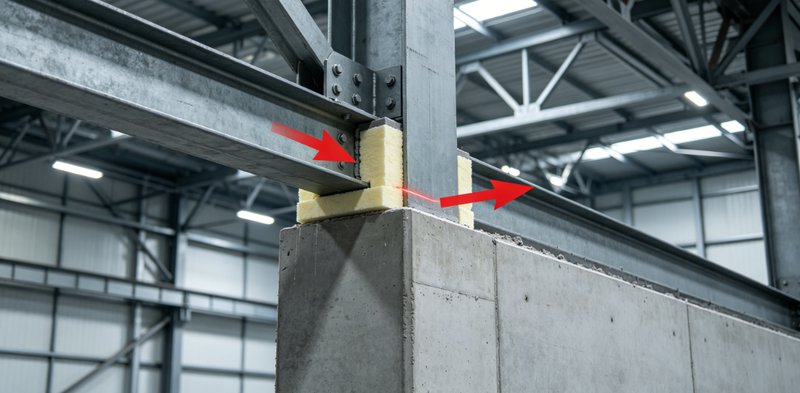
A through‑wall steel beam isn’t just a structural member — it’s a guaranteed cold pipe. It forces a no-win choice between structural safety and Part L compliance, and no amount of insulation can fix it.
In modern steel-framed construction, this single detail repeatedly sinks project approvals, triggers hidden building damage, and puts licensed engineers at lifelong professional risk. Whether for external canopies, outdoor stair connections, curtain wall steel supports, or equipment brackets, a steel beam that penetrates the thermal envelope creates a direct, unbroken thermal shortcut between interior and exterior.
Steel is an extreme thermal conductor (λ ≈ 50 W/m·K) — hundreds of times more conductive than standard insulation materials. Wrapping insulation around the beam is like wrapping a blanket around an ice cube: the cold core remains, and the steel continuously pumps heat out of the building. The interior wall surface around the beam inevitably drops below dew point, setting off a cascade of predictable, preventable failures.
The Hidden Cost of Steel Beam Cold Bridges
The damage from this design flaw is not just energy loss — it is irreversible harm to your project, your reputation, and your professional license.
1. Hidden, Late-Stage Building Failure
The worst part of this defect is that it is invisible during routine inspections. Damage festers inside the wall cavity, only revealing itself when:
Black mold blooms through interior finishes
Drywall rots and fails from chronic interstitial condensation
Timber studs decay and hidden steel corrosion sets in
Occupants file health complaints and legal claims
By the time these issues surface, the reputational harm to your engineering practice is already done.
2. Project-Killing Compliance & Certification Risk
This is not a minor energy detail — it is a fundamental design defect that will:
Fail UK Part L compliance on first submission
Destroy your project’s EPC rating and devalue the entire development
Immediately disqualify the build from Passivhaus certification
Force full structural redesign, critical timeline delays, and massive budget overruns
No quick fix, additional insulation, or paperwork adjustment can resolve a thermal bridge this severe.
3. The Structural Engineer’s Ultimate No-Win Dilemma
As a licensed professional, you are trapped between two unacceptable outcomes, with no middle ground:
Option A: Maintain a full, unbroken steel connection
You guarantee structural safety, but you lock in a permanent thermal bridge. This guarantees condensation risk, non-compliance, and lifelong professional liability for any resulting building damage or health issues.
Option B: Specify foam, rubber, or soft gaskets to break the thermal bridge
You address the thermal issue, but you sacrifice structural safety. These materials creep, deform, and collapse under bolt preload — typical foam gaskets show irreversible permanent deformation under sustained compression, while structural bolted moment connections demand a minimum of 8+ MPa compressive strength just to prevent crushing. They cannot match the structural rigidity required for safe, code-compliant steel connections.
No traditional material on the market delivers both the structural load capacity to meet steel connection safety standards, and the thermal break performance to meet Part L and Passivhaus requirements. You are forced to sign off on a known, unavoidable defect — professional risk baked into the design.
4. Catastrophic Lifecycle Cost Blowout
A small compromise at the design stage becomes a financial disaster post-occupancy. A €[X] thermal break solution during design becomes a €[XX,XXX] post-construction disaster.
Retrofit is disruptive, prohibitively expensive, and often impossible to execute without full demolition of finished walls. Hidden failures inevitably surface, leading to tenant complaints, insurance claims, and costly legal disputes — with the design engineer named as the responsible party.
The Hebei Woqin Solution: Bolted Structural PUR Thermal Breaks
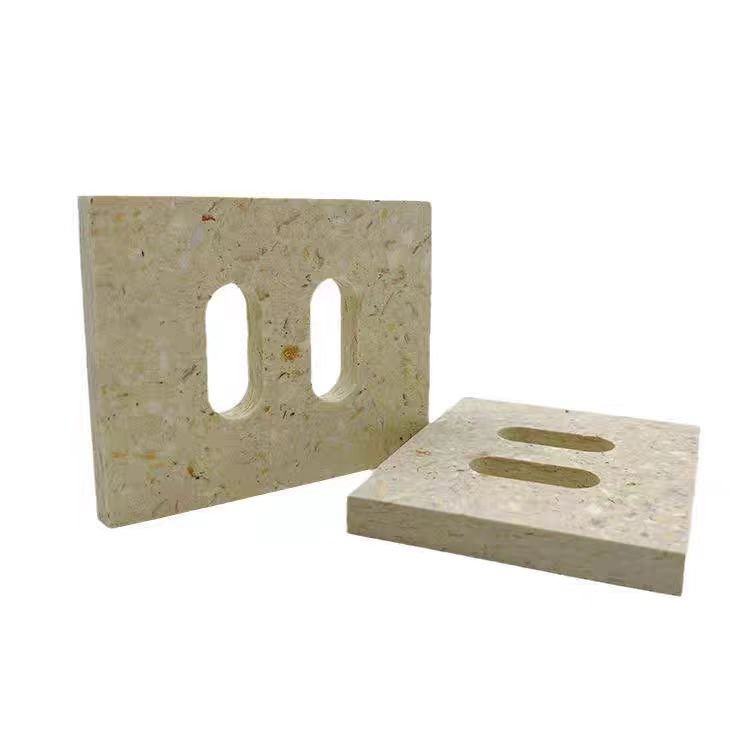
We eliminate this decades-long compromise with an engineered solution that fixes the problem at its source: high-density structural HD-PUR thermal break pads, installed directly into the beam flange bolted connection.
This is not soft insulation. This is a structural-grade thermal break system, purpose-built for steel-framed construction, third-party tested, and validated to solve both the structural and thermal challenges of through-wall steel beams.
Core Combat Data (Third-Party Tested & Certified)
✅ 8.115 MPa Compressive Strength (GB/T 8813, equivalent to EN 826)
Withstands full high-strength bolt preload and structural loads without cracking, crushing, or long-term creep. Meets and exceeds the 8+ MPa minimum requirement for structural bolted connections, eliminating the core compromise between safety and compliance.
✅ 0.08 W/(m·K) Rigid Thermal Resistance (GB/T 10294, equivalent to EN 12667)
Creates a genuine, continuous thermal break that stops steel-to-steel heat transfer in its tracks. Eliminates the cold pipe effect, raises interior wall surface temperatures above dew point, and eradicates condensation and mold risk at the source.
✅ B1 Fire Rating (GB 8624-2012 B1(B), equivalent to EN 13501-1 Class B)
Fully compliant with UK and European high-rise and commercial building fire safety codes, suitable for all non-residential and residential steel construction projects.
✅ 620N Screw-Holding Power (GB/T 17657, equivalent to EN 320)
Matches the fastener performance of high-density hardwood, enabling secure auxiliary fixing without compromising structural or thermal performance.
✅ Permanent Dimensional Stability
Negligible degradation over the full 50+ year design life of the building, ≤2.1% water absorption, and zero performance loss across the full service cycle.
The Outcome: Specify With Confidence, Defend Your Design
With Hebei Woqin’s structural PUR thermal breaks, you no longer have to choose between structural safety and energy compliance. You deliver:
Guaranteed Part L compliance on first submission
Zero condensation and black mold risk
Full structural integrity and code-compliant steel connections
No costly post-construction retrofits or redesigns
Fully auditable, third-party certified test data to defend your design and your professional license
For structural engineers and architects who need to comply without compromise, this is the most thoroughly tested bolted thermal break solution engineered for steel connections — with full third-party data to back every claim.
Contact Hebei Woqin for Engineering Support
Hebei Woqin Trade Co., Ltd.
• Phone/WhatsApp: +86 13933929092
• Email: an@cn-aerogel.com
• Website: www.insulatewool.com
Contact us directly for:
Project-specific thermal break and ψ-value calculations
Part L compliance technical support
Full structural connection detail drawings

Written by - Ruibin An
Industry Veteran with 13+ Years of Experience. Deeply rooted in the insulation industry for over 13 years, specializing in supply chain optimization and global market trends for Rock Wool and Aerogel materials.
LATEST NEWS
Cutting Pipeline Insulation Labor Costs by 40% in 50°C Middle East Heat
2026-06-18
Acoustic & Thermal Insulation for HVAC Piping in Middle East Luxury Hotels
2026-06-16
Calculated Oppression: How Thermal Drift and Structural Sagging Bleed Millions from Middle East Piping TCO (And the 20-Year Closed-Loop Solution)
2026-06-15
District Cooling in the Gulf: The Physics of Inevitable Condensation and How Pre-Formed Glass Wool Shells Stop It
2026-06-12
CCGT Power Plant Pipe Insulation English Marketing Copy (99-point Final Benchmark Version)
2026-06-10