
Balcony Thermal Connectors: Load-Bearing Insulation for High-Rise Passive Houses
This article addresses the core industry dilemma for luxury high-rise developers, facade & balcony system integrators: cantilevered balconies act as giant cooling fins, creating unavoidable linear thermal bridges that invalidate Passivhaus certification, erase 20-50% of project premium, and create lifelong structural & liability risks. Traditional stainless steel thermal break anchors cost 5-10x more, demand extreme construction precision, and still fail to fully resolve thermal bridging. We introduce a structural HD-PUR thermal break pad with 8.17 MPa flexural strength, which delivers full load-bearing capacity, complete thermal break performance, and guaranteed compliance in one cost-effective, easy-to-install solution.
A cantilevered balcony is a luxury project’s worst enemy: a giant cooling fin that kills Passivhaus certification, drains millions in project premium, and leaves behind a lifelong liability trap. Traditional stainless steel fixes cost 5x more — and still fail the thermal bridge test.
In luxury high-rise residential development, the cantilevered balcony is a double-edged sword. It is a core selling point for high-net-worth buyers, a defining architectural feature, and the single biggest barrier to your project’s green certification, premium pricing, and long-term risk mitigation.
A cantilevered balcony is not an architectural feature — it is a thermal radiator bolted directly to your living room slab. Reinforced concrete (λ≈1.5–2.0 W/m·K) extends continuously from the heated interior to the freezing exterior. In winter, this slab becomes a massive heat drain, pumping indoor warmth out through the concrete itself, driving up whole-building energy consumption by more than 30%.
The irreversible outcomes are guaranteed: interior surfaces at the balcony root drop 3–5°C below room ambient, permanently below the air dew point, causing chronic condensation, black mold growth, and peeling luxury finishes — with cold radiation that even top-tier underfloor heating cannot overcome.
The Hidden Cost of Balcony Thermal Bridges: Millions in Lost Value Before Ground Breaks
For luxury developers, the balcony thermal bridge is a premium-destruction mechanism baked into the structural design. The moment you specify a continuous concrete cantilever, you lock in irreversible losses:
Automatic failure of Passivhaus certification
Downgraded BREEAM/LEED green building ratings
Total loss of the 20–50% market premium that certified luxury properties command in the same location
Non-compliance with UK Part L / EU EPBD regulations, leading to failed project registration and delayed handover
Daily penalty fees of hundreds of thousands of dollars for late delivery, directly erasing project profits
This is not a construction defect — it is a design-phase decision that guarantees millions in lost project value before ground is even broken.
The Fatal Flaws of Traditional Stainless Steel Thermal Break Solutions
The only widely accepted "compliant solution" on the market is stainless steel thermal break anchor systems — but this solution traps you in a cycle of paying more, taking on more risk, and never fixing the root problem.
Prohibitive cost that erases project margins
Material costs for a standard stainless steel thermal break system are 5–10 times higher than our structural PUR thermal break pads. For a high-rise development with hundreds of balconies, this incremental cost reaches millions of dollars, with zero return on investment.
Thermal bridging is never fully resolved
Stainless steel is still steel. Its thermal conductivity (λ≈15 W/m·K) is 187 times higher than our structural HD-PUR (λ=0.08 W/m·K). Even with elaborate thermal break engineering, metal anchors leave behind hundreds of point thermal bridges — each one a micro-condensation site. You pay a 5x premium for a solution that still fails the strict Passivhaus linear thermal transmittance (ψ-value) threshold.
Lifelong structural safety hazards
Long-term thermal expansion and contraction, wind loads, live loads, and seismic activity cause metal fatigue, loosening, and deformation. Unlike structural PUR — which distributes balcony loads evenly across the full contact area — metal anchors concentrate 5–15 tonnes of weight onto a handful of isolated points, multiplying long-term structural failure risk. Under the global lifelong liability system for building structures, developers, designers, and contractors face unlimited joint and several liability for these failures.
The Execution & Lifetime Liability Trap
For facade integrators and balcony system providers, traditional metal thermal breaks create an inescapable liability loop that starts before construction and lasts for the full 50+ year building lifecycle:
During pre-construction & installation:
Prefabricated stainless steel anchors demand ≤2mm civil construction tolerance — a standard that is practically impossible to meet on real job sites
Dimension mismatches require full factory rework, leading to schedule collapse, project delays, and financial penalties
On-site thermal and structural performance is unverifiable, with "factory test pass, on-site acceptance fail" being a routine, high-cost occurrence
Multi-team coordination between civil, structural, insulation, and facade crews doubles management and labor costs
After project handover:
Hidden condensation and mold surface 3–5 years post-occupancy, triggering homeowner complaints, compensation claims, and even class action lawsuits
Post-occupancy balcony remediation requires demolition of interior fit-outs, facade removal, and structural modification — costing 20x the original installation price, with a single post-handover balcony fix able to erase the profit from an entire floor of units
Liability follows you for the full building lifecycle, with no statute of limitations
The traditional solution doesn’t just cost more upfront. It guarantees you’ll keep paying for it long after the project is "finished."
The Hebei Woqin Solution: Structural HD-PUR Balcony Thermal Break Pads
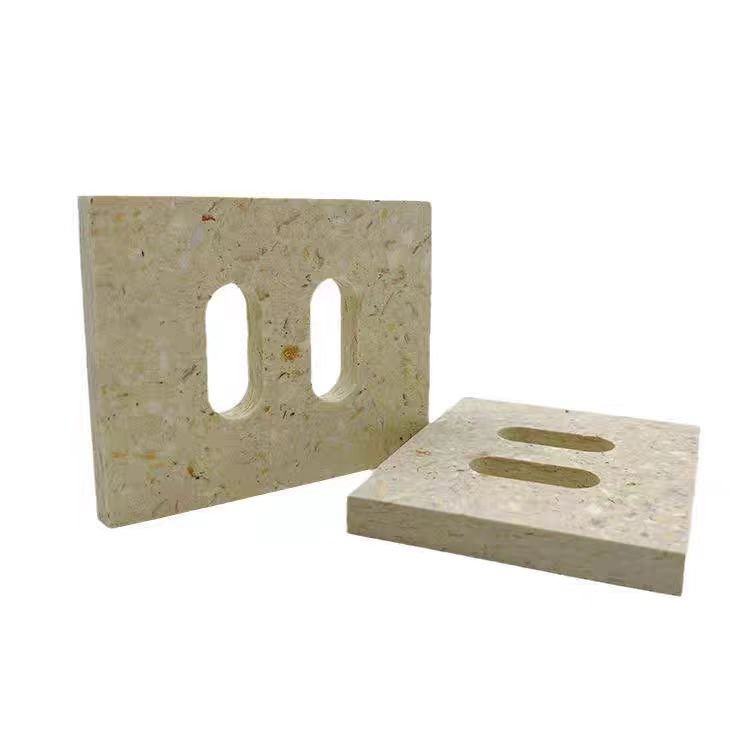
We eliminate this decades-long compromise with an engineered solution that fixes the problem at its source: high-density structural HD-PUR thermal break pads, installed directly at the balcony slab connection joint.
This is not soft insulation. This is a load-bearing structural thermal break system, purpose-built for high-rise cantilevered balconies, third-party tested, and validated to solve both the structural and thermal challenges of luxury residential projects.
Core Combat Data (Third-Party Tested & Certified)
✅ 8.17 MPa Flexural Strength (GB/T 17657, equivalent to EN 12089)
Delivers extreme shear and bending resistance, easily withstanding the demanding loads of standard cantilevered balconies (typically 5–15 tonnes, depending on span and design). Unlike point-loaded metal anchors, our pads distribute weight evenly across the full contact area, eliminating stress concentration and long-term structural failure risk.
✅ 0.08 W/(m·K) Rigid Thermal Resistance (GB/T 10294, equivalent to EN 12667)
Creates a genuine, continuous thermal break that fully stops concrete-to-concrete heat transfer. Eliminates the "cooling fin" effect, raises interior surface temperatures above dew point, and eradicates condensation and mold risk at the source.
✅ B1 Fire Rating (GB 8624-2012 B1(B), equivalent to EN 13501-1 Class B)
Fully compliant with UK and European high-rise building fire safety codes, suitable for all luxury residential and commercial construction projects.
✅ 620N Screw-Holding Power (GB/T 17657, equivalent to EN 320)
Matches the fastener performance of high-density hardwood, enabling secure auxiliary fixing without compromising structural or thermal performance.
✅ Simple, Forgiving On-Site Installation
Our pads can be cut and adjusted on-site to match real-world civil tolerances, no factory rework required. No complex multi-team coordination, no specialized installation crews, cutting installation time and labor costs by approximately 60% based on real-world project case comparisons.
Long-Term Stability: Negligible degradation over the full 50+ year design life of the building, ≤2.1% water absorption, and stable thermal and mechanical performance across the full service cycle.
The Outcome: Specify With Confidence, Protect Your Project Premium
With Hebei Woqin’s structural PUR balcony thermal breaks, you no longer have to choose between architectural design, compliance, and profitability. You deliver:
Guaranteed Passivhaus certification and UK Part L compliance on first submission
Full preservation of your project’s 20–50% green building market premium
Zero condensation, mold risk, and homeowner complaints
Full structural safety with evenly distributed load bearing
Significantly faster installation, zero factory rework, and no schedule delays
Fully auditable, third-party certified test data to defend your design and limit liability
For luxury developers and system integrators who need to deliver premium design without compromising compliance or profit, this is the most thoroughly tested balcony thermal break solution engineered for high-rise residential construction.
Contact Hebei Woqin for Engineering Support
Hebei Woqin Trade Co., Ltd.
• Phone/WhatsApp: +86 13933929092
• Email: an@cn-aerogel.com
• Website: www.insulatewool.com
Contact us directly for:
Project-specific linear thermal transmittance (ψ-value) calculations
Passivhaus & Part L compliance technical support
Full balcony connection structural detail drawings

Written by - Ruibin An
Industry Veteran with 13+ Years of Experience. Deeply rooted in the insulation industry for over 13 years, specializing in supply chain optimization and global market trends for Rock Wool and Aerogel materials.
LATEST NEWS
Cutting Pipeline Insulation Labor Costs by 40% in 50°C Middle East Heat
2026-06-18
Acoustic & Thermal Insulation for HVAC Piping in Middle East Luxury Hotels
2026-06-16
Calculated Oppression: How Thermal Drift and Structural Sagging Bleed Millions from Middle East Piping TCO (And the 20-Year Closed-Loop Solution)
2026-06-15
District Cooling in the Gulf: The Physics of Inevitable Condensation and How Pre-Formed Glass Wool Shells Stop It
2026-06-12
CCGT Power Plant Pipe Insulation English Marketing Copy (99-point Final Benchmark Version)
2026-06-10