
The Ultimate Cool Roof Solution: Why Aerogel Coating is Transforming Southeast Asia's Buildings
Southeast Asia’s relentless tropical heat and high humidity pose severe challenges for building insulation. Traditional materials like bulky fiberglass and rigid PIR boards often fail due to severe space constraints, moisture entrapment, and the dreaded "metal roof oven effect." This article explores how ultra-thin, breathable, and Class A1 fireproof Silica Aerogel Thermal Insulation Coating is revolutionizing energy efficiency for industrial metal roofs, wooden resorts, and urban high-density housing across the region.
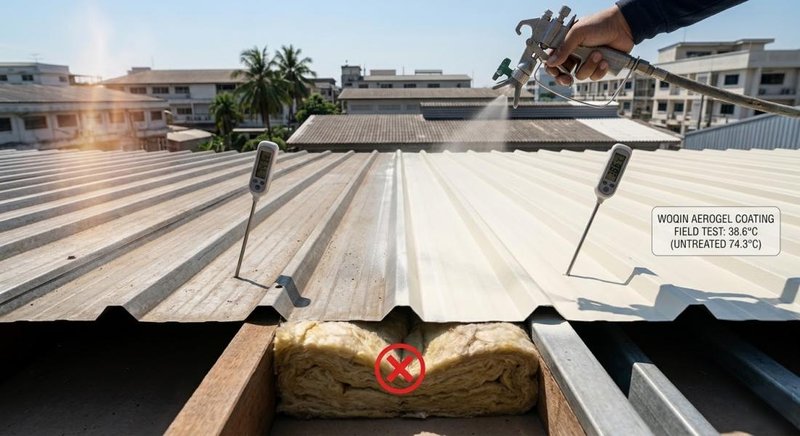
1. Introduction: The Tropical Insulation Challenge
Countries across Southeast Asia—such as Thailand, Indonesia, the Philippines, and Vietnam—share a common architectural enemy: a relentless combination of scorching equatorial sun and extreme humidity. As global temperatures rise, the operational costs of HVAC systems are skyrocketing.
While the need for thermal insulation is obvious, traditional materials like thick fiberglass wool or rigid polyurethane (PIR) panels are facing severe "acclimatization" issues in SEA's unique building structures, specifically in lightweight metal roofing and traditional wooden houses.
To combat this, leading EPCs and developers are turning to a next-generation material science solution: Woqin Aerogel Thermal Insulation Coating.
2. The "Big Three" Insulation Failures in Southeast Asia
Before introducing the solution, we must look at why traditional insulation is failing in the tropical built environment.
Pain Point 1: The Metal Roof "Oven Effect"
A vast majority of industrial plants, warehouses, and even residential homes in SEA utilize corrugated metal roofs. Under the direct equatorial sun, the surface temperature of these metal sheets can easily exceed 70°C (158°F). Without proper thermal breaks, the heat radiates directly into the building, turning the interior into a literal oven and sending air conditioning bills through the roof.
Pain Point 2: The "Shallow Rafter" Paradox & Compressed Optimism
Many local buildings and traditional roofs suffer from severe space constraints. A common, yet fatal, mistake made by contractors is trying to force 150mm of fiberglass wool into a 50mm shallow rafter space. As structural engineers often say: "You cannot compress thermal performance into existence." Insulation works by trapping air. When you squash bulky fiberglass, you destroy the air voids, rendering the insulation useless. Furthermore, cutting rigid PIR boards to fit between timber joints almost always leaves gaps, leading to massive thermal bridging.
Pain Point 3: The Moisture Trap in Wooden Resorts
Southeast Asia is famous for its breathtaking wooden resorts and villas. However, traditional porous insulation materials, such as fiberglass and mineral wool, absorb the high ambient humidity like a sponge. When the air-conditioned cool indoor air meets the hot, humid outdoor air within the wall cavity, it creates interstitial condensation. This trapped moisture cannot escape, leading to the rapid rotting of expensive centuries-old timber structures and the growth of toxic black mold.
3. The Aerogel Coating Advantage: A Data-Driven "Cool Roof" Armor
Woqin Aerogel Coating is not about adding bulky layers to a building; it is about manipulating thermodynamics at the nano-level. Backed by rigorous CNAS/CMA certified testing, here is why it outperforms traditional methods:
- Zero Space Compromise (Thermal Conductivity: 0.032 W/(m·K)): You no longer need to "squash" thick wool into tight spaces. By applying just a 2mm to 6mm layer of Aerogel Coating (via airless sprayer or trowel), you create a continuous, gap-free thermal barrier. It drastically lowers the surface temperature without stealing an inch of valuable architectural space.
- Breathable & Hydrophobic (96-Hour Water Resistance): Unlike standard acrylic paints, Aerogel Coating is highly hydrophobic yet vapor-permeable. In our standardized tests, the coating showed no abnormality after 96 hours of continuous water immersion. It acts as a one-way valve: it prevents external liquid water (rain) from entering, but allows internal water vapor to "breathe" out. This completely eliminates the condensation and timber-rotting risks.
- Ultimate Safety: Class A1 Fireproof & 1.1 MPa Adhesion: Fire safety is paramount for wooden structures and dense urban housing. Our coating achieves a Class A1 (Non-combustible) fire rating, demonstrating 0 seconds of sustained burning and a mere 4°C temperature rise in furnace testing. Combined with a massive 1.1 MPa bond strength, it adheres fiercely to both metal and concrete, withstanding the region's fierce monsoon winds and torrential rains.
4. Top 3 Application Scenarios in SEA
- Industrial Cool Roofs (Metal & Concrete): Spraying Aerogel Coating directly onto factory roofs reflects solar radiation and blocks thermal transfer, dropping the interior surface temperature by up to 15°C+ (validated by field tests in Bangkok industrial estates) and slashing cooling loads.
- Luxury Wooden Resorts & Heritage Buildings: Providing an invisible, ultra-thin shield of thermal and fire protection that preserves the rustic aesthetic of the timber without the risk of moisture decay.
- Urban High-Density Housing: Troweling the coating onto exterior concrete walls to protect top-floor residents from the unbearable "steamer effect" of the tropical summer.
5. Conclusion
Physics is indifferent to good intentions. You cannot solve Southeast Asia's modern cooling challenges using bulky, moisture-absorbing 20th-century materials. By upgrading to Woqin Aerogel Thermal Insulation Coating, you are investing in a seamless, breathable, and fireproof thermal envelope.
Ready to beat the tropical heat?
Hebei Woqin is actively seeking strategic partnerships with EPC contractors, developers, and building material distributors across Southeast Asia.
[Contact Us Today] to request your 1kg Free Pilot Sample and our full CNAS/CMA Technical Data Sheet (TDS). Let's engineer a cooler, safer future together.

Written by - Ruibin An
Industry Veteran with 13+ Years of Experience. Deeply rooted in the insulation industry for over 13 years, specializing in supply chain optimization and global market trends for Rock Wool and Aerogel materials.
LATEST NEWS
Acoustic & Thermal Insulation for HVAC Piping in Middle East Luxury Hotels
2026-06-16
Calculated Oppression: How Thermal Drift and Structural Sagging Bleed Millions from Middle East Piping TCO (And the 20-Year Closed-Loop Solution)
2026-06-15
District Cooling in the Gulf: The Physics of Inevitable Condensation and How Pre-Formed Glass Wool Shells Stop It
2026-06-12
CCGT Power Plant Pipe Insulation English Marketing Copy (99-point Final Benchmark Version)
2026-06-10
Locking in 600°C: Composite Shells for CSP Molten Salt Pipelines in the GCC
2026-06-10