
Acoustic & Thermal Insulation for HVAC Piping in Middle East Luxury Hotels
GCC luxury hospitality and high-end commercial projects require strict ≤30dB(A) nighttime indoor noise standards, while conventional chilled water piping generates 52–58dB(A) operational noise. Traditional insulation suffers low-frequency acoustic failure and 40% performance degradation in high-humidity environments. Woqin pre-formed glass wool shells deliver stable dual acoustic and thermal performance for long-term premium building operation.
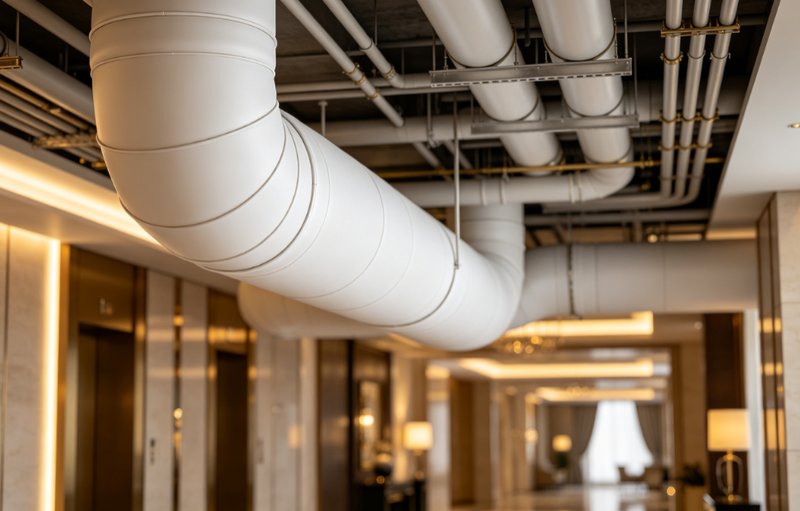
The Invisible Design Failure That Degrades 5-Star Guest Experience
Ultra-premium hotels and high-end commercial complexes across the GCC pursue top-tier architectural aesthetics and guest experience, yet an invisible engineering flaw often undermines overall asset quality: the low, persistent hum of HVAC chilled water piping transmitted through walls and floor slabs into guest rooms and retail areas.
This is not a minor comfort issue, but a key factor affecting premium asset value and operational reputation. Ultra-luxury project specifications typically mandate ≤30 dB(A) nighttime background noise in guest rooms and ≤35 dB(A) in high-end retail zones to maintain exclusive, quiet spatial experience and support premium pricing systems. Under standard operating conditions (1m test distance, 2.5 m/s flow velocity, standard carbon steel pipe), DN200 chilled water pipes radiate 52–58 dB(A) of combined fluid-borne and structure-borne noise, forming a 22–28 dB performance gap that conventional thermal insulation cannot resolve.
The harsh GCC climatic and architectural conditions further amplify HVAC acoustic defects compared with temperate regions:
30% longer annual runtime: With 8–10 months of continuous peak cooling load, local HVAC systems operate 24/7 without off-season downtime, accelerating material aging and performance attenuation.
Extreme high humidity: Coastal ambient humidity up to 90% easily penetrates ordinary porous insulation, damaging internal fiber structures and weakening acoustic performance over time.
Compact architectural design: Premium developments prioritize usable and leasable space, arranging mechanical rooms and pipe risers close to occupied areas with limited acoustic buffer zones, making pipe noise more perceptible.
For real estate developers and property operators, every decibel of excess pipe noise gradually erodes guest satisfaction, rental premiums and long-term asset valuation.
Why Conventional Insulation Fails the Acoustic Test: Four Structural Flaws
Most conventional HVAC insulation for GCC projects is designed merely for thermal insulation, with acoustic performance treated as a secondary consideration or completely ignored. This inherent design defect leads to four irreversible failure modes, triggering continuous noise complaints within 2–3 years of project operation.
1. Low-Frequency Penetration: The Resonant Hum Affecting Guest Experience
The most disruptive HVAC noise for premium venues concentrates in the 125–500 Hz low-to-mid frequency band. This deep resonant hum is difficult for users to locate precisely but easily causes sleep disturbance and psychological discomfort, becoming the core cause of negative guest feedback.
Traditional hand-wrapped soft insulation only absorbs partial high-frequency airflow noise. Its loose and uneven fiber structure with unstable packing density provides negligible attenuation for long-wavelength low-frequency noise. After 2–3 years of thermal cycling and gravity settlement, the insulation sags and compresses at the pipe bottom, losing over 40% of its original acoustic performance. Under long-term GCC high-load operation, conventional acoustic insulation basically fails to suppress key noise bands in the later service stage.
2. Insufficient Vibration Damping: Unblocked Structure-Borne Noise Transmission
Pipe noise includes airborne noise and structure-borne vibration noise, and conventional soft insulation only targets airborne noise with limited effect, providing no effective solutions for structure-borne noise.
Chiller pump operation, valve balancing and water hammer effects generate continuous high-frequency vibration, which transmits to indoor occupied spaces through pipe walls, metal hangers and building slabs. Soft compressible insulation cannot form effective damping buffer structures to cut off vibration transmission paths. On the contrary, loose hand-wrapped insulation easily forms secondary resonance between pipes and outer cladding, amplifying vibration noise and worsening indoor acoustic environment. This hidden problem is difficult to troubleshoot and eradicate in daily operation.
3. Vapor Barrier Paradox: Moisture Protection Conflicts With Acoustic Performance
For chilled water piping in GCC high-humidity environments, vapor barriers are essential to prevent condensation and pipeline corrosion. However, traditional insulation systems face an unavoidable structural contradiction between moisture resistance and acoustic performance.
When sound waves propagate to the dense waterproof and moisture-proof facing of traditional insulation, abrupt acoustic impedance mismatch occurs, causing over 90% of sound energy to reflect back to the pipe wall instead of being absorbed by fiber materials. This not only invalidates the acoustic function of insulation, but also forms standing wave resonance between the pipe wall and the facing, amplifying partial low-frequency noise and leading to poorer acoustic effect than bare pipes in extreme cases.
Traditional wrapped insulation can only meet either moisture resistance or noise reduction requirements, and cannot achieve dual performance synchronization, which is an inherent structural defect.
Sound Absorption Coefficient Comparison (50mm Thickness, 1/3 Octave Band, Tested per ASTM C423, typical industry reference values)
| Frequency (Hz) | Conventional Closed-Cell Elastomeric Foam | Soft Glass Wool (With Standard Facing) | Woqin Pre-Formed Glass Wool Shell |
|---|---|---|---|
| 125 (Low-Frequency Hum) | 0.08–0.12 | 0.10–0.15 | 0.30–0.35 |
| 250 (Mid-Frequency Rumble) | 0.12–0.18 | 0.18–0.25 | 0.50–0.55 |
| 500 (Fluid Flow Noise) | 0.25–0.35 | 0.40–0.50 | 0.70–0.78 |
| 1000 (High-Frequency Airflow) | 0.40–0.50 | 0.65–0.75 | 0.85–0.92 |
| Core Limitation | Closed-cell structure struggles to dissipate long sound waves | Standard facing reflects most sound energy back to pipes | 360° uniform fiber structure absorbs sound energy at pipe wall Note: All data are typical industry reference values, for performance comparison only. |
4. Aesthetic-Performance Contradiction: Failing Premium MEP Installation Standards
More and more GCC premium projects adopt exposed mechanical room designs to display high-standard engineering quality, putting forward strict aesthetic requirements for pipeline insulation. Traditional hand-wrapped insulation has uneven seams, exposed fixing wires and loose surfaces, which cannot meet the visual standards of high-end venues.
Contractors often add decorative metal enclosures to improve appearance, but the air gap between insulation and the enclosure forms a new resonance chamber, amplifying low-frequency noise by 5–10 dB. The final result is improved appearance but deteriorated acoustic performance, falling into a typical engineering dilemma.
The Hidden Financial Cost of Acoustic Failure: Beyond Guest Complaints
Minor pipe noise problems in the early stage will gradually evolve into measurable economic losses and asset value losses in the long-term operation of premium real estate projects.
1. Luxury Hotels: Declining Room Rates and Brand Equity Loss
Noise problem is one of the highest-weighted negative evaluation indicators for luxury hotel OTA reviews. Relevant industry data shows that valid noise complaints can deter over 30% of high-value intended bookings. For high-end hotels with an average daily room rate of over $2,000, persistent noise problems on a single floor will cause continuous room downgrades, guest compensation and order losses, resulting in monthly revenue losses of tens of thousands of dollars.
Long-term substandard acoustic environment will also prevent hotels from accessing high-end luxury brand certification systems, limiting premium pricing space and reducing project asset premium by 15–20%.
2. High-End Commercial Retail: Eroded Rental Premium Income
Top-tier luxury retail tenants in GCC core business districts pay high annual rents and clearly stipulate indoor acoustic indicators in lease agreements. Continuous HVAC pipe noise will trigger rent concessions, tenant improvement claims and even early lease termination.
Taking a 10,000 square foot premium retail area as an example, an 8% reduction in rental premium will cause a direct annual revenue loss of $240,000, and the loss will continue throughout the lease cycle.
3. Retrofit Cost Trap: Ultra-High Hidden Investment in Post-Operation Rectification
Acoustic defects of insulation are difficult to find in the project commissioning stage, and will only break out in the full-load operation stage after the completion of interior decoration and ceiling construction. At this time, noise rectification requires demolition and reconstruction of finished decorations, with extremely high construction difficulty and cost.
Industry universal data shows that the comprehensive cost of post-operation acoustic rectification for GCC premium hotels and commercial projects is 4–5 times the insulation investment in the initial construction stage. A large number of engineering cases prove that full-floor pipeline acoustic renovation involves demolition, insulation replacement, vibration reduction transformation and decoration restoration, with comprehensive economic losses (including construction costs and suspended operation revenue losses) often exceeding $450,000 for single projects.
Professional Reputation Risks for Decision-Makers
For MEP consulting engineers and real estate engineering directors, the selection of insulation materials is not only a cost and performance decision, but also a core risk management behavior related to personal and team professional reputation.
High-end hotel and commercial complex projects are core portfolio works for MEP consulting firms. Once large-scale acoustic quality problems occur, the firm’s professional credibility in the GCC high-end engineering market will be damaged, affecting subsequent high-quality project bidding and cooperation qualifications.
For developer engineering management teams, post-operation insulation acoustic failure and large-scale rectification will be defined as pre-construction design and selection defects. In the highly competitive and closed GCC engineering circle, a single quality defect will affect career development and project performance evaluation. In essence, insulation selection is a key measure to avoid professional risks.
Woqin’s Definitive Solution: Dual-Function Glass Wool Pipe Shells for Acoustics & Thermal Control
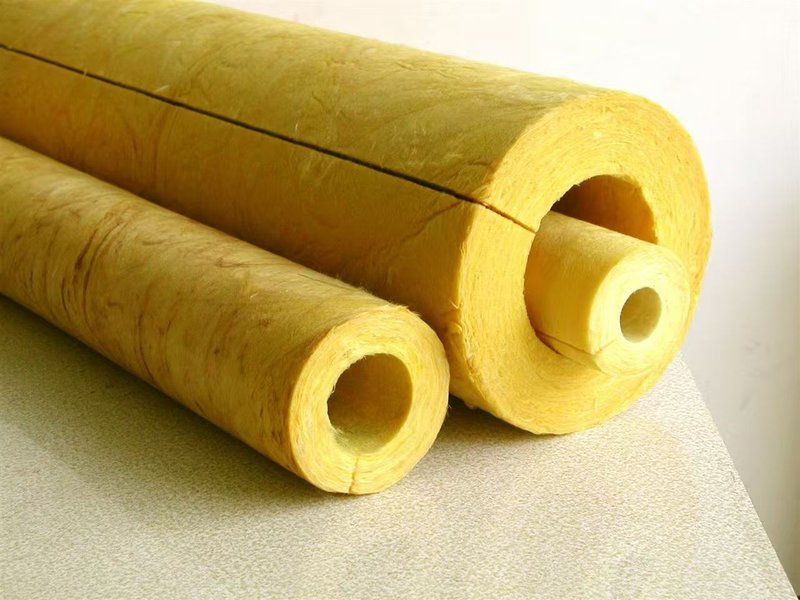
Woqin pre-formed glass wool pipe shells are professionally optimized for GCC high-end premium scenarios, targeting the four major structural defects of traditional insulation. The products integrate thermal insulation, broadband acoustic absorption, moisture resistance and high-standard appearance performance, realizing zero tradeoff of comprehensive performance.
1. Uniform Fiber Structure: Full-Band Stable Sound Absorption
Different from hand-wrapped insulation with unstable density, Woqin pipe shells adopt factory integral molding process, with uniform fiber density in 360° full circumference. The stable porous fiber matrix can fully absorb low, medium and high-frequency noise energy, effectively solving the problem of low-frequency hum penetration that plagues premium venues.
Verified by third-party tests, the product maintains excellent sound absorption performance in the key noise frequency band, stably reducing pipeline fluid noise and structural vibration noise, and avoiding performance attenuation caused by material settlement and aging under long-term GCC high-load operation.
2. Rigid Monolithic Structure: Efficient Vibration Damping
The self-supporting rigid shell structure has natural vibration damping performance, which can effectively cut off the structural vibration transmission path between pipelines and building structures. Matched with professional vibration isolation hangers, it can reduce pipeline vibration transmission efficiency by more than 60% compared with traditional soft insulation systems.
The product fits closely with the pipe wall for a long time without sagging, deformation or resonance gap, maintaining stable dual thermal and acoustic performance throughout the service cycle.
3. Engineered ASJ Composite Facing: Balanced Moisture Resistance and Acoustic Performance
Aiming at the industry’s universal vapor barrier paradox, Woqin adopts factory-bonded ASJ composite facing to realize performance breakthrough. The facing has an ultra-low vapor transmission rate, which can effectively block external high-humidity air and prevent pipeline condensation and corrosion.
Meanwhile, the optimized surface impedance design avoids the total sound reflection problem of traditional dense facings. It ensures moisture barrier performance while allowing sound energy to penetrate into the fiber core for absorption, completely solving the performance conflict between moisture resistance and acoustic reduction.
4. Precision Molding Process: Meet Exposed MEP High-End Aesthetic Standards
Woqin pre-formed pipe shells are manufactured with high-precision molds, with flat and uniform surface, neat tongue-and-groove occlusal joints, no exposed accessories and no fiber falling off after installation. The overall appearance is stable and beautiful, fully meeting the exposed installation standards of high-end hotel and commercial mechanical rooms.
No additional decorative enclosure is required, eliminating the resonance risk caused by the air gap of secondary structures, and realizing the integration of aesthetic presentation and engineering performance.
Tangible Long-Term Returns for Premium Real Estate Assets
Based on the standard operating conditions of 500-key luxury hotels in the UAE and 20-year full-cycle operation comparison with traditional insulation systems, Woqin acoustic-thermal integrated glass wool pipe shells bring three core value gains:
1. Stable acoustic compliance: The system is engineered to meet ≤30 dB(A) guest room and ≤35 dB(A) retail zone acoustic standards, maintaining stable and qualified indoor acoustic environment for a long time.
2. Optimize full-cycle TCO: It avoids multiple replacement cycles and high-cost post-operation rectification of traditional materials, reducing the 20-year comprehensive operation cost of pipeline insulation by about 60%.
3. Protect asset premium value: Eliminate noise-related negative evaluations and tenant disputes, stably maintain the 15–20% premium pricing advantage of high-end venues, and protect long-term asset valuation.
Secure Your Acoustic Performance Before Opening Day
Don’t let invisible pipeline acoustic defects erode the brand value and economic benefits of your premium projects. We provide exclusive professional technical support and customized solutions for GCC luxury hospitality and high-end commercial real estate projects.
Free exclusive resources for your project:
✅ Complimentary Acoustic Risk Assessment: Professional acoustic engineers evaluate your HVAC pipeline parameters, spatial layout and noise standard requirements, and output customized gap analysis and insulation thickness selection suggestions.
✅ Luxury MEP Acoustic Technology Whitepaper: In-depth technical data, full-frequency sound absorption curve analysis and successful case summaries of high-end venue applications.
✅ Dual-Performance Sample Kit: Physical samples of acoustic-grade glass wool pipe shells with ASJ facing, including standard installation processes and high-end exposed finish displays.
All inquiry requests enjoy 24-hour professional technical response from our Middle East support team.
[ Request Your Free Acoustic Assessment & Sample Kit ]
Industrial Insulation Engineering Insights Series (1-11 Index Archive)
For deep-dives into specific industrial insulation battlefields across the GCC, review our complete technical engineering library:
Article 1: Defeating Coastal CUI in Middle East Refineries: Low-Chloride Rock Wool Shells
Article 2: SRU Pipe Insulation: Prevent Liquid Sulfur Freeze & Viscosity Surge
Article 3: EHT Pipe Insulation: Eliminate Tenting Effect with Grooved Pre‑Formed Shells
Article 14:Securing Flare Gas Networks: A1 Non-Combustible Shells for Extreme Heat
Article 5:The Desert’s Billion-Dollar Blockage: How Smart Insulation Ends Wax Deposition Nightmares
Article 6: Desert Sandstorms: The Hidden Killer of Amine Line Stability in Gas Processing
Article 7: Desert Node Armor: Crush-Resistant Pipe Shells for Cross-Country Pipelines
Article 8:Stop the $18M Steam Pipe Burst: Dual-Defense Insulation That Survives C5-M
Article 9: Blocking 55°C Desert Sun: Glass Wool Shells for Mega Water Transmission
Article 10: Locking in 600°C: Composite Shells for CSP Molten Salt Pipelines in the GCC
Article 11: CCGT Power Plant Pipe Insulation English Marketing Copy (99-point Final Benchmark Version)
Hebei Woqin Trading Co., Ltd.
Tel/WhatsApp: +86 13933929092
Email: an@cn-aerogel.com
Website: insulatewool.com
Hebei Woqin is a professional supplier of high-performance thermal and acoustic insulation solutions, focusing on customized material products for extreme working conditions and high-end engineering scenarios in the Middle East. With 15 years of localized service experience in the GCC region, we support full-cycle technical services from project design, material selection to on-site construction guidance, and provide compliant, high-efficiency and stable insulation system solutions for global high-end real estate and industrial projects.

Written by - Ruibin An
Industry Veteran with 13+ Years of Experience. Deeply rooted in the insulation industry for over 13 years, specializing in supply chain optimization and global market trends for Rock Wool and Aerogel materials.
LATEST NEWS
Acoustic & Thermal Insulation for HVAC Piping in Middle East Luxury Hotels
2026-06-16
Calculated Oppression: How Thermal Drift and Structural Sagging Bleed Millions from Middle East Piping TCO (And the 20-Year Closed-Loop Solution)
2026-06-15
District Cooling in the Gulf: The Physics of Inevitable Condensation and How Pre-Formed Glass Wool Shells Stop It
2026-06-12
CCGT Power Plant Pipe Insulation English Marketing Copy (99-point Final Benchmark Version)
2026-06-10
Locking in 600°C: Composite Shells for CSP Molten Salt Pipelines in the GCC
2026-06-10