
Cutting Pipeline Insulation Labor Costs by 40% in 50°C Middle East Heat
GCC summer midday work bans shrink construction windows. Traditional hand-wrapped insulation causes low efficiency and schedule overruns. Woqin pre-formed pipe shells cut labor hours and reduce total installed costs for Middle East EPC projects.
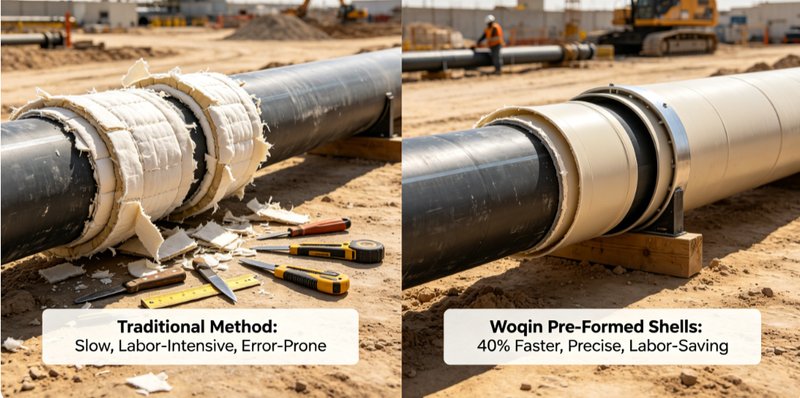
The 50°C Schedule Nightmare: The Hidden Cost Drain on Middle East EPC Projects
For every EPC pipeline project in the GCC, the single biggest schedule risk is not welding quality, not material delivery, and not supply chain delays. It is a non-negotiable legal mandate written into local labor law: outdoor work is strictly prohibited during high-temperature midday periods throughout summer months.
Per Saudi Ministry of Human Resources and Social Development (HRSD) summer outdoor work regulations and equivalent UAE MOHRE provisions, the midday construction ban cuts daily valid on-site working hours to just 6–6.5 hours — a 35–40% reduction compared to projects built in temperate climates. Violations may incur fines of up to SAR 50,000 per worker per violation and immediate project suspension, with zero room for on-site negotiation or exception. The ban applies fully to all open-air and semi-open piping corridor works — temporary shade structures do not qualify for official exemption.
This is not a workforce motivation problem. It is a structural, legal constraint that cannot be solved with tighter schedules or stricter site management. When paired with lump-sum turnkey contracts that lock in both budget and schedule, and local Iqama visa quotas that cap total on-site headcount, it creates a closed-loop dead end: you cannot work longer hours legally, you cannot add unlimited workers, and you cannot pass cost overruns to the project owner.
Traditional hand-wrapped soft blanket insulation, designed for temperate climates with unrestricted work windows, is poorly suited to the constrained operating environment in the GCC. It turns a minor auxiliary scope item into one of the highest-risk triggers for project delay and continuous margin erosion.
The Trapped Triangle: Three Rigid Constraints Breaking Traditional Insulation Logic
Three non-negotiable regional constraints form an inescapable trap for conventional hand-applied insulation installation in the Middle East. None of these limitations can be eliminated through standard project management adjustments.
1. Time is legally capped: Summer midday work bans eliminate 4 hours of prime daylight construction time. Year-round, 35°C+ high-temperature weather spans more than 8 months annually, keeping worker productivity consistently suppressed far below temperate climate benchmarks.
2. On-site headcount is legally capped: Local Iqama visa quota systems set a hard ceiling on total project labor scale. Local skilled insulation crews are extremely scarce, and newly arrived foreign workers typically require extensive onboarding before reaching productive output levels, making it impossible to boost construction progress simply by adding manpower.
3. Cost risk is fully retained by contractors: Most GCC energy and infrastructure EPC projects adopt lump-sum turnkey contracting modes, placing 100% of labor overrun, rework and schedule delay liability on the general contractor. There is no conventional change-order mechanism to compensate for heat-induced low efficiency. Every extra labor hour and every delayed construction day directly consumes project profit margins.
Traditional hand-installed insulation relies entirely on two core acceleration methods: extending working hours and increasing on-site labor. Both optimization paths are completely blocked in the GCC market. This is not a workmanship defect — it is a fundamental mismatch between conventional installation processes and the unique regulatory and climatic environment of the Middle East.
Four Inefficiency Traps of Traditional Soft Blanket Installation
Even under ideal temperate construction conditions, hand-wrapped insulation remains a labor-intensive, low-output process. Under GCC extreme heat and rigid schedule pressure, its inherent inefficiencies multiply, evolving into a full-scale schedule crisis and continuous cost overrun.
1. Cumbersome Multi-Step Process Creates a Low Productivity Ceiling
Complete soft blanket insulation installation requires six fully manual on-site procedures: field measurement, manual cutting, multi-layer wrapping, wire fastening, seam trimming and outer cladding fitting. The entire process heavily depends on skilled manual operation with no standardized efficiency guarantee.
Under standard 25°C conditions, a skilled worker can complete 18–22 linear meters of DN200 straight pipe per day. For valves, elbows, tees and other irregular fittings — the core source of schedule uncertainty in pipeline projects — manual cutting and customized fitting takes 5–8 times longer per unit than straight pipe construction, forming the biggest bottleneck for overall insulation progress.
2. High Temperature Triggers Exponential Productivity Decay
Under 50°C extreme ambient temperatures, workers’ physical exertion and heat stress load are 2.5 times higher than room temperature standards. In line with local safety specifications, crews require a 15-minute rest interval for every 45 minutes of effective work, further reducing effective working time by 30%.
Sustained heat fatigue also doubles the probability of dimensional cutting errors, uneven wrapping and irregular fastening, pushing on-site rework rates to 15–20%. For construction schedules already compressed by legal working hour restrictions, repeated rework consumes massive valid working time.
Industry data shows the net output of skilled workers on straight pipe drops to only 9–11 meters per day in peak summer conditions — less than half of standard temperate climate productivity.
3. Unstable Manual Quality Leads to Costly Re-Inspection and Rework
Hand wrapping naturally produces uneven insulation thickness, gap-prone seams and sagging issues on horizontal pipelines, failing to meet the strict acceptance standards of leading GCC oil and gas operators. Industry data verifies that rework costs for high-altitude, high-temperature remedial construction are 3–5 times higher than initial installation costs.
Remedial work further squeezes limited construction windows, creating a vicious cycle: rushed on-site installation leads to substandard quality, substandard results trigger inspection failures, and mandatory rework causes more schedule delays.
4. Uncontrolled On-Site Waste Generates Hidden Overhead Costs
Industry data shows traditional on-site manual cutting generates over 20% material scrap. In remote desert project sites, construction waste transportation and disposal costs are 3 times higher than urban project standards. Meanwhile, auxiliary materials including binding wire, adhesive tape and sealants often exceed budget consumption due to heat aging and inaccurate manual operation.
These hidden overhead costs are rarely reflected in initial material unit-price comparisons but can increase the final total installed cost by 10–15% upon project completion.
The Cascading Financial Blow: Why Material Price Is Only a Minor Part of TIC
Procurement teams that evaluate insulation solutions solely based on raw material unit prices fall into a typical “penny wise, pound foolish” cognitive trap. The material cost only accounts for a small proportion of the total installed cost (TIC), while labor inefficiency and schedule delays trigger cascading high-value losses.
Direct Labor Costs Rise Substantially
Fully loaded skilled insulation labor costs in the GCC — including basic wages, accommodation, visa fees, insurance and high-temperature allowances — range from $15–25 per hour. The 40% extended construction cycle caused by low manual efficiency pushes per-meter labor costs up by more than 60%, excluding additional summer safety management overheads.
Schedule Delays Trigger Disproportionate Liquidated Damages
Insulation construction sits at the final stage of the pipeline engineering critical path. All upstream procedures including pipe welding, pressure testing and anti-corrosion treatment will compress the reserved window for insulation work. Since no subsequent procedures can absorb delayed progress, every single day of insulation schedule slippage directly translates to overall project handover delay.
In a typical GCC refining EPC scenario, a $4.2 million insulation subcontract scope with a 21-day overall schedule delay can trigger up to $3.78 million in liquidated damages — nearly equivalent to the full value of the insulation subcontract. Critically, liquidated damages are calculated against the total project contract value, not the insulation subcontract value. This creates extreme risk leverage: minor delays in late-stage auxiliary procedures can erase nearly all profit of the entire insulation scope.
Indirect Fixed Costs Accumulate Continuously
Every additional week of delayed construction increases fixed overheads including on-site project management, scaffolding rental, mechanical equipment leasing and site security. These continuous fixed expenditures typically account for 5–8% of the monthly project output value, forming long-term hidden cost burdens that are easily overlooked in initial budgeting.
Warranty Period Remedial Liabilities Increase Long-Term Risks
Hand-applied insulation systems have an effective service life of only 3–5 years under harsh GCC climatic conditions, prone to sagging, cracking and corrosion-under-insulation issues during the warranty period. General contractors are obligated to provide free remedial maintenance, and the comprehensive cost of return visits for remote desert projects is 5–10 times higher than on-site construction costs during the peak period.
High-Stakes Professional Risks: Beyond Project Margins
Insulation schedule overruns and cost deviations bring not only economic losses but also long-term professional reputation risks to core EPC decision-makers.
For EPC Project Managers: Schedule Performance Defines Market Qualification
On-time handover is the core assessment KPI for EPC project management teams. Project delays caused by insulation inefficiency will not only deduct team performance bonuses but also downgrade the contractor’s supplier rating with top local operators. A poor performance record will directly disqualify enterprises from subsequent high-value GCC project tenders.
The Middle East EPC industry circle is highly closed and interconnected. A single high-profile delay record will accompany the corporate and personal project portfolio for years. Compromising construction efficiency to save minor material costs is a high-risk decision for long-term market layout.
For Commercial & Quoting Directors: Pricing Accuracy Determines Professional Credibility
Traditional manual insulation processes create an unavoidable pricing dilemma: quoting based on real full labor hours leads to high bid prices and lost tenders, while aggressive low pricing for bid winning locks in irreversible project losses.
Losing a tender can be attributed to fierce market competition, but project losses caused by inaccurate pricing are universally defined as insufficient professional judgment. For commercial directors, pricing failure leaves a lasting professional stain far more impactful than a failed bid.
Woqin’s Breakthrough: Snap-On Pre-Formed Shells Rewrite EPC Construction Economics
Woqin pre-formed pipe shells are factory-engineered exclusively for the extreme high-temperature and strictly regulated construction environment of the GCC, targeting the root inefficiencies of traditional manual insulation processes and completely breaking the regional schedule and cost deadlock.
40% Labor Saving: Zero On-Site Cutting, One-Step Snap-Fit Installation
All Woqin pipe shells are prefabricated with precise dimensional molds matching standard pipe diameters, eliminating on-site measurement, cutting and wire fastening procedures entirely. On-site construction only requires two steps: fitting the two half-shells around the pipeline and locking the tongue-and-groove joint tightly in place.
Under typical GCC site conditions, a trained two-person crew can complete 40–50 meters of DN200 straight pipe insulation per valid working day, doubling the on-site efficiency of traditional hand-wrapped systems. Custom pre-formed elbows, tees and valve fittings completely eliminate the efficiency bottleneck of special-shaped node construction. Across full project scopes including straight pipes and irregular fittings, Woqin pre-formed solutionscan reduce total installation labor hours by approximately 40%.
Factory Standardization Ensures High First-Pass Inspection Rate
Unlike manually constructed insulation with unstable quality, factory-molded pipe shells feature uniform thickness, tight joints and no sagging risk. With standardized installation by trained crews, the system typically achieves a first-pass inspection rate above 95%, eliminating repeated rework and inspection delays that consume core construction time.
Minimal On-Site Waste Eliminates Hidden Overheads
Prefabricated molding reduces on-site material scrap rate from over 20% to below 3%, with no excessive consumption of auxiliary materials such as binding wires and sealants. It greatly cuts waste disposal and supplementary material costs, especially suitable for remote desert GCC projects with high logistics overheads.
Long-Term Stable Performance Reduces Warranty Risks
Woqin rigid monolithic pipe shells resist sagging, settlement and sandstorm abrasion. Engineered for a 20+ year service life under standard operating conditions, the system maintains stable thermal and structural performance throughout the project lifecycle, effectively reducing warranty-period remedial liabilities and long-term asset operation costs.
Total Installed Cost (TIC) Comparison: Prefab Shells Beat Traditional Systems
Although pre-formed pipe shells carry a slight raw material premium, the massive savings in labor, rework, waste and schedule risk make them the lowest total-cost solution for Middle East EPC pipeline projects. The full-cost comparison below is based on typical GCC summer construction conditions and DN200 pipeline standards.
| Cost Component (Per 100m DN200 Pipe) | Traditional Soft Blanket | Woqin Pre-Formed Pipe Shells |
|---|---|---|
| Material Cost | Baseline | +30% Premium |
| Installation Labor Cost | 100% | 60% |
| Rework & Re-inspection Cost | 15% of material + labor | <3% |
| Scrap & Consumable Overrun | 12% | <3% |
| Schedule Delay Risk Contingency | 8–12% of total scope value | 2–3% |
| Total Installed Cost | 100% Baseline | 72–78% of Baseline Note: Data based on typical EPC quoting practices, DN200 straight pipe and standard GCC summer site conditions. Actual values vary by project scope, pipe diameter, site location and crew proficiency. The economic logic is clear and irreversible: the labor and hidden cost savings of pre-formed pipe shells far offset the minor material premium. When eliminating massive liquidated damage risks caused by schedule delays, the total cost advantage becomes absolutely dominant. |
Secure Your Schedule and Project Margin Before Peak Summer Heat
Do not rely on outdated manual installation processes to bear the legal risks, schedule pressure and profit losses of GCC high-temperature construction. Optimize your insulation construction solution in advance to lock in project margins and stable delivery.
We provide professional customized technical analysis tools and project assessment services exclusively for GCC EPC contractors:
✅ Editable Pre-Formed vs. Wrapped Insulation TIC Comparison Model — Configurable for your project pipe diameters, total scope and regional labor rates, supporting accurate quotation and budget verification.
✅ Customized Schedule Impact Assessment — Professional team evaluates your insulation scope against summer working hour restrictions and quantifies recoverable schedule buffers.
✅ On-Site Installation Demo Kit — Physical product samples and standardized installation guidelines for site supervision and crew training.
All inquiries receive a prompt response from our Middle East EPC support team, typically within 24 business hours.
[ Download the Editable Labor & TIC Comparison Model ] (Primary CTA — for Commercial & Quoting Teams)
[ Request a Custom Schedule Impact Assessment ] (Secondary CTA — for Project Management Teams)
View more related content
Article 1: Defeating Coastal CUI in Middle East Refineries: Low-Chloride Rock Wool Shells
Article 2: SRU Pipe Insulation: Prevent Liquid Sulfur Freeze & Viscosity Surge
Article 3: EHT Pipe Insulation: Eliminate Tenting Effect with Grooved Pre‑Formed Shells
Article 14:Securing Flare Gas Networks: A1 Non-Combustible Shells for Extreme Heat
Article 5:The Desert’s Billion-Dollar Blockage: How Smart Insulation Ends Wax Deposition Nightmares
Article 6: Desert Sandstorms: The Hidden Killer of Amine Line Stability in Gas Processing
Article 7: Desert Node Armor: Crush-Resistant Pipe Shells for Cross-Country Pipelines
Article 8:Stop the $18M Steam Pipe Burst: Dual-Defense Insulation That Survives C5-M
Article 9: Blocking 55°C Desert Sun: Glass Wool Shells for Mega Water Transmission
Article 10: Locking in 600°C: Composite Shells for CSP Molten Salt Pipelines in the GCC
Article 11: CCGT Power Plant Pipe Insulation English Marketing Copy (99-point Final Benchmark Version)
Article 14:Acoustic & Thermal Insulation for HVAC Piping in Middle East Luxury Hotels
Contact Us
Hebei Woqin Trading Co., Ltd.
Tel/WhatsApp: +86 13933929092
Email: an@cn-aerogel.com
Website: insulatewool.com
Hebei Woqin is a global supplier of high-performance thermal and acoustic insulation solutions, focusing on prefabricated insulation systems tailored for extreme Middle Eastern industrial and EPC construction scenarios. With 15 years of localized service experience in the GCC market, we provide full-cycle support including project scheme optimization, accurate budgeting, on-site construction guidance and after-sales technical services, helping EPC clients optimize construction efficiency, control total costs and avoid schedule and compliance risks.

Written by - Ruibin An
Industry Veteran with 13+ Years of Experience. Deeply rooted in the insulation industry for over 13 years, specializing in supply chain optimization and global market trends for Rock Wool and Aerogel materials.
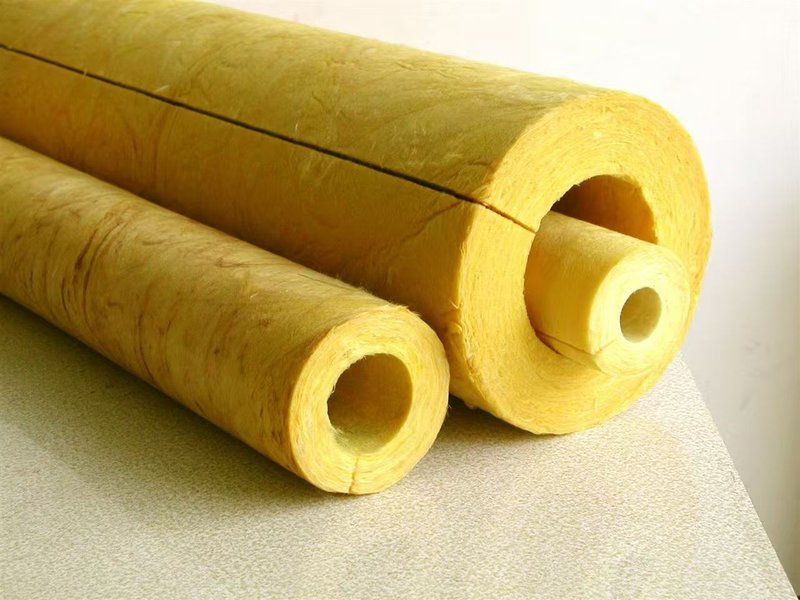
LATEST NEWS
Cutting Pipeline Insulation Labor Costs by 40% in 50°C Middle East Heat
2026-06-18
Acoustic & Thermal Insulation for HVAC Piping in Middle East Luxury Hotels
2026-06-16
Calculated Oppression: How Thermal Drift and Structural Sagging Bleed Millions from Middle East Piping TCO (And the 20-Year Closed-Loop Solution)
2026-06-15
District Cooling in the Gulf: The Physics of Inevitable Condensation and How Pre-Formed Glass Wool Shells Stop It
2026-06-12
CCGT Power Plant Pipe Insulation English Marketing Copy (99-point Final Benchmark Version)
2026-06-10