
Unlocking Aramco & SABIC Compliance: The Highly Secure Path to Mechanical Completion Sign-Off
Saudi Aramco and SABIC insulation compliance is the ultimate supply chain litmus test. This article breaks down critical pain points—asbestos, CUI, MC documentation gaps—and how Woqin's certified, data-backed compliance package helps EPCs navigate pre-qualification.
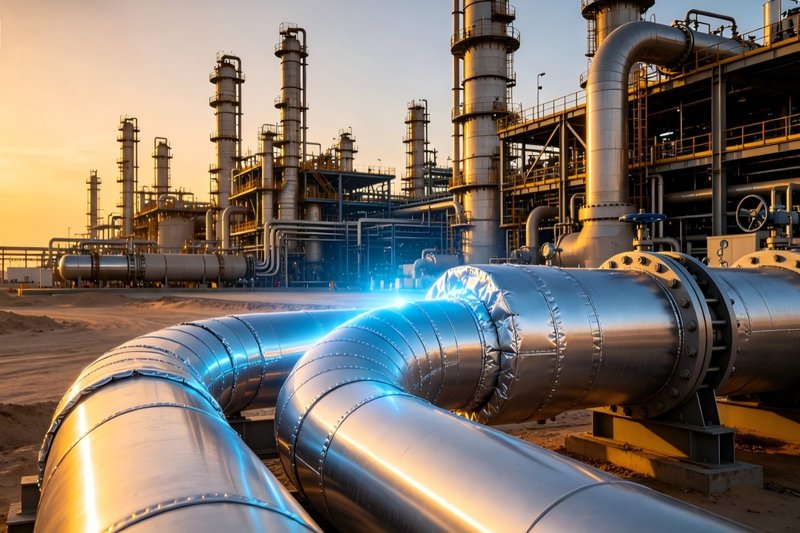
Introduction: The Gateway to Middle East Megaprojects—Why Compliance is the Sword of Damocles for EPCs
Securing a multi-billion-dollar engineering, procurement, and construction (EPC) contract from Saudi Aramco or SABIC is a monumental achievement. However, the celebration is short-lived as supply chain directors immediately transition into one of the world's most rigorous compliance battlegrounds: Vendor Approval.
In the extreme industrial climate of the Persian Gulf—where ambient temperatures exceed 55°C, high humidity and salt spray constantly coat equipment, and abrasive desert sandstorms punish infrastructure—thermal insulation is not a mere wrapping material. It is the industrial armor protecting thousands of kilometers of high-pressure, high-hazard, and high-value piping networks. Middle East operators know that even a microscopic material defect will be aggressively amplified by this environment, potentially resulting in catastrophic unplanned shutdowns or fatal explosions.
Consequently, Aramco's Project Management Teams (PMT) and Project Inspection Departments (PID) enforce stringent verification protocols. For an EPC's supply chain director or chief engineer, insulation compliance is not just a standard to be met; it is a high-stakes campaign tied directly to personal professional reputation, the timely release of millions in retention bonds, and the financial stability of the project.
Deep-Dive into Pain Points: Three Technical Red Lines and Their Commercial Toll
When unqualified or under-certified insulation suppliers compromise on quality, they pull international EPCs across three critical technical red lines:
1. Asbestos Contamination: Trace Residue, Immediate Site Quarantine
In Saudi Arabia, asbestos is a zero-tolerance environmental and health red line. Low-end manufacturers often introduce trace asbestos due to cheap raw inputs or cross-contamination on unsegregated production lines. If an Aramco Health, Safety, and Environment (HSE) Officer detects trace asbestos during a random on-site inspection, the consequences are severe: the affected construction zone risks immediate Site Quarantine. The EPC is forced to execute an incredibly expensive Asbestos Abatement protocol. The vendor faces blacklisting, and the EPC risks environmental fines and legal liabilities.
2. Excess Chlorides: Triggering the Incurable Disease of Stainless Steel (CUI & SCC)
Middle East refineries and LNG terminals heavily utilize 304L and 316L austenitic stainless steel piping. If the insulation shells contain leachable chloride levels that exceed strict thresholds, the chlorides rapidly concentrate under the insulation layer due to cyclical moisture and salt spray evaporation. This triggers Stress Corrosion Cracking (SCC)—a catastrophic failure mode that propagates microscopically inside the steel structure and is invisible to the naked eye. Operators enforce uncompromising alignment withASTM C795/C692 corrosion tests, which conventional materials consistently fail.
3. High Organic Binder Content: The Financial Black Hole of Outgassing
Standard rock wool or glass wool pipes often rely on phenolic resins as organic binders to maintain structural shape. On high-temperature lines operating above 300°C, these organic binders undergo irreversible slow thermal degradation (outgassing) and carbonization. Once the binder burns off, the pipe shell degrades from a rigid protective jacket into a loose "sponge," causing the material's thermal conductivity (k-value) to surge significantly within a few years. This compromises energy efficiency targets and creates a hidden hazard that challenges Aramco's A1 non-combustible requirements.
Procedural Black Holes: The Endless MAR Rejection Loop and the Mechanical Completion Nightmare
Beyond physical engineering risks, supply chain directors frequently face paralyzing procedural bottlenecks:
- The Endless MAR (Material Approval Request) Rejection Loop: Before any material arrives on-site, a comprehensive MAR must be submitted. If the vendor's English test reports are formatted improperly, utilize outdated local standards instead of ASTM codes, or lack international mutual recognition marks like ILAC-MRA / CNAS, the MAR is rejected. Each rejection cycle rapidly consumes the project's procurement schedule.
- VID Inspections and Demurrage at the Port: When the cargo arrives at Middle Eastern ports, Aramco's Vendor Inspection Department (VID) executes random physical sampling. Discoveries of density deviations or geometric dimensional variances can lead to shipment rejections at the site gate. Daily demurrage fees quickly erode project profit margins.
- The MC Blockade: It is a common nightmare: the piping is fully installed, and hydro-testing is complete. However, at the final Mechanical Completion (MC) handover phase, the operator's auditor hesitates to sign off because the insulation vendor failed to provide batch-level traceability for just a few pipe spools out of thousands. The handover process stalls—not for an engineering failure, but for a documentation gap. Because of this, multi-million-dollar project retention bonds can be delayed for months, paralyzing the EPC's cash flow.
The Woqin Blueprint: Turning Auditor Hesitancy into Rapid MC Sign-Off
Auditors for Middle East energy giants are inherently risk-averse; they require an airtight, fully traceable data map to sign their names with confidence.
While pipe shells are heavily scrutinized in Aramco projects, Hebei Woqin Trading Co., Ltd.'s compliance portfolio extends across the full spectrum of industrial thermal solutions. We deliver far more than premium materials—we hand you a highly secure, compliance-ready passport to navigate Middle East megaprojects:
1. A Strictly Controlled Material Baseline
- Certified Asbestos-Free: Every batch of Woqin insulation undergoes testing by independent, accredited third-party laboratories, providing specialized Asbestos-Free verification reports to mitigate site quarantine risks.
- A1 Non-Combustible Classification: Woqin insulation shells are engineered with optimized, ultra-low organic binder ratios, significantly reducing the fuel source for smoldering degradation and smoke development under continuous high-temperature exposure—closing the loop between low outgassing potential and the stringent performance criteria of the EN 13501-1 A1 Non-Combustible classification.
2. Active Corrosion-Inhibiting Chemistry: Upgrading from Passive Compliance to Active Defense
This chemistry is embedded across Woqin's full mineral wool and aluminum silicate portfolio. To combat CUI, Woqin products do not simply reduce leachable chloride ($Cl^-$) and fluoride ($F^-$) concentrations;we push them well below the ASTM C795 Karnes curve threshold, with typical batch results capable of registering at remarkably low levels (e.g., can be $<10$ ppm).
The Active Protection Mechanism: Formulated into the microstructure of Woqin insulation is a specialized silicate and sodium ion buffering chemistry. When external moisture breaches the weather barrier, the insulation actively leaches controlled silicate ions. These ions migrate to the 304/316L stainless steel surface, facilitating a dense passivation film that mitigates the anodic corrosion reaction, drastically reducing the probability of CUI and SCC.
3. Rigid Quality Control and Definitive Laboratory Data
Leveraging our official testing repository, Woqin provides robust experimental evidence to support technical audits:
- Rock Wool & Aluminum Silicate Pipe Shells: Produced with engineered geometric dimensions incorporating tongue-and-groove joints to match ASTM and GB/T 5480 allowable deviations. Combined with a stable bulk density typical of 107 kg/m³ (±5% tolerance vs. the industry-typical ±15%), a tensile strength of 44 kPa for specialized linings, and a shot content consistently controlled below 3% (compared to the common 5-8% range), these shells deliver uniform thermal performance and resist sagging under extreme service conditions.
- Aerogel Blankets: Rigorous testing has demonstrated hydrophobic rates up to 99.7% (significantly exceeding the $\ge 98.0\%$ industry benchmark), ensuring superior moisture protection. Furthermore,vibration mass loss rates have been recorded as low as 0.3% (against the allowable standard of $\le 1.0\%$), providing long-term stability under pipeline vibration.
- Cold Chain & Specialty Armors (VIP & PUR): For specific Middle East LNG cryogenic services, Woqin supplies Vacuum Insulation Panels (VIP) boasting an ultra-low typical thermal conductivity of 0.002 W/(m·K), alongside High-Density Polyurethane (HD-PUR) blocks with a density of 380 kg/m³ to withstand mechanical loads.
Seamless Integration into the Procurement Workflow: Safeguarding Your Project Closeout
Partnering with Hebei Woqin facilitates a streamlined procurement experience tailored to Middle East operator workflows:
1. Ready-to-Submit Submittal Packages: Woqin delivers a comprehensive, standardized English submittal binder. It features Material Test Reports (MTRs), third-party laboratory data stamped with international ILAC-MRA / CNAS mutual recognition logos, Material Safety Data Sheets (MSDS), and our internal QA/QC Manual, supporting swift MAR reviews.
2. Full End-to-End Traceability: We enforce a strict tracking policy across our supply chain. When the VID inspects your shipment, our verifiable documentation is designed to effortlessly match the physical cargo, drastically reducing the risk of custom delays and site rejections.
3. Supporting a Smooth Mechanical Completion (MC): With comprehensive turnover documentation delivered alongside the physical materials, the operator's PID inspectors are equipped to sign the MC certificate with confidence. By removing documentation gaps as a barrier, we help clear the way for the milestone handover process during which your 5% to 10% project retention bonds are reviewed for release.
View more related content
Article 1: Defeating Coastal CUI in Middle East Refineries: Low-Chloride Rock Wool Shells
Article 2: SRU Pipe Insulation: Prevent Liquid Sulfur Freeze & Viscosity Surge
Article 3: EHT Pipe Insulation: Eliminate Tenting Effect with Grooved Pre‑Formed Shells
Article 14:Securing Flare Gas Networks: A1 Non-Combustible Shells for Extreme Heat
Article 5:The Desert’s Billion-Dollar Blockage: How Smart Insulation Ends Wax Deposition Nightmares
Article 6: Desert Sandstorms: The Hidden Killer of Amine Line Stability in Gas Processing
Article 7:Desert Node Armor: Crush-Resistant Pipe Shells for Cross-Country Pipelines
Article 8:Stop the $18M Steam Pipe Burst: Dual-Defense Insulation That Survives C5-M
Article 9: Blocking 55°C Desert Sun: Glass Wool Shells for Mega Water Transmission
Article 10: Locking in 600°C: Composite Shells for CSP Molten Salt Pipelines in the GCC
Article 11:CCGT Power Plant Pipe Insulation English Marketing Copy (99-point Final Benchmark Version)
Article 14:Acoustic & Thermal Insulation for HVAC Piping in Middle East Luxury Hotels
Article 15:Cutting Pipeline Insulation Labor Costs by 40% in 50°C Middle East Heat
Contact Us
Hebei Woqin Trading Co., Ltd.
Tel/WhatsApp: +86 13933929092
Email: an@cn-aerogel.com
Website: insulatewool.com
Call to Action (CTA)
Do not let documentation omissions on an insulation package delay millions of dollars in final project payouts.
Hebei Woqin has pre-assembled a comprehensive Middle East Energy Compliance Package, stocked with ASTM C795 corrosion-inhibiting test charts, certified asbestos-free validations, and full English A1 non-combustibility data.
Contact our international engineering project technical team today to request your compliance package, and help keep your project approvals and closeouts on schedule!

Written by - Ruibin An
Industry Veteran with 13+ Years of Experience. Deeply rooted in the insulation industry for over 13 years, specializing in supply chain optimization and global market trends for Rock Wool and Aerogel materials.
LATEST NEWS
Unlocking Aramco & SABIC Compliance: The Highly Secure Path to Mechanical Completion Sign-Off
2026-06-25
Cutting Pipeline Insulation Labor Costs by 40% in 50°C Middle East Heat
2026-06-18
Acoustic & Thermal Insulation for HVAC Piping in Middle East Luxury Hotels
2026-06-16
Calculated Oppression: How Thermal Drift and Structural Sagging Bleed Millions from Middle East Piping TCO (And the 20-Year Closed-Loop Solution)
2026-06-15
District Cooling in the Gulf: The Physics of Inevitable Condensation and How Pre-Formed Glass Wool Shells Stop It
2026-06-12