
Beyond Insulation: Why Structural Thermal Breaks Are Essential for Modern Industrial Infrastructure
Thermal bridges are among the most overlooked causes of energy loss, condensation and long-term structural deterioration. High-density rigid polyurethane insulation blocks are engineered to interrupt heat flow while supporting heavy structural loads, helping engineers improve energy efficiency, reduce maintenance risks and enhance long-term building performance.
1. Introduction: The Hidden Cost of Structural Thermal Bridges
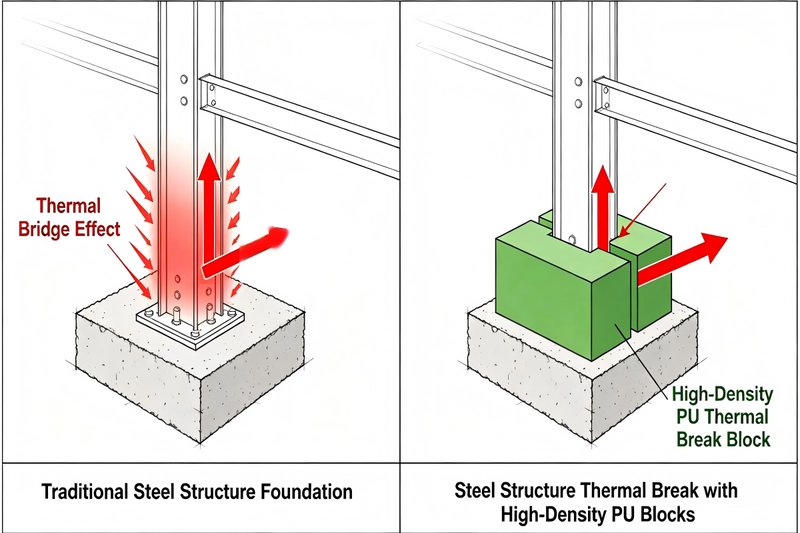
When a steel column base in a heated warehouse shows persistent condensation while the wall insulation meets code, the problem is rarely the insulation. It's the column itself—acting as an uninsulated thermal highway from the inside to the outside.
In modern buildings and industrial facilities, improving insulation performance is often associated with increasing wall thickness or selecting materials with lower thermal conductivity.
However, many projects continue to experience unexpected heat loss, condensation and rising operating costs—even when high-performance insulation systems have been installed.
The reason is frequently not the insulation itself.
It is the presence of structural thermal bridges.
Whenever highly conductive materials such as steel, concrete or metal fasteners penetrate the insulation envelope, they create direct pathways for heat transfer. These localized heat flow paths can significantly reduce the effectiveness of the overall thermal system.
Although thermal bridges typically occupy only a small percentage of the total building envelope, they can account for a disproportionately large share of energy loss while increasing the risk of condensation, corrosion and long-term durability issues.
As energy efficiency standards become more demanding and industrial facilities pursue longer service life with lower operating costs, controlling structural thermal bridges has become an important engineering consideration rather than simply an insulation upgrade.
2. Why Traditional Structural Connections Become Thermal Bridges
Structural elements are designed primarily to transfer loads—not to interrupt heat flow.
Steel columns, pipe supports, equipment foundations, curtain wall anchors and concrete structural connections all possess significantly higher thermal conductivity than surrounding insulation materials.
As a result, heat naturally bypasses the insulation layer through these structural connections.
The consequences extend far beyond increased energy consumption.
Typical engineering challenges include:
- Localized condensation forming around steel connections and equipment supports
- Corrosion accelerated by repeated moisture accumulation at thermal bridge locations
- Mold growth caused by persistent surface condensation in occupied buildings
- Frost heave and floor damage beneath cold storage facilities due to uncontrolled heat transfer
- Reduced thermal efficiency that increases HVAC operating costs throughout the building lifecycle
- Difficulty meeting increasingly stringent building energy codes and passive building performance requirements
- In many projects, increasing insulation thickness alone cannot eliminate these localized heat transfer paths because the structural connection itself remains uninterrupted.
- Addressing thermal bridges therefore requires more than additional insulation.
- It requires a material capable of providing both structural load transfer and thermal isolation within the same engineering solution.
3. Why Conventional Insulation Cannot Solve Structural Thermal Bridges
Most conventional insulation materials are designed with one primary objective: reducing heat transfer.
While they perform well in walls, roofs and standard building envelopes, they are rarely engineered to withstand concentrated structural loads.
When insulation is placed beneath steel columns, equipment foundations or heavy pipe supports, it must continuously resist compressive stress while maintaining dimensional stability. Conventional low-density insulation materials often deform under sustained loading, creating settlement, uneven support and renewed thermal bridges.
In many industrial environments, structural connections are subjected not only to static loads but also to vibration, thermal cycling and dynamic loading from equipment or vehicle traffic.
As deformation develops, the thermal break gradually loses effectiveness, increasing heat transfer while placing additional stress on surrounding structural components.
For engineers, the challenge is no longer selecting an insulation material with a lower thermal conductivity.
It is selecting a material capable of delivering both long-term structural performance and reliable thermal isolation under real operating conditions.
4. The Engineering Principle Behind High-Density Structural Thermal Breaks
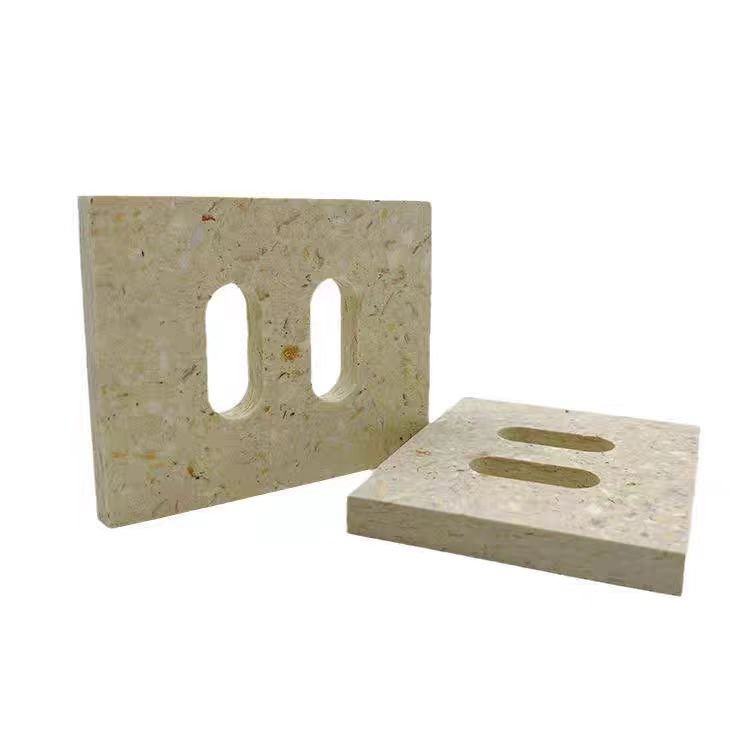
High-density rigid polyurethane insulation blocks are engineered specifically for applications where structural support and thermal isolation must work together.
Rather than functioning solely as insulation, these blocks become an integral part of the structural load path.
Their high-density closed-cell construction provides the compressive strength required to support heavy loads while significantly reducing conductive heat transfer through structural connections.
Unlike steel or concrete, which rapidly transfer heat, and unlike low-density insulation, which collapses under structural loading, high-density polyurethane introduces a thermal interruption between structural members without compromising mechanical stability.
This dual-function design enables engineers to control heat flow while maintaining the load-bearing capacity required for demanding industrial applications.
Typical characteristics verified under ASTM and ISO standard test conditions include:
- High compressive strength suitable for structural support applications
- Low thermal conductivity to reduce conductive heat transfer
- Low water absorption for improved durability in humid environments
- Stable mechanical performance across both low- and medium-temperature operating conditions
- Closed-cell structure that helps maintain long-term dimensional stability
- Rather than increasing insulation thickness throughout an entire system, engineers can strategically interrupt localized heat transfer at critical structural connections where thermal bridges are most likely to occur.
5. Engineering Benefits Across Industrial Infrastructure
The value of structural thermal break blocks extends well beyond improving thermal insulation.
When properly integrated into engineering design, they contribute to improved energy performance, enhanced structural durability and lower lifecycle maintenance costs.
5.1 Reduced Energy Loss
Interrupting conductive heat flow through structural connections helps improve the overall efficiency of the building envelope or industrial process system.
Instead of allowing heat to bypass surrounding insulation through steel or concrete, thermal break blocks reduce localized heat transfer at the source.
5.2 Lower Condensation and Corrosion Risk
By increasing the surface temperature around structural connections, thermal break blocks help reduce the likelihood of condensation forming on steel components.
This contributes to lower moisture accumulation, reducing conditions that may accelerate corrosion or create mold-related issues in occupied environments.
5.3 Reliable Structural Load Transfer
High-density polyurethane blocks are designed to support concentrated compressive loads while maintaining dimensional stability.
This makes them suitable for applications such as structural steel supports, equipment foundations, cold storage flooring and insulated pipe supports where both mechanical strength and thermal isolation are required.
5.4 Improved Long-Term Durability
Stable mechanical properties, low water absorption and resistance to environmental degradation help reduce maintenance requirements throughout the service life of the installation.
For industrial owners, this supports lower lifecycle costs and improved long-term operational reliability.
5.5 Greater Design Flexibility
High-density polyurethane blocks can be manufactured in customized dimensions and machined to tight tolerances, allowing engineers to integrate thermal breaks into complex structural details without significantly altering the overall design.
Instead of treating thermal bridges as unavoidable consequences of structural design, engineers can incorporate thermal isolation directly into the load path, improving both energy efficiency and structural performance within a single engineered solution.
6. Where Structural Thermal Breaks Deliver the Greatest Value
Structural thermal breaks create the greatest value wherever heavy structural loads and heat transfer occur simultaneously.
Instead of increasing insulation thickness across an entire building or industrial system, engineers can strategically interrupt localized heat flow at critical structural connections.
The following sections examine three high-priority applications in detail, followed by additional scenarios where the same engineering principles apply.
6.1 Steel Structure Foundations
The Problem:
Steel columns must transfer significant structural loads into the foundation. At the same time, they act as highly conductive thermal pathways, channeling heat directly through the insulation envelope at every column base.
The Engineering Challenge:
Traditional design places steel base plates directly on concrete, with insulation fitted around the column perimeter. This leaves the primary thermal bridge uninterrupted. Attempts to insert conventional insulation beneath the base plate fail because low-density materials deform under concentrated compressive loads, creating settlement and structural instability.
The Solution:
High-density polyurethane thermal break blocks are installed directly beneath column base plates, becoming part of the structural load path. Anchor bolts pass through the block, transferring loads while the closed-cell PU matrix interrupts conductive heat flow.
The Result:
When properly designed and installed, engineers achieve reliable structural load transfer with significantly reduced heat loss through the foundation connection. Condensation risk around column bases is minimized, supporting long-term structural integrity and improved energy performance.
6.2 Cold Storage Floors
The Problem:
Cold storage facilities maintain continuous temperature differences of 40°C or more between the refrigerated interior and the supporting concrete slab. Without adequate thermal isolation at the floor, heat migrates upward through the slab, driving refrigeration energy consumption higher while creating conditions for frost heave and concrete degradation.
The Engineering Challenge:
Cold storage floors must simultaneously support heavy dynamic loads—forklift traffic, pallet racking, stored product weight—while interrupting heat transfer. Conventional insulation materials used in walls and roofs lack the compressive strength to perform this dual function. When they deform under sustained loading, the floor structure settles unevenly, creating cracks, cold spots and renewed thermal bridges that accelerate frost damage.
The Solution:
High-density polyurethane thermal break blocks are integrated into the cold storage floor assembly, positioned between the structural slab and the wearing surface. Their high compressive strength supports operational loads without long-term deformation, while their closed-cell structure provides reliable thermal isolation and moisture resistance throughout the service life.
The Result:
When properly designed and installed, refrigeration energy consumption is reduced, frost heave and concrete cracking are minimized, and the floor structure maintains dimensional stability under decades of operational loading. Maintenance intervals are extended, lowering total lifecycle cost.
6.3 Pipe Supports and Cryogenic Systems
The Problem:
Pipe supports in insulated piping systems are often one of the most significant localized thermal bridge points. At cryogenic temperatures, these uninsulated support points not only waste energy but also create cold spots where atmospheric moisture condenses and freezes, leading to ice buildup, corrosion under insulation, and potential insulation system failure.
The Engineering Challenge:
Pipe shoes and support assemblies must carry the full weight of the pipe and its contents while accommodating thermal expansion and contraction. Standard insulation materials cannot withstand these concentrated compressive loads, while metal-to-metal contact at supports creates a direct thermal short circuit between the cold pipe and the ambient structure.
The Solution:
High-density structural insulation blocks are installed between the pipe shoe and the support structure, interrupting conductive heat transfer while maintaining the compressive strength required for continuous operational loads. For cryogenic applications, closed-cell PU construction resists moisture ingress, preventing ice formation at the support interface.
The Result:
When properly designed and installed, heat gain in cold systems is reduced, ice formation at supports is minimized, and the long-term integrity of the insulation system is preserved. These benefits are particularly valuable for LNG facilities, cryogenic process systems, refrigeration plants and industrial utility piping.
6.4 Additional Applications
Beyond the three high-priority cases above, structural thermal break blocks deliver measurable value across a broad range of building and industrial applications:
Curtain Wall and Building Envelope Connections: Curtain wall brackets, window frames and façade support systems frequently penetrate the building insulation layer. Thermal break blocks at these connection points improve overall envelope performance while reducing condensation and improving occupant comfort.
Industrial Equipment Foundations: Heavy mechanical equipment often requires rigid structural support while operating under elevated or reduced temperatures. Thermal break blocks isolate equipment bases from surrounding structures, reducing localized heat transfer while maintaining long-term dimensional stability.
Passive Buildings and High-Performance Construction: As building energy regulations continue to evolve toward near-zero energy standards, minimizing thermal bridges has become a design requirement rather than an optimization option. High-density structural insulation blocks help designers meet these demanding performance targets while maintaining structural integrity at critical load-bearing connections.
7. Engineering Decision Framework
Selecting a structural insulation material involves more than comparing thermal conductivity values.
Engineers should evaluate how the material performs under combined thermal and mechanical loading throughout the service life of the installation.
The following framework provides a practical comparison.
| Engineering Requirement | Conventional Insulation | High-Density PU Thermal Break |
|---|---|---|
| Thermal Insulation | ✓ | ✓ |
| Structural Load Bearing | Limited | Designed for High Compressive Loads |
| Thermal Bridge Reduction | Limited | Highly Effective |
| Long-Term Dimensional Stability | Load Dependent | Improved Under Sustained Loading |
| Moisture Resistance | Varies | Closed-Cell Structure |
| CNC Machining Capability | Limited | High Precision Available |
| Cold Storage Flooring | Limited | Generally Recommended |
| Structural Steel Connections | Not Recommended | Generally Recommended |
| Cryogenic Pipe Supports | Limited | Suitable The engineering question is no longer simply: "Which insulation material has the lowest thermal conductivity?" Instead, modern projects increasingly ask: "Which material can simultaneously support structural loads while interrupting heat flow?" That distinction defines the role of structural thermal break technology. |
8. Technical Boundary Conditions & Compliance Disclaimer
The engineering information presented in this article is based on laboratory testing, product development and standard application practices.
Actual project performance depends on multiple variables, including structural design, load distribution, installation quality, environmental exposure, operating temperature, product dimensions and long-term service conditions.
Mechanical and thermal properties should always be evaluated using the applicable product specification and verified against project-specific engineering requirements. Where necessary, structural calculations and thermal simulations should be completed prior to material selection.
All content in this article is for technical reference only and does not constitute a contractual guarantee or engineering warranty. Project-specific solutions shall be determined through professional design calculation and on-site construction verification.
9. Conclusion
For decades, insulation materials have primarily been selected according to thermal conductivity.
However, modern industrial and high-performance building projects demand more than thermal resistance alone.
Structural connections must simultaneously carry heavy loads, resist moisture, maintain dimensional stability and interrupt heat transfer.
This is precisely where high-density structural thermal break technology creates value.
Rather than treating thermal bridges as unavoidable consequences of structural design, engineers can integrate thermal isolation directly into critical load paths, improving energy efficiency, reducing condensation risk and supporting long-term structural durability.
Ultimately, the future of thermal insulation is not defined solely by lower thermal conductivity.
It is defined by how effectively structural and thermal performance work together within the same engineering solution.
Thermal bridging was once accepted as an unavoidable consequence of putting steel where insulation should be. It no longer needs to be.
Next Steps
Whether you are designing steel structures, cold storage facilities, cryogenic systems or high-performance building envelopes, selecting the appropriate structural thermal break solution should begin with a comprehensive evaluation of both thermal and mechanical requirements.
Woqin provides customized high-density rigid polyurethane insulation blocks for structural thermal break applications, supported by engineering consultation, CNC machining, project-specific sizing and technical documentation.
Contact our engineering team to discuss your project requirements or request additional technical information.
Ruibin An
Thermal Insulation Specialist | Aerogel & Stainless Steel VIP Manufacturer
Hebei Woqin Trading Co., Ltd.
Email: an@cn-aerogel.com
Website: www.cn-aerogel.com

Written by - Ruibin An
Industry Veteran with 13+ Years of Experience. Deeply rooted in the insulation industry for over 13 years, specializing in supply chain optimization and global market trends for Rock Wool and Aerogel materials.
LATEST NEWS
Beyond Insulation: Why Structural Thermal Breaks Are Essential for Modern Industrial Infrastructure
2026-06-29
The Ultimate Guide: "Survival Rules" and System Defenses for Industrial Piping Insulation in Extreme Middle Eastern Environments
2026-06-25
Unlocking Aramco & SABIC Compliance: The Highly Secure Path to Mechanical Completion Sign-Off
2026-06-25
Cutting Pipeline Insulation Labor Costs by 40% in 50°C Middle East Heat
2026-06-18
Acoustic & Thermal Insulation for HVAC Piping in Middle East Luxury Hotels
2026-06-16