
High-Density Rigid PU Thermal Break Blocks: North American Code-Compliant Structural Solution
This guide introduces 600kg/m³ high-density rigid polyurethane thermal break blocks for North American construction. Combining high load-bearing capacity and low thermal conductivity, they meet IECC and NECB codes for steel foundations, cold storage floors and cryogenic piping.
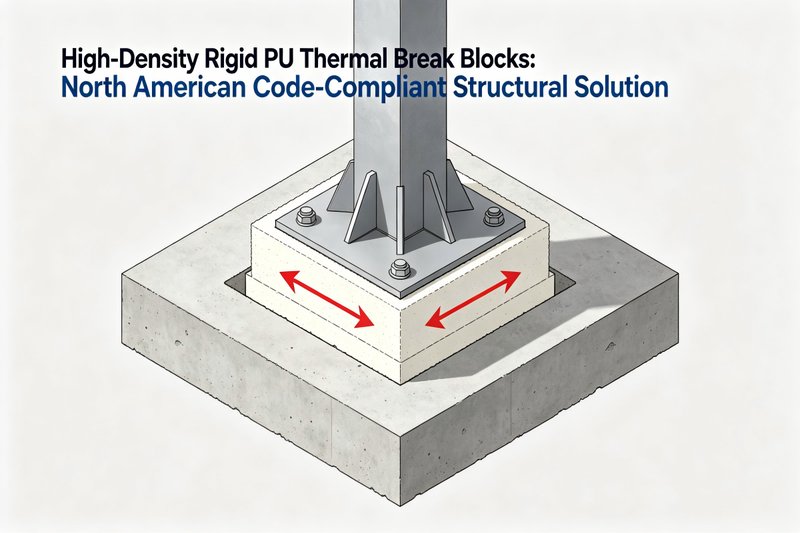
1. Introduction: The Hidden Compliance & Cost Crisis in North American Construction
When a building inspector flags an unmitigated steel column base as a thermal bridge deficiency during plan review, the project doesn’t just lose a day of schedule. It loses weeks of rework, soft costs and downstream trade delays — and risks thousands of dollars in liquidated damages.
Across the United States and Canada, building teams are investing heavily in high-performance wall and roof insulation to meet tightening energy codes — yet a large share of projects still fall short of energy targets, suffer premature structural corrosion, or face unexpectedly high operational costs.
The root cause is almost never the plane insulation itself. It is structural thermal bridges: localized points where steel columns, pipe supports, equipment bases and concrete connections penetrate the thermal envelope, creating unobstructed pathways for heat transfer.
For readers seeking a full engineering breakdown of thermal bridge physics and global application principles, refer to our foundational technical guide on structural thermal break technology. This article focuses exclusively on the North American market: why thermal bridges carry disproportionate financial and compliance risk in this region, what performance thresholds local projects require, and how high-density load-bearing insulation blocks solve the problem within local code and jobsite frameworks.
Three realities make thermal bridges a uniquely urgent problem for North American construction:
1. Ratcheting energy codes: IECC 2024, ASHRAE 90.1 and Canadian NECB 2020 have tightened envelope performance thresholds, making thermal bridge heat loss a common reason for inspection failure.
2. Extreme climate and load conditions: From the deep freeze of northern Canada to the humid heat of the U.S. Gulf Coast, and from heavy forklift traffic in distribution hubs to cryogenic LNG infrastructure, North American projects push materials to wider operational limits than most global markets.
3. High lifecycle costs: Skilled labor, utility rates and structural maintenance costs are among the highest in the world. A thermal bridge failure that triggers corrosion, frost heave or code non-compliance multiplies into costs many times the price of the original material solution.
2. The Three Most Expensive Thermal Bridge Failures in North American Projects
Thermal bridges do not merely waste energy. In North American project economics, they trigger three cascading cost centers that directly erode project margins and asset value.
2.1 Steel Column Base Corrosion & Energy Code Rejection
Steel column base plates are the most pervasive thermal bridge in low-rise commercial, industrial and institutional construction. When a steel column runs directly from a heated interior through the foundation to exterior concrete, it acts as a conductive highway, pulling heat out of the building and chilling the base plate assembly.
In humid continental and coastal North American climates, this temperature drop causes persistent condensation on and around the base plate, anchor bolts and surrounding concrete. Over 5–10 years, this triggers hidden steel corrosion that weakens connection strength and requires costly structural repair.
Worse, as energy enforcement has tightened, building departments increasingly flag unmitigated column base thermal bridges as a deficiency in envelope performance. Projects that meet wall insulation R-values but ignore structural thermal bridges can still fail IECC/NECB compliance reviews, triggering plan revisions, schedule delays and liquidated damages on commercial projects.
2.2 Cold Storage Floor Frost Heave & Runaway Energy Costs
North America’s cold storage and food logistics sector is one of the largest and most demanding in the world. Facilities routinely maintain 40°C+ temperature differences between interior cold rooms and sub-slab soil, placing enormous thermal stress on floor assemblies.
When thermal bridging is not properly addressed through the floor structure, two predictable failures occur:
- Refrigeration energy bloat: Heat seeping upward through structural floor points forces compressors to run longer and harder. ASHRAE research and field facility audits consistently show that unmitigated floor thermal bridges can increase cold storage refrigeration energy use by 18–25%. At U.S. industrial electricity rates, this translates to tens of thousands of dollars in annual excess operating cost for a mid-sized facility.
- Frost heave and slab cracking: Uncontrolled heat transfer can freeze soil beneath the slab, causing expansion, uneven lifting and eventual concrete cracking. Once frost heave damage sets in, floor repair requires facility shutdown, product relocation and full slab reconstruction — downtime costs that can exceed $10,000 per day for large distribution facilities.
Standard wall insulation materials cannot solve this, because they lack the compressive strength to withstand sustained forklift traffic, pallet racking loads and heavy point loads. Under load, they deform, settle and create new thermal gaps.
2.3 Cryogenic Pipe Support Ice Buildup & Insulation System Failure
The U.S. Gulf Coast, Midwest industrial corridor and Canadian energy corridor host a dense concentration of cryogenic processing, LNG transfer and industrial refrigeration piping systems. On these systems, pipe support shoes are among the most severe localized thermal bridges.
When cold pipe makes direct metal-to-metal contact with a support structure, heat conducts into the pipe at the support point, creating cold spots on the exterior of the insulation system. Atmospheric moisture condenses and freezes at these points, building up ice layers that can damage insulation jacketing, trap moisture against the pipe wall and trigger corrosion under insulation (CUI).
In cryogenic service, the stakes are higher: thermal leakage at supports raises line temperatures, reduces process efficiency and increases the risk of ice-related mechanical failure. Maintenance in cryogenic environments requires specialized crews, lockout-tagout procedures and extended shutdown windows, and industry benchmark data places repair costs at 5–10 times the cost of equivalent ambient-temperature work.
3. Non-Negotiable Sourcing Criteria for North American Projects
Not all thermal break materials are suitable for North American jobsite and regulatory conditions. Based on regional code requirements, climate extremes and heavy-load operating patterns, any structural thermal break solution must meet five mandatory thresholds.
3.1 Verifiable Thermal Performance for Code Submittal
To pass plan review and inspection, thermal performance must be documented with standardized test data that can be included in IECC, ASHRAE 90.1 and NECB compliance submittals. Target thermal conductivity must be low enough to meaningfully reduce heat flow at structural connection points, and performance claims must be traceable to third-party laboratory testing.
3.2 Compressive Strength Matched to Heavy Industrial Loads
Material strength must be sized to the actual application loads:
- Steel column base applications require sufficient compressive strength to support full column loads without creep or permanent deformation over the building lifecycle.
- Cold storage floor applications must withstand both static racking loads and dynamic forklift traffic, including point loads from wheel contact.
- Cryogenic pipe supports must maintain dimensional stability under combined axial, shear and thermal expansion forces.
As a baseline, structural-grade thermal break blocks for North American industrial service should demonstrate a minimum compressive strength of 8 MPa, with higher ratings for heavy-load conditions.
3.3 Wide-Temperature Stability Across Climate Zones
A single specification must work from southern Texas to northern Canada. This requires stable mechanical and thermal performance across a broad temperature range, from cryogenic LNG service conditions up to elevated industrial operating temperatures.
For cold climate and freeze-thaw zones, low water absorption and closed-cell construction are non-negotiable — materials that absorb moisture will degrade through freeze-thaw cycling and lose both structural and thermal performance over time.
3.4 Fire & Environmental Compliance
North American construction requires adherence to strict fire safety and environmental standards. Thermal break blocks installed inside building envelopes must meet recognized flame spread and smoke development ratings. They must also be free of restricted blowing agents and comply with RoHS and relevant environmental directives, particularly for projects targeting green building certification.
3.5 Precision Machining for Standardized Construction
North American construction operates on tight dimensional tolerances and standardized connection details. Thermal break blocks must support CNC machining, custom bolt hole patterns and project-specific sizing to fit standard base plate, pipe shoe and curtain wall connection details without field modification.
Off-site prefabrication capability is a significant advantage: it reduces field labor time, improves installation quality and aligns with the modular construction practices increasingly adopted across the U.S. and Canada.
4. How High-Density Rigid Polyurethane Blocks Meet North American Project Requirements
Hebei Woqin’s high-density rigid polyurethane (PUR) insulation blocks are engineered specifically to address the structural-thermal dual challenge that defeats conventional insulation and pure structural materials. With a nominal density of 600 kg/m³ and independently verified performance across mechanical, thermal and fire safety metrics, they function as an integrated component of the structural load path — not just an add-on insulation layer.
4.1 Lab-Verified Performance Aligned With Regional Standards
All core performance parameters are validated through standardized testing, with documentation available for project submittal:
- Compressive strength: 8.1–14.5 MPa (up to 2100 psi), covering light commercial column bases through heavy-duty cold storage floor and industrial equipment base applications.
- Thermal conductivity: 0.08 W/(m·K) at 25°C mean temperature, delivering meaningful thermal interruption at structural connection points.
- Density: 602 kg/m³, providing the structural rigidity required for long-term load-bearing service.
- Water absorption: 2.1% after 24-hour immersion, supporting durable performance in humid and freeze-thaw environments.
- Fire performance: Class B1 (self-extinguishing, no flaming drips), meeting applicable building fire safety requirements.
- Service temperature range: Stable from -196°C to +120°C, covering cryogenic LNG pipe supports through elevated-temperature industrial equipment bases.
4.2 The Structural-Thermal Dual Advantage
The core value of high-density PUR blocks is that they resolve the fundamental tradeoff that plagues North American thermal bridge mitigation:
- Steel and concrete carry load but transfer heat freely.
- Conventional insulation reduces heat flow but collapses under structural loading.
High-density closed-cell polyurethane introduces a controlled thermal interruption directly into the load path. Installed between the structural member and its support, the block transfers compressive loads through the assembly while substantially reducing conductive heat transfer.
This eliminates the need for workarounds such as oversized base plates, supplementary insulation wraps or reduced load ratings — all of which add cost, complexity and risk to North American projects.
4.3 Custom Fabrication for North American Connection Details
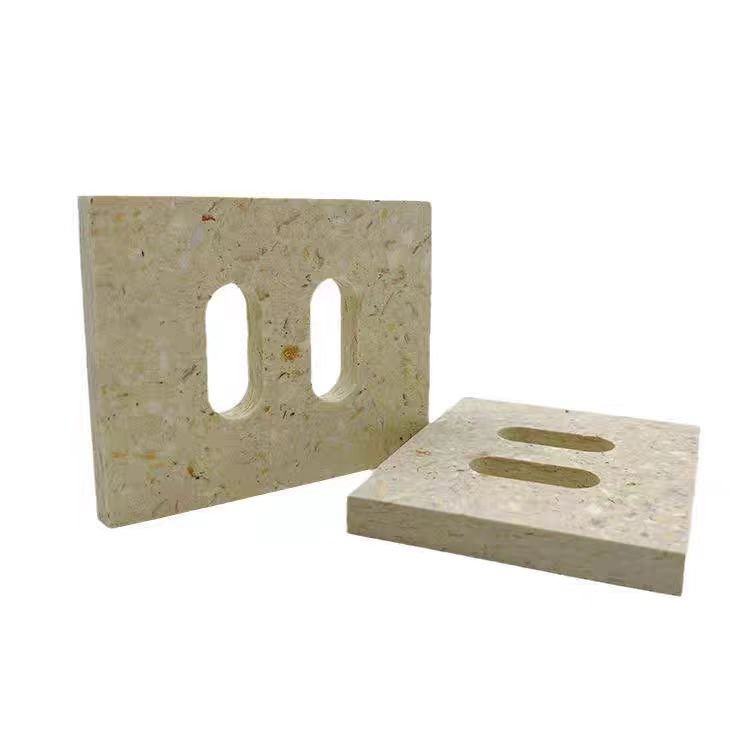
To match the standardized but project-specific nature of North American construction, blocks are available in sizes from 100×100 mm small pads up to 600×600 mm large-format blocks, with CNC machining tolerances of ±1 mm.
Common prefabrication options include:
- Pre-drilled anchor bolt hole patterns matched to standard steel column base plate details
- Custom shapes for pipe shoe and saddle supports
- Stepped and profiled geometries for curtain wall and window sill thermal breaks
This off-site precision reduces field labor, improves installation consistency and helps projects stay on schedule in high-cost labor markets.
5. Real-World ROI for North American Owners & Contractors
The financial case for structural thermal break blocks in North America rests on three measurable value streams: energy savings, avoided failure costs and reduced lifecycle maintenance.
5.1 Cold Storage Facility Energy Payback
For a typical 50,000 ft² frozen food distribution facility in the U.S. Midwest:
- Unmitigated floor and column thermal bridges contribute approximately 20% of refrigeration heat gain.
- Installing high-density PUR thermal break blocks at floor load points and column bases reduces this heat gain substantially, cutting annual refrigeration electricity costs by an estimated 15–20%.
- At prevailing industrial electricity rates, the material and installation investment is typically recovered in 2–3 years through energy savings alone — before accounting for avoided frost heave repair and extended slab service life.
5.2 Commercial Structural Project Compliance & Risk Reduction
For multi-story steel-frame commercial buildings in code-enforced markets:
- Integrating thermal break blocks at column bases, beam connections and façade anchors improves overall envelope thermal performance, helping projects meet IECC and NECB thermal bridging requirements on the first plan review submission.
- Avoiding a single plan rejection and re-submittal cycle saves 2–4 weeks of schedule delay and associated soft costs, general conditions and potential liquidated damages — a value far exceeding the total cost of the thermal break material package.
- Over the building lifecycle, reduced condensation and corrosion extend structural connection service life and lower long-term capital maintenance expenses.
5.3 Cryogenic Industrial System Reliability Gains
For cryogenic processing and refrigeration piping systems:
- Thermal break blocks at pipe supports minimize cold-spot formation, ice buildup and corrosion under insulation — the closed-cell PUR structure resists moisture ingress even under sustained condensation conditions, preventing ice formation at the support interface and extending insulation system service life while reducing annual maintenance hours.
- Fewer insulation failures and less scheduled shutdown maintenance translate to higher system uptime and lower long-term ownership cost, which is particularly valuable for process-critical LNG and industrial refrigeration assets.
6. Conclusion
For decades, North American construction teams accepted thermal bridges as an unavoidable tradeoff of structural steel and heavy industrial design. They no longer have to.
High-density load-bearing thermal break technology closes the gap between structural performance and energy code compliance, delivering a single engineered solution that works across steel foundations, cold storage floors and cryogenic piping. In a market defined by tightening codes, rising labor costs and extreme climate conditions, it is no longer an optional upgrade — it is the standard for durable, code-compliant industrial infrastructure.
7. Technical Boundary Conditions
All performance data is derived from standardized laboratory testing conducted under controlled conditions. Actual in-service performance depends on project-specific design parameters including load magnitude, temperature range, installation quality, environmental exposure, moisture conditions and long-term maintenance practices.
Thermal break blocks are engineered components that must be integrated into a properly designed structural and thermal assembly. Structural and thermal performance should be verified by qualified engineers on a project-by-project basis, with due consideration for applicable building codes, industry standards and local jurisdictional requirements.
This document is for technical reference only and does not constitute engineering advice, warranty or guarantee of specific field results.
8. Next Steps for Your North American Project
Addressing structural thermal bridges is one of the highest-return investments a project team can make for code compliance, energy performance and long-term structural durability — especially in the high-cost, high-regulation North American market.
Hebei Woqin supplies high-density rigid polyurethane thermal break blocks engineered for North American code, climate and load conditions, backed by full test documentation, CNC custom fabrication and application engineering support.
Contact Us
Company Information
Hebei Woqin Trading Co., Ltd.
Email: an@cn-aerogel.com
Website: www.cn-aerogel.com

Written by - Ruibin An
Industry Veteran with 13+ Years of Experience. Deeply rooted in the insulation industry for over 13 years, specializing in supply chain optimization and global market trends for Rock Wool and Aerogel materials.
LATEST NEWS
High-Density Rigid PU Thermal Break Blocks: North American Code-Compliant Structural Solution
2026-07-01
Beyond Insulation: Why Structural Thermal Breaks Are Essential for Modern Industrial Infrastructure
2026-06-29
The Ultimate Guide: "Survival Rules" and System Defenses for Industrial Piping Insulation in Extreme Middle Eastern Environments
2026-06-25
Unlocking Aramco & SABIC Compliance: The Highly Secure Path to Mechanical Completion Sign-Off
2026-06-25
Cutting Pipeline Insulation Labor Costs by 40% in 50°C Middle East Heat
2026-06-18