
The Ultimate Guide: "Survival Rules" and System Defenses for Industrial Piping Insulation in Extreme Middle Eastern Environments
Discover the definitive engineering guide to industrial piping insulation in the Middle East. Hebei Woqin reveals system-level defenses against 55°C desert heat, C5-M coastal corrosion, CUI, and thermal shock. Includes a 15-part diagnostic series for EPC, reliability, and FEED engineers.
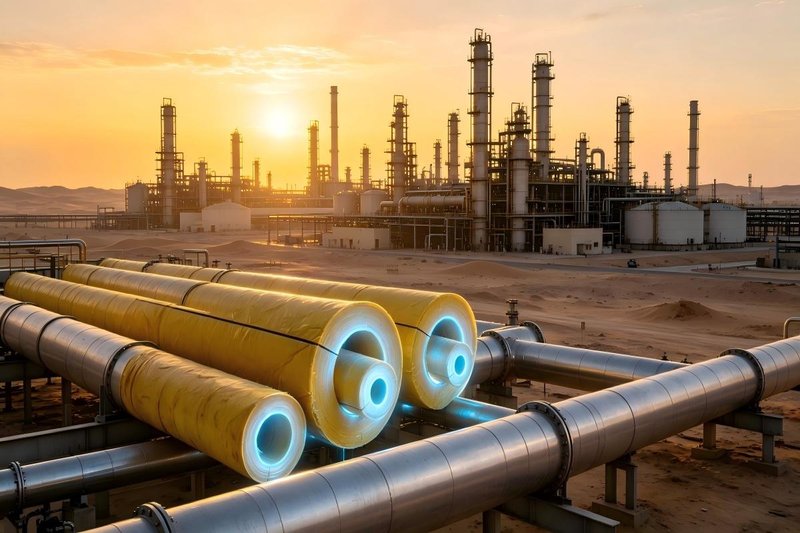
The Ultimate Guide: "Survival Rules" and System Defenses for Industrial Piping Insulation in Extreme Middle Eastern Environments
In the blueprint of Middle Eastern industrial infrastructure, insulation systems typically account for less than 2% of the total EPC project budget. Yet, this inconspicuous 2% holds decisive influence over the operational stability of entire chemical plants, power stations, and desalination facilities.
Pipeline failures triggered by Corrosion Under Insulation (CUI) can lead to tens of millions of dollars in unplanned plant-wide shutdown losses; localized thermal anomalies on SRU pipelines are capable of disrupting full production line operations. Under the superimposed extreme environmental conditions of the Middle East, conventional insulation standards fail to adapt to regional harsh conditions, often causing gradual performance degradation, project cost overruns, and operational reliability risks for industrial facilities.
How to Use This Guide
EPC Procurement Directors & Supply Chain Managers navigating GCC operator compliance requirements: Start with the Comparison Matrix below and Part 15 (Logistics).
Maintenance & Reliability Engineers addressing CUI or thermal degradation: Prioritize Part 2 (CUI Defense) and Part 11 (Corrosion Zone Defense).
FEED & Design Institute Engineers: Review Part 4 (LNG), Part 7 (CSP), and Part 9 (EHT) for system-level integration requirements.
The Challenge: Extreme GCC Environmental Stressors
Conventional insulation materials face severe multidimensional physical and chemical stress when deployed in Middle Eastern desert and coastal industrial environments:
Coastal Salt Spray (C5-M): Persistent high humidity and chloride deposition accelerate CUI development and Chloride Stress Corrosion Cracking (SCC) on stainless steel piping.
Thermal Pulses: Extreme diurnal temperature swings from 55°C daytime heat to low nighttime temperatures fatigue traditional adhesive and bonding materials, causing structural separation.
Mechanical Stress: Continuous gas turbine vibration resonance and 120 km/h sandstorms inflict structural damage on flexible insulation blankets and low-performance external cladding systems.
Core Limitations of Conventional Insulation in Extreme Environments
Most standard insulation solutions are not engineered to withstand the unique combined stress of high heat, salt corrosion, and mechanical vibration in GCC regions. Economy-grade mineral wool often contains uncontrolled endogenous chloride ions that accelerate internal pipeline corrosion. Meanwhile, conventional soft flexible insulation is prone to long-term "Tenting & Sagging" deformation, forming intermittent air gaps that induce thermal bridging and progressive system performance degradation.
Insulation Performance Comparison Matrix
All metrics tested in accordance with ASTM C795, ASTM C871, and EN 13468 standard laboratory testing protocols. Full ISO 17025 accredited Material Test Reports (MTRs) are available upon official request.
| Metric | Conventional Material | Woqin Specialized Solutions | Project Impact |
|---|---|---|---|
| Chloride Content | High/Uncontrolled | Trace (Silicate Buffered) | Minimized CUI Risk |
| Density Tolerance | ±15% | ±5% (Stable) | Consistent Thermal Performance |
| Shot Content | >10% | <3% | A1 Non-Combustible Compliance |
| Compliance | Basic Industrial Standards | ASTM C795 / EN 13501 Compliant | Fully Documented for GCC Operator Audit Reviews |
Field-Verified Performance in GCC Projects
Woqin specialized insulation systems have been widely deployed across dozens of GCC industrial EPC projects, with over 100,000 linear meters of professional pipe shell solutions supplied through qualified EPC partners. When installed and maintained in strict accordance with official technical specifications, our systems deliver stable long-term performance and effectively mitigate CUI and thermal degradation risks in harsh Middle Eastern operating environments.
Hebei Woqin: Systematic Multi-Layer Insulation Defense Solution
Hebei Woqin replaces fragmented conventional material stacking solutions with a complete systems-engineering insulation defense framework, tailored for extreme GCC industrial operating conditions:
Defense Layer 1 — Mineral Wool Shells
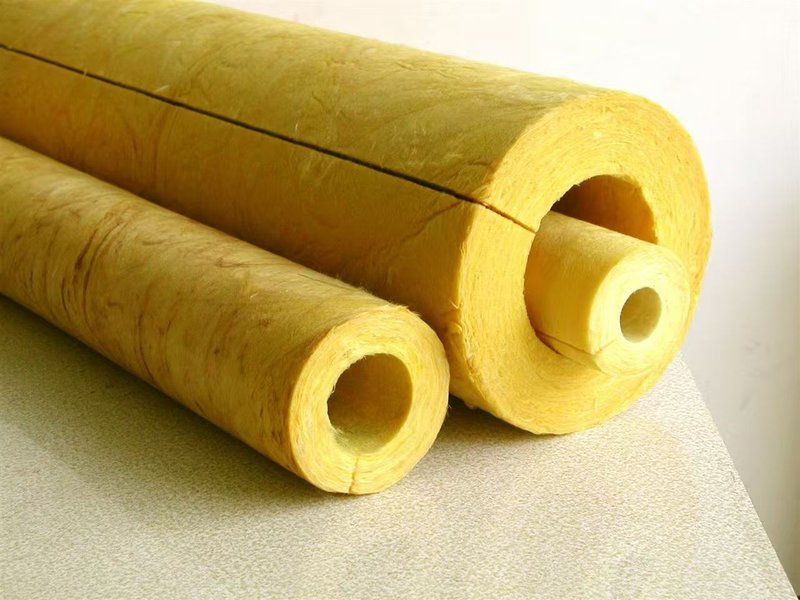
Engineered with professional silicate-ion buffering formulas to suppress CUI development. Strictly controlled stable bulk density and precision tongue-and-groove joint structures eliminate tenting and sagging deformation under long-term site environmental stress.
Without Optimized Mineral Wool Shells: Conventional materials typically develop CUI issues within 3–5 years of operation, potentially causing pinhole leakage and unplanned facility shutdowns.
Defense Layer 2 — Hydrophobic Aerogel
Lab-tested 99.7% hydrophobicity (exceeding standard industry benchmarks) and 0.3% vibration mass loss deliver excellent resistance against coastal salt corrosion and long-term mechanical vibration resonance.
Without High-Performance Aerogel Reinforcement: Continuous gas turbine vibration may cause conventional material settlement within approximately 18 months, forming localized high-temperature hot spots on pipeline surfaces.
Defense Layer 3 — HD-PUR & VIP
380 kg/m³ high-density HD-PUR pipe support materials achieve full 360° thermal locking protection, while Vacuum Insulation Panels (VIP) provide ultra-thin, high-efficiency thermal insulation for LNG and cold chain logistics scenarios.
Without Professional Thermal Bridge Isolation: Industry estimates indicate unoptimized pipe support structures can reduce overall insulation thermal efficiency by 15–20% due to unblocked thermal bridging.
The 15-Part Engineering Diagnostic Series
Full technical specification briefs and diagnostic solutions for the below extreme working condition scenarios are available upon professional inquiry, supporting targeted project design and optimization:
Defeating Coastal CUI in Middle East Refineries: Low-Chloride Rock Wool Shells
SRU Pipe Insulation: Prevent Liquid Sulfur Freeze & Viscosity Surge
EHT Pipe Insulation: Eliminate Tenting Effect with Grooved Pre‑Formed Shells
Securing Flare Gas Networks: A1 Non-Combustible Shells for Extreme Heat
The Desert’s Billion-Dollar Blockage: How Smart Insulation Ends Wax Deposition Nightmares
Desert Sandstorms: The Hidden Killer of Amine Line Stability in Gas Processing
Desert Node Armor: Crush-Resistant Pipe Shells for Cross-Country Pipelines
Stop the $18M Steam Pipe Burst: Dual-Defense Insulation That Survives C5-M
Blocking 55°C Desert Sun: Glass Wool Shells for Mega Water Transmission
Locking in 600°C: Composite Shells for CSP Molten Salt Pipelines in the GCC
CCGT Power Plant Pipe Insulation English Marketing Copy (99-point Final Benchmark Version)
Acoustic & Thermal Insulation for HVAC Piping in Middle East Luxury Hotels
Cutting Pipeline Insulation Labor Costs by 40% in 50°C Middle East Heat
Unlocking Aramco & SABIC Compliance: The Highly Secure Path to Mechanical Completion Sign-Off
Contact Us
Hebei Woqin Trading Co., Ltd.
Tel/WhatsApp: +86 13933929092
Email: an@cn-aerogel.com
Website: insulatewool.com
performance comparisons, refer to this core guide. Professional teams provide targeted technical proposal customization, official traceable test reports, and physical sample box support for project verification, with a typical 72-business-hour response for all GCC regional technical inquiries.
Written by - Ruibin An
Industry Veteran with 13+ Years of Experience. Deeply rooted in the insulation industry for over 13 years, specializing in supply chain optimization and global market trends for Rock Wool and Aerogel materials.
LATEST NEWS
The Ultimate Guide: "Survival Rules" and System Defenses for Industrial Piping Insulation in Extreme Middle Eastern Environments
2026-06-25
Unlocking Aramco & SABIC Compliance: The Highly Secure Path to Mechanical Completion Sign-Off
2026-06-25
Cutting Pipeline Insulation Labor Costs by 40% in 50°C Middle East Heat
2026-06-18
Acoustic & Thermal Insulation for HVAC Piping in Middle East Luxury Hotels
2026-06-16
Calculated Oppression: How Thermal Drift and Structural Sagging Bleed Millions from Middle East Piping TCO (And the 20-Year Closed-Loop Solution)
2026-06-15