
Needle-Punched Ceramic Fiber Blankets: Optimizing Density and Slag Content for Extreme Environments
Discover why generic insulation fails in extreme heat. Learn how optimizing needle-punched ceramic fiber blankets with a 107 kg/m³ density and ≤11.6% slag content prevents thermal bridges, stops vibration slump, and guarantees long-term industrial safety.
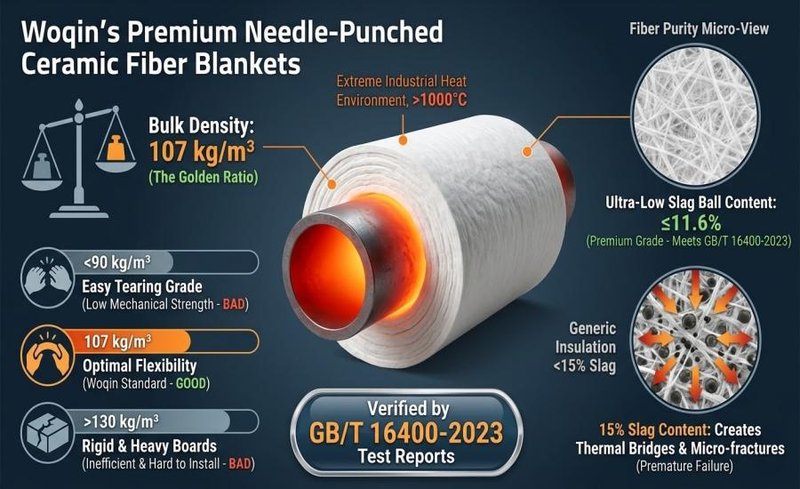
For extreme industrial thermal management, generic insulation fails under vibration and thermal cycling. High-purity needle-punched ceramic fiber blankets with optimized bulk density (107 kg/m³) and ultra-low slag ball content (≤11.6%) provide stable, long-lasting thermal resistance. Verified by certified GB/T 16400-2023 testing, these precise specifications are the difference between decades of reliable performance and catastrophic premature failure.
1. The Slag Ball Problem: Why Purity and Thermal Bridges Matter
In high-temperature applications such as petrochemical pipelines, kilns, and heavy machinery, impurities dictate the lifespan of your insulation. "Slag balls" are non-fibrous, solid glassy byproducts created during the fiber manufacturing process (specifically particles with a diameter Φ > 0.212mm).
- The Risk of Impurity: High slag content creates dangerous thermal bridges—solid pathways that allow heat to bypass the insulating air pockets. Furthermore, these heavy, rigid particles act as internal stress points, increasing the risk of mechanical degradation under constant industrial vibration.
- The Negative Impact: To put this into perspective, a generic, low-cost blanket with a 15% slag content would have roughly 30% more thermal bridges than a premium alternative. This significantly accelerates heat loss and invariably leads to premature failure during aggressive cyclic heating.
- The Premium Standard: Our premium needle-punched ceramic fiber blankets strictly control slag ball content to ≤ 11.6%. This precise formulation ensures a high-purity fibrous matrix, directly meeting GB/T 16400-2023 requirements for premium-grade refractory fiber. It guarantees consistent thermal resistance without the risk of internal breakdown.
2. Bulk Density Optimization: The 107 kg/m³ Sweet Spot
In heavy industry, insulation must perfectly balance heat retention, structural integrity, and deadweight. Bulk density is the most critical parameter in achieving this equilibrium.
- Too Light (< 90 kg/m³): Low-density blankets fail to store sufficient thermal energy and lack mechanical strength. They tear easily under installation stress and are highly prone to settling or powdering under constant mechanical vibration.
- Too Heavy (> 130 kg/m³): Overly dense rigid boards lose the critical flexibility required for wrapping complex pipe geometries, valves, and flanges. They also add unnecessary deadweight to equipment housings.
- The Optimal Spec: A calibrated bulk density of exactly 107 kg/m³ strikes the perfect balance. It is well above lightweight grades (< 90 kg/m³) that tear easily, yet flexible enough to outperform heavy rigid boards (> 130 kg/m³). This optimized density provides maximum heat storage capacity while retaining the pliability necessary for complex installations or composite systems (such as pairing with advanced aerogel layers).
3. Eradicating Guesswork with Certified Test Reports
In extreme industrial environments, material failure equals catastrophic downtime. Procurement and engineering teams cannot rely on marketing assumptions; they require hard data.
Leading refractory insulation manufacturers provide comprehensive, certified laboratory test reports. Based on our latest laboratory data, a properly optimized 107 kg/m³ alumina-silicate blanket delivers uncompromising performance:
- Thermal Conductivity: Maintained at an ultra-low 0.134 W/(m·K) at extreme 500°C operating temperatures.
- Moisture Defense: Maximum moisture content capped at 0.2%, preventing initial thermal shock.
- Dimensional Stability: Minimal linear shrinkage of just -1.5% after 24 hours of continuous exposure at 800°C.
Conclusion & The Complete Specification Matrix
Upgrading to certified, low-slag, optimally dense ceramic fiber blankets is not just a routine maintenance task—it is a critical engineering upgrade that directly impacts operational safety, reduces energy waste, and extends equipment lifespan.
However, optimizing density and purity is only part of the equation for a fail-safe system. To ensure your insulation survives the absolute harshest industrial conditions, you must account for mechanical stress and extreme peak temperatures:
- Mechanical Integrity: For environments involving heavy mechanical vibration (like reciprocating pumps or marine engines), density alone isn't enough. Read how .Read how 44kPa tensile strength prevents vibration slump.
- High-Temperature Stability: If your operations run near peak temperatures of 1260°C, verifying low linear shrinkage specs is just as critical as checking the slag content to prevent thermal gap failures over time.

Written by - Ruibin An
Industry Veteran with 13+ Years of Experience. Deeply rooted in the insulation industry for over 13 years, specializing in supply chain optimization and global market trends for Rock Wool and Aerogel materials.
LATEST NEWS
CCGT Power Plant Pipe Insulation English Marketing Copy (99-point Final Benchmark Version)
2026-06-10
Locking in 600°C: Composite Shells for CSP Molten Salt Pipelines in the GCC
2026-06-10
Blocking 55°C Desert Sun: Glass Wool Shells for Mega Water Transmission
2026-06-10
Stop the $18M Steam Pipe Burst: Dual-Defense Insulation That Survives C5-M
2026-06-04
Desert Node Armor: Crush-Resistant Pipe Shells for Cross-Country Pipelines
2026-06-03