
Stop Single-Layer Failures: How 1260°C Ceramic + Aerogel Composites Halve Insulation Thickness
In heavy metallurgy and 600MW power generation, relying on a single insulation material has reached its physical limits. Discover why engineers are abandoning traditional single-layer setups and turning to composite thermal barriers. By integrating 1260°C, 44kPa needle-punched ceramic fiber blankets with ultra-low conductivity aerogel, facilities are stopping vibration slump, eradicating thermal bridges, and halving overall insulation thickness while securing Class A1 fire safety for decades.
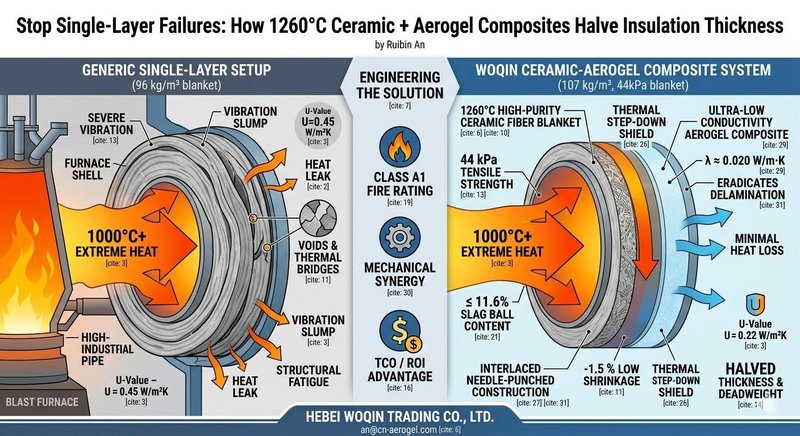
In the demanding environments of metallurgy and power generation, facility engineers face a constant battle against extreme heat. A recent inspection of a power plant furnace highlighted a critical industry reality: unexpected heat loss from single-layer insulation failures not only risks operational efficiency but creates severe safety hazards.
When lining boilers, high-temperature furnaces, and heat exchangers that reach up to 1260°C, relying on a single type of conventional insulation is no longer sufficient. Today, the most advanced heat containment solutions require a hybrid approach.
Top-tier refractory insulation manufacturers are solving this by engineering composite thermal barriers—specifically, combining traditional 1260°C ceramic fiber blankets with advanced aerogel composites. But this integration is highly complex; you cannot build a next-generation aerogel system on a weak foundation.
Here is the engineering logic behind the ultimate composite thermal barrier.
1. The Thermal "Step-Down" Shield: Protecting the Aerogel
Aerogel is celebrated for its ultra-low thermal conductivity (often around 0.020 W/m·K). However, in environments exceeding 650°C, the delicate nano-porous structure of standard aerogel begins to degrade. This is where the alumina-silicate ceramic fiber blanket steps in as the mandatory "Fire Shield."
Positioned directly against the extreme heat source, the high-purity ceramic blanket takes the initial thermal assault. Its primary job is to "step down" the temperature from 1000°C+ to a safe working range for the subsequent aerogel layer.
To execute this flawlessly, the ceramic fiber must be exceptionally pure. Hebei Woqin’s blankets feature a strictly controlled slag ball content of ≤ 11.6%. This high fiber purity eliminates the internal thermal bridges that plague generic blankets, ensuring a uniform temperature drop. Furthermore, our blankets comply with Class A1 fire ratings. This non-combustible classification guarantees that the primary insulation will not fuel fire spread, protecting both the expensive aerogel layers behind it and the facility's infrastructure.
2. The Mechanical Synergy: Eradicating Delamination and Slump
Enhancing thermal barrier performance requires more than just stacking materials. The harsh reality of power plants involves relentless mechanical stress and vibrations.
Consider the reality of a generic setup: A standard, low-cost 96 kg/m³ blanket with poor tensile strength will inevitably sag under continuous turbine vibration. Once it slumps, it creates a void, allowing intense heat to bypass the shield and literally crush or degrade the fragile aerogel layer behind it.
This is why leading ceramic fiber blanket suppliers insist on extreme mechanical toughness. Our needle-punched blankets, characterized by an interlaced fiber construction, provide the robust foundation necessary to prevent this catastrophic failure. With an optimized bulk density of 107 kg/m³ and an industry-leading tensile strength of 44 kPa (double the industry average), Hebei Woqin’s ceramic blanket acts as the structural "rebar" of the system. It guarantees that the heavy aerogel layers remain firmly anchored around vibrating turbines and complex pipe geometries without suffering from "vibration slump."
3. The U-Value Revolution: Halving Insulation Thickness (From 0.45 to 0.22 W/m²K)
When you combine a structurally flawless, low-shrinkage (-1.5% at 800°C) ceramic fiber blanket with an aerogel composite, the results redefine facility economics.
This hybrid structure leverages the mechanical toughness of the ceramic fibers, while the aerogel adds an extraordinary dimension of insulation. For EPC contractors and facility managers, the math is undeniable:
- The Ceramic Layer handles the extreme heat and vibration, providing a baseline conductivity of 0.134 W/(m·K) at 500°C.
- The Aerogel Layer traps the remaining heat with near-zero conductivity.
Together, they form a highly efficient barrier. In practical applications, replacing a traditional thick rock wool setup with this composite system can drop the overall thermal transmittance (U-Value) from a standard 0.45 W/m²K down to an astonishing 0.22 W/m²K.
Achieving this target U-Value requires only 40% to 50% of the thickness of traditional setups. This integration aligns perfectly with industrial demands for improved energy conservation. It drastically reduces the deadweight on piping infrastructure, cuts down on expensive metal cladding, and frees up critical operational space in tight industrial corridors.
Conclusion: Stop Guessing, Start Engineering
The 1260°C ceramic fiber blanket remains a crucial component for industries focused on safety, longevity, and cost control. However, its true potential is unlocked when engineered to the precise specifications—low shrinkage, high tensile strength, and optimized density—required to support advanced aerogel composites.
Are you dealing with failing insulation in your power plant or metallurgical facility? Don't replace it with the same generic materials that will fail again.
Action Hook: Send our engineering team your current operating temperatures, pipe dimensions, and ambient conditions. We will provide a custom thermal calculation showing exactly how much space and energy you can save by upgrading to a Woqin Ceramic-Aerogel Composite System. Contact Us Today for a Free Thermal Audit.

Written by - Ruibin An
Industry Veteran with 13+ Years of Experience. Deeply rooted in the insulation industry for over 13 years, specializing in supply chain optimization and global market trends for Rock Wool and Aerogel materials.
LATEST NEWS
District Cooling in the Gulf: The Physics of Inevitable Condensation and How Pre-Formed Glass Wool Shells Stop It
2026-06-12
CCGT Power Plant Pipe Insulation English Marketing Copy (99-point Final Benchmark Version)
2026-06-10
Locking in 600°C: Composite Shells for CSP Molten Salt Pipelines in the GCC
2026-06-10
Blocking 55°C Desert Sun: Glass Wool Shells for Mega Water Transmission
2026-06-10
Stop the $18M Steam Pipe Burst: Dual-Defense Insulation That Survives C5-M
2026-06-04