
The Foundation of Mega-LNG Tanks: Bearing 10,000-Ton+ Loads at -196°C with 8 MPa Structural HD-PUR
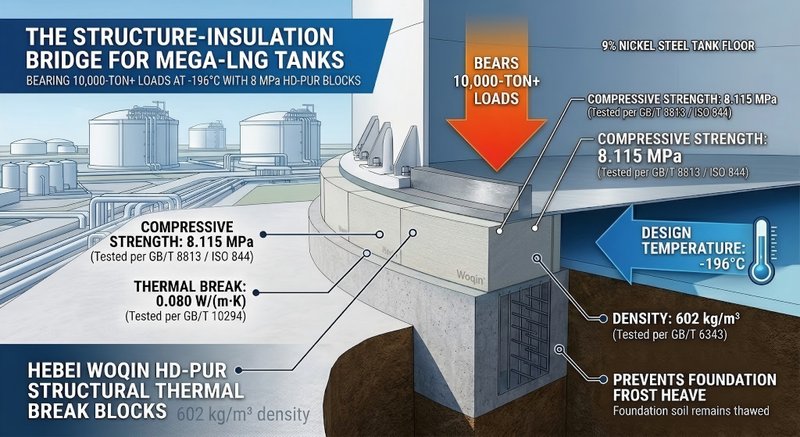
In the civil engineering of mega-scale Liquefied Natural Gas (LNG) storage tanks, the concrete ring beam represents the ultimate stress point. Structural engineers are tasked with a critical thermodynamic paradox: transferring over 10,000 tons of static and dynamic weight to the ground while preventing -162°C cold energy from triggering catastrophic foundation frost heave. This technical whitepaper analyzes why traditional materials fail the "Long-Term Stability Test" and introduces Hebei Woqin’s 602 kg/m³ Structural HD-PUR—an engineered polymer matrix with a verified 8.115 MPa compressive strength designed to bridge the gap between structural integrity and cryogenic insulation.
1. Redefining PUR: From "Insulation Foam" to "Primary Structural Element"
Before evaluating foundation thermal breaks, we must address a critical industry misconception. In many engineering circles, Polyurethane (PUR) is categorized strictly as a low-density, non-load-bearing insulation (typically 30-50 kg/m³).
Hebei Woqin’s HD-PUR is not a foam; it is a structural polymer.
With a verified density of 602 kg/m³ (Tested per GB/T 6343), this material behaves as an isotropic synthetic composite. It is engineered to replace legacy materials like high-density hardwood or perlite concrete, which often fail under the extreme thermo-mechanical cycles of LNG operations.
2. The "Zero-Datum" Crisis: Why 2mm Matters
For a 200,000 m³ LNG tank, structural stability begins at the ring beam. Engineers often overlook the "amplification effect" of foundational settling.
The Structural Reality: A mere 2mm deflection or "Cold Creep" in the ring beam thermal blocks can result in more than 10mm of misalignment at the tank roof. This displacement can compromise primary vapor seals, trigger stress fractures in the 9% Nickel steel inner tank, and lead to catastrophic secondary containment failure.
3. Bridging the Gap: Why Concrete is Not the Answer
A common question from structural designers is: "Why not use high-strength concrete directly?" While reinforced concrete possesses superior compressive strength (30-50 MPa), its high thermal conductivity makes it a "Cold Bridge" that invites frost heave. Conversely, traditional insulation is too weak to support the tank’s tonnage.
Woqin’s HD-PUR (8.115 MPa per GB/T 8813) serves as the "Structural Bridge." It provides the necessary bearing capacity to stabilize 10,000-ton+ loads while delivering a thermal conductivity of 0.080 W/(m·K) (GB/T 10294). It is the only material that simultaneously protects the foundational soil from freezing and the tank structure from settling.
Critical Failure Mode 1: 10,000-Ton Static Loads & the "2mm/10mm Amplification" Risk
In the life cycle of a 200,000 m³ LNG storage tank, the vertical static load is colossal. The thermal break blocks on the ring beam are subjected to constant, extreme pressure.
The Structural Crisis: Traditional secondary insulation materials often suffer from "Cold Creep"—a slow, microscopic cellular collapse.
- The Quantitative Danger: Our engineering simulations show that a mere 2mm of structural deflection at the foundation ring beam can amplify into a >10mm misalignment at the tank roof. This is enough to rupture primary vapor seals and cause uneven stress on the 9% Nickel steel inner tank, potentially leading to catastrophic containment failure.
The Woqin Solution: With a verified compressive strength of 8.115 MPa (Tested per GB/T 8813 / ISO 844), Woqin HD-PUR is engineered to support over 800 tons per square meter. Unlike legacy perlite or low-density materials, our 602 kg/m³ matrix ensures that the "Zero-Datum" level remains perfectly stable throughout the 50-year design life, preventing the structural tilting that haunts traditional designs.
Critical Failure Mode 2: The "Frost Heave" Catastrophe (Soil Mechanics)
For a civil engineer, the greatest threat to an LNG terminal is the freezing of the sub-soil. Liquid Natural Gas at -162°C acts as a massive thermal sink. Without a high-performance thermal break, this "cold energy" migrates through the concrete ring beam into the earth.
The Catastrophe: Once the groundwater in the soil undergoes a phase change into ice, it generates a violent "Frost Heave Force." This upward expansion pressure is capable of cracking reinforced concrete slabs and inducing non-uniform settlement of the entire tank foundation.
The Woqin Solution: Delivering a thermal conductivity of 0.080 W/(m·K) (Tested per GB/T 10294), Woqin HD-PUR acts as the definitive thermodynamic barrier. It effectively decouples the cryogenic environment from the foundation soil, keeping the sub-structure safely above the freezing point and eliminating the risk of frost-induced heave.
Critical Failure Mode 3: Biological Decay & The "Internal Splitting" of Legacy Timber
Historically, high-density hardwoods (HDW) were the only option for load-bearing thermal breaks. But hardwood is an organic, porous material.
The Liability: In the damp, unventilated environment of a tank foundation, wood is prone to fungal decay and insect infestation. More critically, wood absorbs moisture via capillary action. When this trapped water meets -162°C temperatures, it expands into ice, causing "Internal Splitting"—effectively shattering the block from the inside out and compromising the tank's support.
The Woqin Solution: Woqin HD-PUR is a 100% synthetic, inorganic-matrix polymer with a closed-cell rate exceeding 95% (Tested per GB/T 10799). It is "biologically dead," meaning it cannot rot or support mold. With a water absorption rate of <2.1% (24h immersion), it remains bone-dry and structurally intact in high-humidity coastal environments, providing the maintenance-free certainty that organic timber can never match.
Engineering Benchmark: Legacy Materials vs. Woqin HD-PUR
To assist EPCs in material selection, the following table compares the structural and thermal performance of common ring beam insulation options against Woqin HD-PUR.
| Performance Metric | Traditional Hardwood (HDW) | Low-Density PUR (50 kg/m³) | Perlite Concrete | Woqin HD-PUR |
| Density | ~700 kg/m³ | 30-50 kg/m³ | ~400 kg/m³ | 602 kg/m³ |
| Compressive Strength | Anisotropic (Directional) | < 0.5 MPa | ~1-2 MPa | 8.115 MPa |
| Thermal Conductivity | ~0.15 W/(m·K) | 0.024 W/(m·K) | ~0.20 W/(m·K) | 0.080 W/(m·K) |
| Water Resistance | High Absorption (Swelling) | Medium | High | Low (< 2.1%) |
| Closed-Cell Rate | N/A (Porous) | > 90% | N/A | > 95% |
| Biological Decay | High Risk (Fungi/Insects) | None | None | Zero (Inorganic) |
| 50-Year Reliability | Requires Monitoring | High Creep Risk | Cracking Risk | Maintenance-Free |
Critical Failure Mode 4: Anisotropic Vulnerability vs. Isotropic Shear Resistance
The structural stress on a ring beam is not purely vertical. During the initial commissioning phase, as thousands of tons of LNG at -162°C are pumped in, the 9% Nickel inner steel tank undergoes severe thermal contraction. This massive dimensional change generates violent, horizontal shear forces that are transferred directly to the foundation thermal breaks.
The Structural Flaw: Hardwood is inherently anisotropic—its strength is directional. While it may offer decent compression resistance along the grain, it is extremely vulnerable to transverse forces. Under the unpredictable, multi-directional shear stresses of a shrinking mega-tank, wood is highly prone to longitudinal splitting (cleavage failure).
The Woqin Solution: HD-PUR is an isotropic engineered matrix. Its molecular structure provides perfectly uniform strength across all 360 degrees. According to comprehensive laboratory testing, Woqin’s 602 kg/m³ HD-PUR boasts a flexural strength of 8.17 MPa and a shear strength of 1.02 MPa. It possesses no weak "grains." It actively absorbs and distributes complex, multi-directional shear stresses without micro-fracturing, ensuring the foundation remains intact during extreme cryogenic cycles.
Critical Failure Mode 5: Fastening Integrity & The 50-Year "Zero-Maintenance" Mandate
For EPC contractors and structural designers, the ring beam thermal break carries a terrifying engineering reality: once the mega-tank is commissioned, these blocks are permanently inaccessible. You cannot lift a 200,000 m³ tank to replace a rotting or shattered piece of insulation.
Furthermore, these blocks often require mechanical fastening (anchoring) to the concrete base or steel interfaces. Drilling into brittle legacy plastics or dried hardwood frequently induces micro-cracking, which immediately compromises the block's structural integrity before the tank is even built.
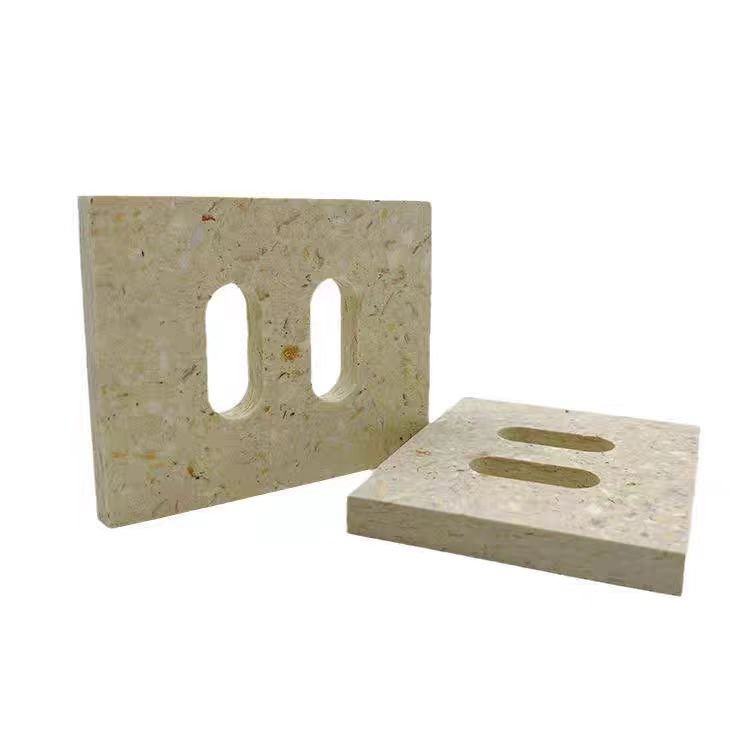
The Woqin Solution: Woqin’s HD-PUR machines and fastens exactly like premium hardwood, but without the risk of splitting. Laboratory tests verify a massive screw pull-out force (grip strength) of 620N. Engineers can confidently drill, anchor, and secure these blocks. The dense matrix grips the fasteners with extreme force while maintaining its vapor-tight, load-bearing integrity for a guaranteed 50-year design life.
Conclusion: Do Not Compromise the Ankle of Your LNG Mega-Structure
In the zero-tolerance landscape of cryogenic infrastructure, the concrete ring beam is no place for outdated materials. Specifying legacy timber, perlite, or low-density plastics exposes your multi-billion-dollar asset to the catastrophic risks of cold creep, foundation frost heave, and internal splitting.
Hebei Woqin’s 8.115 MPa Structural HD-PUR bridges the impossible gap. It delivers the uncompromising load-bearing capacity required to stabilize 10,000-ton+ structures, combined with an elite 0.080 W/(m·K) thermal barrier to protect the foundational soil.
Protect your structural "Zero-Datum." Eliminate the risk of frost heave. Specify engineered certainty for the next 50 years.
Secure Your Structural Load-Bearing Calculations Today
Stop relying on compromised materials for modern mega-projects. Contact Hebei Woqin's cryogenic engineering team to discuss your specific tank tonnage, thermal gradient requirements, and to secure a physical prototype of our 602 kg/m³ HD-PUR blocks.
👉 Email our Technical Desk: an@cn-aerogel.com
👉 Explore our Factory-Direct Capabilities: www.insulatewool.com
🔗 Explore Related Cryogenic Engineering Solutions:
Written by - Ruibin An
Industry Veteran with 13+ Years of Experience. Deeply rooted in the insulation industry for over 13 years, specializing in supply chain optimization and global market trends for Rock Wool and Aerogel materials.
LATEST NEWS
Stop the $18M Steam Pipe Burst: Dual-Defense Insulation That Survives C5-M
2026-06-04
Desert Node Armor: Crush-Resistant Pipe Shells for Cross-Country Pipelines
2026-06-03
Desert Sandstorms: The Hidden Killer of Amine Line Stability in Gas Processing
2026-06-02
The Desert’s Billion-Dollar Blockage: How Smart Insulation Ends Wax Deposition Nightmares
2026-06-01
Securing Flare Gas Networks: A1 Non-Combustible Shells for Extreme Heat
2026-05-30