
[Technical White Paper] Securing GTT Mark III LNG Carrier Tanks: 8.17 MPa High-Flexural PUR for Extreme Sloshing Loads
In the specialized domain of LNG marine logistics, the containment system must operate at a continuous -162° while withstanding violent kinetic impacts. Modern Fluid-Structure Interaction (FSI) modeling identifies internal "sloshing" as a primary cause of structural fatigue in GTT Mark III membrane systems. This paper presents an engineered solution: Hebei Woqin’s 602 kg/m³ Structural HD-PUR. By achieving a near-identical 8.17 MPa flexural strength (GB/T 8812.2) and 8.115 MPa compressive strength (GB/T 8813), this material exhibits a 1:1 "Toughness-to-Rigidity" ratio. This isotropic performance eliminates the brittle fracture risks inherent in legacy materials, providing a 30-year safety margin against localized sloshing impact spikes.
1. Introduction: The Thermodynamic & Kinetic Paradox of -162° Logistics
The transportation of Liquefied Natural Gas (LNG) at -162° represents the apex of cryogenic engineering. In today's ultra-large LNG carriers (174,000 m³ +), the insulation system is no longer a passive thermal barrier but a critical structural support node.
In the engineering bureaus of major South Korean and Japanese shipyards (HHI, SHI, DSME), the GTT Mark III system is the prevailing standard. However, as tank volumes increase, the thermodynamic paradox intensifies: the insulation must remain stiff enough to support the immense static weight of the cargo, yet resilient enough to survive the dynamic "Liquid Sledgehammer" of the open sea. Specifying Hebei Woqin’s High-Flexural HD-PUR is the definitive response to this challenge.
2. The "Liquid Sledgehammer": Sloshing Dynamics & The Brittle Fracture Trap
During heavy sea states, the liquid cargo within the membrane tank develops massive kinetic momentum. As the ship pitches and rolls, this mass slams into the corners and ceiling of the primary barrier—a phenomenon known as Sloshing.
2.1 The Physics of Localized Impact Spikes
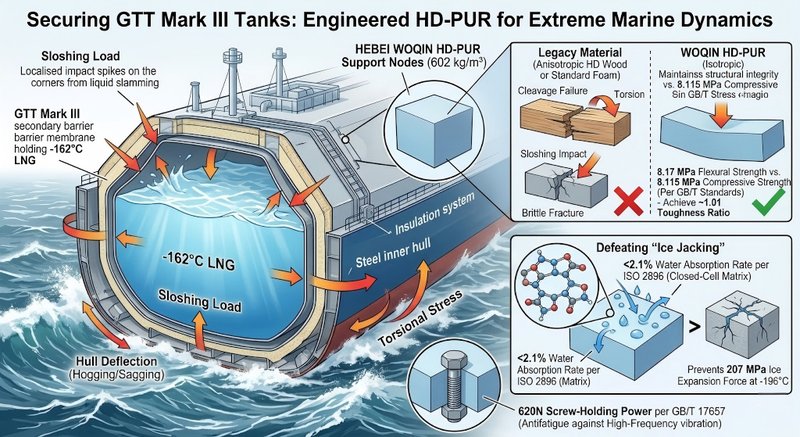
Naval architects utilize FSI (Fluid-Structure Interaction) to simulate these events. Data indicates that sloshing loads are not distributed pressures but millisecond-duration "impact spikes" that can exceed 1.5 MPa in localized zones.
- The Failure Mechanism: Legacy materials with high compressive strength but low flexural resilience (e.g., standard foams or cellular glass) are prone to Brittle Fracture. When the impact spike strikes, the lack of internal toughness causes micro-cracks to propagate instantly, leading to a mechanical breach of the secondary containment barrier.
2.2 The Woqin Innovation: The 1:1 Strength Ratio
Hebei Woqin’s HD-PUR is specifically synthesized to solve the "Brittle Trap" by maximizing Flexural Strength (8.17 MPa, tested per GB/T 8812.2 / ISO 1209-2).
| Mechanical Property | Value (Woqin HD-602) | Test Standard |
| Compressive Strength | 8.115 MPa | GB/T 8813 / ASTM D1621 |
| Flexural Strength | 8.170 MPa | GB/T 8812.2 / ISO 1209-2 |
| Screw-Holding Power | 620 N | GB/T 17657 |
| Flexural-to-Compressive Ratio | ~1.01 | Engineering Benchmark |
By engineering a material where the flexural capacity exceeds the compressive capacity, Woqin achieves "Elastic Toughness." When the sloshing sledgehammer strikes, our HD-PUR absorbs and dissipates the kinetic energy through micro-elastic deformation, effectively shielding the GTT Mark III membrane from structural failure.
3. Torsional Resilience: Hull Deflection & The "Isotropic" Imperative
Beyond the internal sloshing of the liquid cargo, the LNG containment system is continuously subjected to extreme external structural distortion. A 300-meter LNG carrier navigating heavy ocean swells experiences continuous longitudinal bending—a dynamic modeled in naval architecture as Hogging and Sagging.
3.1 Multi-Axis Torsional Stress & The 0.3g Acceleration Factor
During these hull deflections, coupled with wave inertial accelerations (typically modeled at 0.3g for 170,000m³
LNG carriers under severe sea states), the structural nodes between the inner steel hull and the GTT Mark III membrane face massive, multi-directional torsional shear. The insulation block must flex in perfect synchronization with the steel structure.
3.2 The Anisotropic Flaw vs. Isotropic Perfection
Historically, High-Density Wood (HDW) was specified for its compressive limits. However, wood is fundamentally Anisotropic—its mechanical properties are highly directional. Under multi-axis hull torsion, wood is susceptible to Cleavage Failure (longitudinal splitting along the grain).
Hebei Woqin entirely mitigates this risk through an Isotropic polymer matrix. Because the 8.17 MPa flexural strength is uniform across all 360 degrees, the HD-PUR block absorbs multi-directional shear forces without internal tearing, maintaining continuous support geometry regardless of the vessel's hogging or sagging state.
4. The Thermodynamics of "Ice Jacking" in Saline Environments
Offshore LNG operations involve a punishing combination of 100% relative humidity, coastal salt spray, and the -162° cryogenic gradient of the cargo. If an insulation support block absorbs moisture from the marine atmosphere, the thermodynamic consequences are catastrophic.
4.1 The 207 MPa Ice Expansion Threat
When liquid water transitions to ice at cryogenic temperatures, it undergoes a ~9% volumetric expansion. In the confined micro-fissures of an insulation block, this phase change generates an internal hydrostatic pressure of up to 207 MPa (approx. 30,000 psi).
This 207 MPa internal pressure far exceeds the tensile and flexural limits of traditional High-Density Wood or standard cellular glass (<2 MPa flexural strength). The result is "Ice Jacking"—the material is literally shattered from the inside out, destroying the structural node and introducing severe Boil-Off Gas (BOG) thermal bridges.
4.2 Engineered Impermeability: The <2.1% Standard
To eliminate the Ice Jacking mechanism, the insulation must physically block vapor drive. Hebei Woqin’s HD-PUR is engineered with a >95% closed-cell structure. Rigorous laboratory testing confirms an elite Water Absorption Rate of <2.1% (Tested per GB/T 8810 / ISO 2896 under 24-hour continuous immersion).
By restricting water ingress at the molecular level, Woqin’s HD-PUR ensures that internal ice formation is physically impossible. This absolute impermeability preserves the 8.115 MPa compressive integrity and the pristine thermodynamic barrier of the LNG containment system throughout its entire design life.
5. Mechanical Fastening: Mitigating High-Frequency Fatigue
While sloshing and hull deflection represent massive macro-dynamic forces, LNG carriers are simultaneously subjected to relentless micro-dynamic stress: High-Frequency Fatigue. The continuous vibration generated by massive two-stroke marine diesel engines, rotating propulsion shafts, and hydrodynamic wave impacts places severe cyclical stress on the mechanical fasteners securing the insulation blocks to the inner hull.
5.1 The Threat of Fastener Degradation
In standard rigid foams or slowly decaying timber, this relentless vibration causes the cellular structure around fastener threads to pulverize over time. Throughout a 30-year operational life, this inevitably leads to fastener pull-out, structural "play," and the creation of micro-thermal bridges. In a zero-tolerance GTT Mark III system, any structural loosening not only exacerbates sloshing damage but also elevates the daily Boil-Off Rate (BOR) beyond acceptable parameters.
5.2 The 620N Anchor (Tested per GB/T 17657)
Hebei Woqin’s HD-PUR matrix is highly cross-linked to deliver exceptional mechanical grip at the fastener interface. Rigorous laboratory evaluation confirms a remarkable Screw-Holding Power of 620 N (Tested per GB/T 17657).
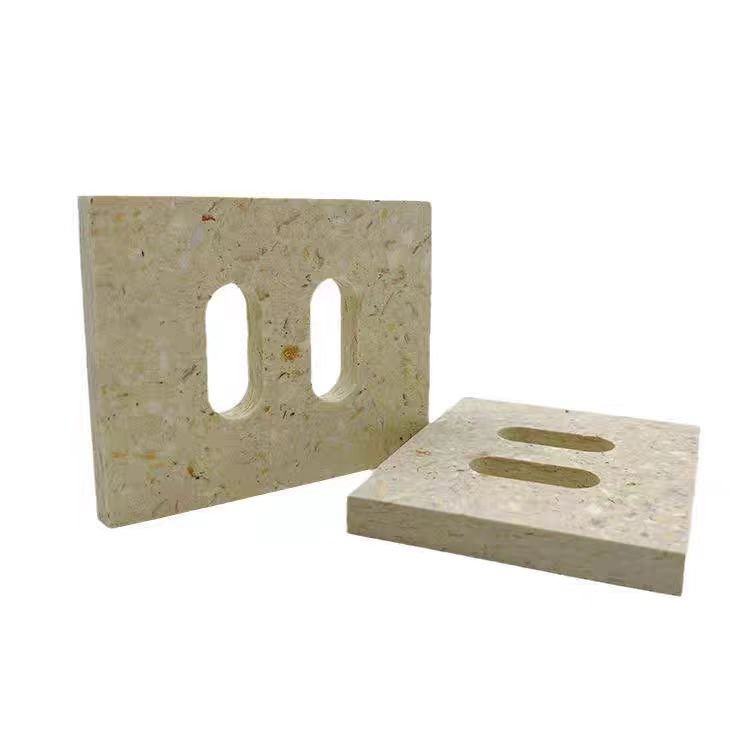
This engineered density allows shipyard technicians to apply high-torque mechanical bolting directly into the PUR matrix—exactly as they would with premium hardwoods—but without inducing any micro-cracking or splintering. Furthermore, the isotropic polymer structure acts as a mechanical dampener, absorbing high-frequency engine vibrations and ensuring the fasteners remain permanently dead-locked.
6. Conclusion: The Engineered Imperative for GTT Mark III Systems
In the high-stakes landscape of marine cryogenic engineering, specifying the optimal structural thermal break is not merely a thermodynamic choice; it is a fundamental safety mandate. For naval architects engineering the next generation of 174,000m³+ LNG mega-carriers, legacy materials present unacceptable risks of brittle fracture, cleavage failure, and internal ice jacking.
Hebei Woqin’s 602 kg/m³ High-Flexural HD-PUR redefines marine containment security. By delivering a ~1.01 Flexural-to-Compressive strength ratio (8.17 MPa) to absorb sloshing impact spikes, an isotropic matrix to survive hull torsion, an elite <2.1% absorption rate to defeat saline ice jacking, and a 620 N screw-holding grip to withstand decades of fatigue, Woqin provides unparalleled lifecycle reliability.
Secure Your Dynamic Load Prototype Today
Stop compromising secondary containment integrity with anisotropic or brittle legacy materials. Contact Hebei Woqin's marine engineering desk today to discuss your specific FSI (Fluid-Structure Interaction) parameters, and secure a physical prototype of our HD-PUR blocks for your shipyard's dynamic load simulations.
👉 Email our Marine Technical Desk: an@cn-aerogel.com
👉 Explore our Factory-Direct Capabilities: www.insulatewool.com
🔗 Explore Related LNG Engineering Solutions:

Written by - Ruibin An
Industry Veteran with 13+ Years of Experience. Deeply rooted in the insulation industry for over 13 years, specializing in supply chain optimization and global market trends for Rock Wool and Aerogel materials.
LATEST NEWS
Stop the $18M Steam Pipe Burst: Dual-Defense Insulation That Survives C5-M
2026-06-04
Desert Node Armor: Crush-Resistant Pipe Shells for Cross-Country Pipelines
2026-06-03
Desert Sandstorms: The Hidden Killer of Amine Line Stability in Gas Processing
2026-06-02
The Desert’s Billion-Dollar Blockage: How Smart Insulation Ends Wax Deposition Nightmares
2026-06-01
Securing Flare Gas Networks: A1 Non-Combustible Shells for Extreme Heat
2026-05-30