
Stopping Boil-Off Gas (BOG): The Role of Structural Thermal Breaks in LNG Piping
For LNG operators, Boil-Off Gas (BOG) is the ultimate "hidden tax" on terminal profitability. In a standard 5 MTPA facility, heat ingress through unoptimized supports can trigger over $20 million in annual flash gas losses and re-liquefaction penalties. This technical guide explores the catastrophic physics of "Ice Jacking" and "Cold Creep," demonstrating why Hebei Woqin’s 8.115 MPa HD-PUR serves as the definitive structural thermodynamic barrier for global LNG infrastructure.
Introduction: The $20 Million "Chronic Bleeding" of LNG Assets
In the zero-tolerance world of LNG export terminals, liquid natural gas is maintained at -162°C (-260°F). At this temperature, the thermodynamic gradient is your greatest enemy. For a typical 5 MTPA (Million Tonnes Per Annum) terminal, the "Reliquefaction Penalty" for structural heat leaks is staggering. Industry benchmarks confirm that unoptimized thermal bridges can lead to profit erosion of $7 million to $24 million USD annually.
While the piping is encased in high-performance insulation, the structural support points—the "Pipe Shoes"—are often the system's Achilles' heel. (For a deep dive into material mechanical selection, see our Guide to Cryogenic Pipe Shoes). Every joule of heat that migrates through these cold bridges is a direct catalyst for BOG generation, forcing your massive compressors to work overtime just to stay in place.
1. The "Heat Highway" and the Nightmarish "Ice Jacking" Effect
The Flaw of Metal-to-Metal Contact
When a cryogenic pipe shoe sits on a steel rack without a high-performance structural thermal break, you have opened a "Heat Highway." Steel, with a thermal conductivity thousands of times higher than insulation, allows ambient heat to bypass the vapor barrier and flood into the cryogenic stream.
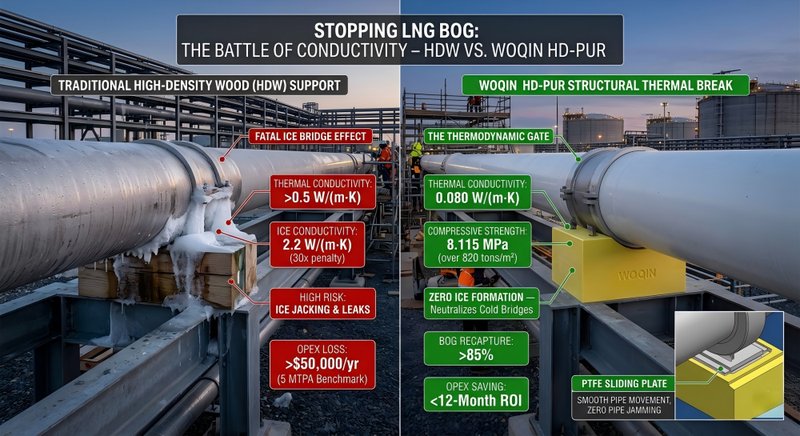
The Failure of Wood: The 0.5 W/(m·K) Collapse & "Ice Jacking"
Historically, High-Density Wood (HDW) was the fallback. But wood is biologically porous. In coastal LNG environments, it inevitably saturates with moisture. At -162°C, this moisture undergoes a violent phase change into ice, leading to two catastrophic failures:
- The Conductivity Spike: Wet, frozen wood can exceed a conductivity of 0.5 W/(m·K)—losing 85% of its original insulation value. In contrast, pure ice (2.2 W/m·K) is nearly 30 times more conductive than Woqin’s HD-PUR.
- Ice Jacking : As water freezes inside the wood or at the interface, the 9% volume expansion generates immense internal pressure. This "Ice Jacking" force is strong enough to rupture high-duty vapor barriers, tear the surrounding insulation jacket, and even lift heavy piping, leading to localized mechanical stress and potential flange leaks.
2. Beyond Standard Foam: Neutralizing "Cold Creep"
The Trap of Low-Density PUR
A common misconception among O&M teams is that "any PUR will do." However, standard-density polyurethane (200-300 kg/m³) is a liability under the crushing weight of full-bore LNG pipes. Over time, these materials suffer from "Cold Creep" —the support block slowly compresses, causing the pipe to sag. This misalignment triggers vibration, damages bellows, and creates air gaps where even more ice can accumulate.
The Woqin 8.115 MPa Defense
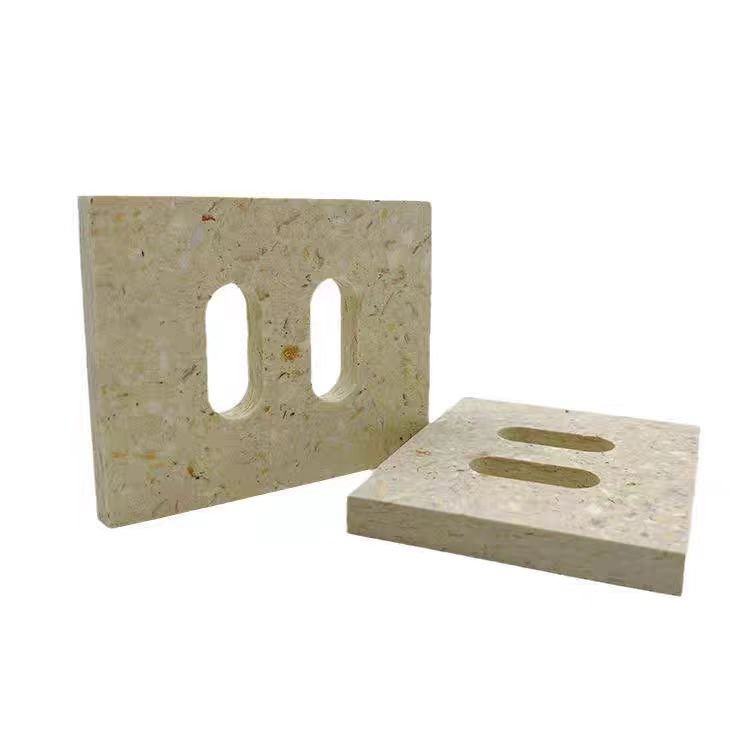
Hebei Woqin’s HD-PUR is engineered to eliminate the risk of subsidence. With a certified Compressive Strength of 8.115 MPa (supported by SGS Report: 冀建检(C)2024-02804), our blocks deliver the structural rigidity of concrete with the thermal resistance of advanced insulation.
By integrating Woqin HD-PUR, you are not just buying a "spacer"; you are installing a Structural Thermal Break that remains dimensionally stable for a 30-year design life, even under the most extreme dynamic and static imposed loads.
3. The Thermodynamic Gate: 0.080 W/(m·K) vs. The 0.5 W/(m·K) "Wet Wood" Collapse
Decoupling the Cryogenic Network
To stop structural BOG, you must achieve near-perfect thermodynamic decoupling between the cryogenic pipe shoe and the steel support. Hebei Woqin’s HD-PUR structural thermal breaks act as an impenetrable gate.
With a strictly certified thermal conductivity of 0.080 W/(m·K), our HD-PUR cuts the rate of heat transfer to its absolute physical minimum. In contrast, consider the performance of traditional materials in high-humidity coastal LNG environments:
- The HD-PUR Barrier: 0.080 W/(m·K).
- The Wet Wood Failure: Once moisture-saturated, traditional wood exceeds 0.5 W/(m·K).
- The Ice Bridge: Pure ice reaches 2.2 W/(m·K).
By upgrading to Woqin, your insulation barrier is 6 times more effective than wet wood and nearly 30 times more efficient than ice. We don't just reduce heat ingress; we eliminate the "Cold Bridge" altogether, keeping your LNG at -162°C and significantly reducing the BOG flash rate.
4. The BOG Simulation Sandbox: Calculating Your ROI
For an O&M Director, the value of a thermal break is measured in the recapture of lost energy. Let’s look at a thermodynamic ROI model for a standard 5 MTPA LNG facility:
The Operational Scenario:
- Medium: Liquid Natural Gas (LNG) at -162°C.
- Ambience: High-humidity coastal air at +30°C.
- The Assets: 800 critical pipe support points across the loading jetty.
The Math of Loss (Unoptimized Supports):
- Heat Ingress: A saturated/frozen wooden support leaks ~120 Watts of heat. Total facility leak = 96 kW.
- BOG Catalyst: This heat evaporates ~80 kg of LNG per hour into waste gas.
- Re-liquefaction Penalty: Re-liquefying this "structural BOG" consumes ~48 kWh of electricity per hour.
- The Annual Bill: At an industrial rate of $0.12/kWh, this single heat-leak source costs the facility over $50,000 USD per year in electricity alone—plus the lost volume of flared cargo.
The Woqin Solution: With our 0.080 W/(m·K) HD-PUR, heat ingress per support drops to <15 Watts. You recapture 87.5% of that lost energy, paying back the entire structural upgrade investment in less than 12 months.
5. Frictionless Dynamics: Coordinating with PTFE Sliding Plates
Eliminating "Pipe Jamming" and Structural Rupture
In cryogenic service, pipelines undergo massive longitudinal contraction. A 100-meter stainless steel line can shrink by over 300mm during cooldown. To accommodate this, pipe shoes are typically mounted on PTFE (Teflon) sliding plates.
The integrity of this movement depends entirely on the foundation.
- The Failure of Standard PUR: Standard-density PUR (softening under load) can suffer from "Cold Creep", causing the PTFE plate to indent into the block. This creates a "mechanical trap" (Pipe Jamming). The resulting shear force during contraction can buckle the pipe or even rip the steel support rack off its foundation.
- The Woqin 8.115 MPa Foundation: With an isotropic compressive strength of 8.115 MPa, Woqin HD-PUR provides a concrete-rigid base for PTFE plates. It remains perfectly level even under peak dynamic loads, ensuring frictionless pipe contraction and protecting your mechanical sightlines from catastrophic stress fractures.
📊 The Ultimate O&M Comparison: HDW vs. Woqin HD-PUR
| Engineering & O&M Metric | Traditional High-Density Wood (HDW) | Woqin HD-PUR Structural Thermal Break | Operational Impact & ROI |
| Thermal Conductivity | ~0.15 (Dry) to >0.5 (Wet/Frozen) | Strictly 0.080 W/(m·K). | 85%+ BOG Recapture: Slashes re-liquefaction OPEX and flaring loss. |
| Compressive Strength | Anisotropic. Prone to grain-splitting and "Ice Jacking" cracks. | 8.115 MPa (Isotropic Strength). | Zero Pipe Sagging: Prevents flange misalignment and mechanical rupture. |
| Moisture / Ice Defense | High Risk. Capillary absorption leads to "Ice Bridge." | 2.1% Water Absorption. | Stops Rack Corrosion: Eliminates external icing and moisture damage. |
| Maintenance Cycle | 5-8 years (Requires recurring scaffolding/replacement). | 30+ Year Maintenance-Free Life. | Lowers LCC: Eliminates 3-4 replacement cycles over the plant life. |
6. Installation Mastery: The 3-Step "Direct-Fastening" Workflow
The Contractor's Advantage: 620N Fastening Power
A major barrier to adopting structural polymers is the fear of brittleness. Standard high-density materials often crack under the torque of heavy industrial bolting. Hebei Woqin’s HD-PUR is engineered to behave like premium hardwood, providing a Screw-Holding Power of 620 N (Face) and 610 N (Edge).
To ensure a 30-year vapor-tight seal, we recommend the following professional installation sequence:
- Precision Machining: Use standard carbide-tipped saw blades or CNC routers for on-site adjustments. The material maintains clean edges without splintering or "dusting" typical of lower-grade foams.
- Structural Bolting (Bolt & Torque): Secure the shoe or support using heavy-duty U-bolts or galvanized fasteners. Our 8.115 MPa matrix allows for high-torque tightening without the risk of crushing or stress-fracturing the block.
- Vapor Defense (Seal & Shield): Once fastened, the fastener penetrations and joints are sealed with cryogenic-grade mastic and overwrapped with a multi-ply vapor barrier (e.g., Foil-Mylar-Foil) to create an unbroken moisture defense.
7. Dynamic Reliability: PTFE Integration & Anti-Loosening
Preventing the "Friction Lock" Catastrophe
LNG pipelines exhibit significant longitudinal movement during cooldown and operation. To accommodate this, pipe shoes must glide across PTFE (Teflon) sliding plates.
- The Competitor Failure (Low-Density PUR): Standard PUR supports often suffer from "Cold Creep", allowing the PTFE plate to sink into the insulation. This creates a mechanical "step" that jams the pipeline. The resulting shear force during thermal contraction can buckle the pipe or tear the support rack.
- The Woqin Synergy: With 8.115 MPa compressive strength, Woqin HD-PUR provides a concrete-rigid, perfectly level foundation. This ensures the PTFE plate remains flush, guaranteeing frictionless dynamic movement and eliminating the risk of catastrophic pipe jamming.
Cryogenic Dimensional Stability
At -162°C, thermal contraction is a threat to mechanical fasteners. If the thermal break shrinks, structural bolts loosen, leading to pipe vibration. Woqin HD-PUR is formulated for extreme dimensional stability, maintaining its volume and bolt-tension at -196°C, ensuring your mechanical connections remain "Install and Forget."
8. Case Study: ROI Benchmark for a 5 MTPA Gulf Coast Facility
Project Context: A large-scale LNG export terminal on the US Gulf Coast faced severe external icing and structural BOG issues on its 3km loading jetty. The existing high-density wooden supports were saturated with high-salinity moisture, creating "Ice Bridges."
The Solution: The facility replaced 1,200 critical support points with Woqin 0.080 W/(m·K) HD-PUR structural thermal breaks.
Verified Outcomes:
- Thermal Performance: Heat ingress per support point dropped from ~125W (Frozen Wood) to <14W (Woqin PUR)—an 88% improvement.
- BOG Recapture: The terminal recorded a 12% reduction in BOG flash rates attributable to structural heat leaks.
- OPEX Impact: The reduction in re-liquefaction compressor electrical load saved the operator an estimated $72,000 USD in the first 12 months of operation.
- Maintenance: Zero reported "Ice Jacking" incidents or vapor barrier ruptures after two full hurricane/humidity seasons.
9. The ESG Verdict: Lowering the Carbon Intensity of LNG
Modern LNG operations are under intense pressure to meet ESG (Environmental, Social, and Governance) targets. Every kilowatt-hour of electricity saved by preventing BOG is a direct reduction in your facility's Scope 2 carbon emissions. By upgrading to Woqin HD-PUR, you are deploying a proven carbon-mitigation strategy that satisfies both shareholders and environmental regulators.
Secure Your Thermodynamic ROI Simulation
Do not let BOG evaporate your profitability. Stop funding recurring scaffolding costs for rotting wood and transition to engineered thermodynamic certainty.
👉 Email: an@cn-aerogel.com
👉 Web: [www.insulatewool.com]
🔗 Explore Related Industrial & Heritage Solutions:

Written by - Ruibin An
Industry Veteran with 13+ Years of Experience. Deeply rooted in the insulation industry for over 13 years, specializing in supply chain optimization and global market trends for Rock Wool and Aerogel materials.
LATEST NEWS
Desert Node Armor: Crush-Resistant Pipe Shells for Cross-Country Pipelines
2026-06-03
Desert Sandstorms: The Hidden Killer of Amine Line Stability in Gas Processing
2026-06-02
The Desert’s Billion-Dollar Blockage: How Smart Insulation Ends Wax Deposition Nightmares
2026-06-01
Securing Flare Gas Networks: A1 Non-Combustible Shells for Extreme Heat
2026-05-30
EHT Pipe Insulation: Eliminate Tenting Effect with Grooved Pre‑Formed Shells
2026-05-29