
Stabilizing the Freeze Line: Why High-Purity Ceramic Fiber is the Secret to 3,000-Day Potlife
In the high-stakes environment of primary aluminum smelting, the electrolytic cell (pot) is the heart of production, yet it operates under constant threat from chemical and mechanical stressors. This comprehensive technical review deconstructs the primary failure modes in smelter insulation—including cryolite vapor sabotage, cathode heaving, and the thermodynamic instability of the freeze line. By analyzing the engineering advantages of high-purity ceramic fiber systems—characterized by 44 kPa tensile strength and ≤11.6% slag content—we demonstrate how smelters like EGA can achieve record-breaking 3,000-day potlife cycles while significantly reducing energy dissipation and carbon footprint.
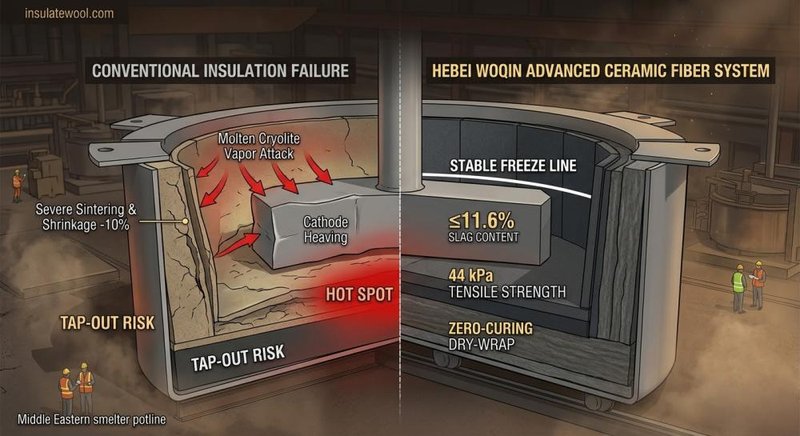
Part 1: The Crisis
In the Middle East, home to global titans like Emirates Global Aluminium (EGA), the scale of primary aluminum production is staggering. These facilities operate the world's longest potlines, where thousands of electrolytic cells run 24/7 at temperatures exceeding 950°C. In this environment, an aluminum smelter isn't just a factory; it is a high-stakes thermodynamic balancing act.
The most critical component of this balance is the pot insulation system. Yet, for many facility managers, insulation remains a "black box" until a failure occurs. When the insulation layer degrades, it’s not just about a higher electricity bill—it’s about the imminent risk of a pot leakage, a disaster that can cost millions in unplanned downtime and equipment loss.
To understand how to extend potlife to 3,000 days or beyond, we must first deconstruct the three "silent killers" of electrolytic cell integrity.
1. The Cryolite "Vapor Sabotage"
While the refractory brick layer acts as the primary barrier, it is never perfectly hermetic. During the electrolysis process, molten bath components—specifically Cryolite (Na3AlF6) and its associated fluoride vapors—slowly penetrate the brick joints.
When these highly corrosive vapors reach the backup insulation layer, a lethal chemical reaction begins. Standard insulation materials often react with fluorides, leading to chemical sintering and shrinkage. As the material loses its porous structure, it turns into a dense, conductive mass. This "chemical sabotage" effectively turns your insulation into a heat-bridge, pulling thermal energy out of the pot and toward the steel shell.
2. The Mechanical Nightmare: Cathode Heaving
An aluminum pot is a violent mechanical environment. As sodium ions penetrate the carbon cathode blocks over time, the blocks undergo graphitization and swelling. This phenomenon, known as Cathode Heaving, generates massive downward and outward pressure on the lining.
If the bottom insulation (often ceramic fiber boards or calcium silicate) lacks sufficient Compressive Strength and Creep Resistance, it will simply be crushed. Once the insulation layer is compressed beyond its elastic limit, the entire internal structure of the pot shifts. This mechanical fracture creates gaps where molten metal can bypass the refractory, leading to the ultimate nightmare: Pot Leakage (Tap-out).
3. The "Freeze Line" Drift: A Thermodynamic Death Spiral
In a healthy electrolytic cell, the insulation is calibrated to maintain a specific temperature gradient that allows a protective layer of solidified bath (the "Sideledge") to form on the side walls. This is known as the Freeze Line.
When insulation performance degrades—whether due to moisture, vibration, or chemical sintering—the Freeze Line begins to drift. As the thermal resistance drops, the solidified ledge melts away, exposing the side-lining to direct erosion by the molten bath. Once the Freeze Line becomes unstable, the pot enters a Thermodynamic Death Spiral: higher energy consumption leads to higher temperatures, further melting the protective ledge, eventually resulting in a shell "hot spot" or a total breach.
The Hidden Cost of "Cheap" Bulk Fiber
For mega-smelters in the Middle East, the temptation to use low-grade, high-slag ceramic fiber is often driven by initial procurement costs. However, in a potline that consumes 14,000 kWh per ton of aluminum, a 1% drop in thermal efficiency due to insulation shrinkage is a financial hemorrhage.
Resilience in 950°C environments cannot be achieved with "commodity" materials. It requires a high-purity, low-shrinkage fibrous matrix that can withstand the chemical and mechanical onslaught of a 5-to-8-year pot cycle.
In Part 2 of this series, we will examine the "Engineering Rescue": How Hebei Woqin’s 44 kPa tensile-strength, ultra-low slag ceramic fiber boards are neutralizing these failure modes and helping smelters achieve record-breaking potlife cycles.
👉 [Explore our technical guide on 1260°C ceramic fiber for Middle East Cracking Furnaces here.]
Part 2: The Salvation
In Part 1, we identified the "Silent Killers" of the aluminum potline: cryolite penetration, cathode heaving, and the thermodynamic death spiral of a drifting freeze line. For a mega-smelter, the solution isn't just "more insulation"—it is Engineering Resilience.
Hebei Woqin’s high-purity alumina-silicate system is designed to neutralize these threats through three specific material breakthroughs.
1. Neutralizing Cathode Heaving: The 44 kPa Mechanical Shield
Traditional insulation boards often act as a weak link, crushing under the immense pressure of sodium-induced cathode expansion. When the insulation is compressed, the pot's geometry shifts, leading to premature lining failure.
Hebei Woqin has engineered a double-needled, high-density (107 kg/m³) ceramic fiber matrix that delivers a verified Tensile Strength of 44 kPa. This structural integrity ensures that our fiber boards act as a "mechanical shield," absorbing the compressive stress of the cathode without fracturing or losing their thermal profile. By maintaining their original thickness under load, our materials ensure the internal pot structure remains aligned for the entire duration of a 3,000-day cycle.
2. Eliminating Chemical Sintering: The ≤11.6% Slag Advantage
The primary cause of insulation shrinkage in smelters is not just heat—it is the reaction between molten bath vapors and the impurities (slag balls) within the fiber. These slag balls act as catalysts for sintering, causing the fibrous network to collapse and create thermal gaps.
By utilizing high-purity raw materials and advanced centrifugal blowing technology, Hebei Woqin has reduced the Slag Ball Content to ≤11.6% (Φ>0.212mm). This exceptional purity means fewer reactive sites for fluoride vapors to attack. The result is a material that maintains a Linear Shrinkage of only -1.5% (@ 800°C). In the high-stakes environment of a 24/7 potline, this dimensional stability is what keeps the Freeze Line locked in place, preventing side-shell hot spots and catastrophic tap-outs.
3. The ROI of Thermal Precision: 0.134 W/(m·K) at 500°C
In an industry where electricity accounts for nearly 40% of production costs, thermal precision is the ultimate competitive advantage. A smelter operating with degraded insulation effectively "exports" heat to the atmosphere at a massive financial loss.
Hebei Woqin’s ceramic fiber system maintains an ultra-low thermal conductivity of 0.134 W/(m·K) at a 500°C mean temperature. For a typical potline, switching from legacy insulation to our high-purity system can reduce heat loss by 5-8%.
- The Calculation: In a facility consuming 14,000 kWh per ton, a 5% improvement in thermal retention translates to hundreds of thousands of dollars in annual energy savings per potline—not to mention the significant reduction in the facility's carbon footprint.
A Turnkey Partner for Smelter Turnarounds
Beyond the material specs, Hebei Woqin understands the logistical pressure of a "Pot Relining" project. Every day a pot is offline is a day of lost revenue.
We provide factory-direct, precision-cut boards and blankets tailored to the exact dimensions of your cell design. Our "Dry-Wrap" system requires zero curing time, allowing your relining teams to accelerate installation schedules and get the potline back into production faster than with traditional castable or brick solutions.
Conclusion: Secure Your Potline’s Future
The difference between a 5-year and an 8-year pot cycle isn't luck—it's material science. By upgrading to Hebei Woqin’s high-purity ceramic fiber system, smelters are securing their most valuable assets against the chemical and physical onslaught of aluminum electrolysis.
Don't wait for the next "red shell" incident. Contact our engineering team today to request a full Technical Data Sheet (TDS) or to schedule a Heat Balance Simulation for your specific potline design.

Written by - Ruibin An
Industry Veteran with 13+ Years of Experience. Deeply rooted in the insulation industry for over 13 years, specializing in supply chain optimization and global market trends for Rock Wool and Aerogel materials.
LATEST NEWS
Cutting Pipeline Insulation Labor Costs by 40% in 50°C Middle East Heat
2026-06-18
Acoustic & Thermal Insulation for HVAC Piping in Middle East Luxury Hotels
2026-06-16
Calculated Oppression: How Thermal Drift and Structural Sagging Bleed Millions from Middle East Piping TCO (And the 20-Year Closed-Loop Solution)
2026-06-15
District Cooling in the Gulf: The Physics of Inevitable Condensation and How Pre-Formed Glass Wool Shells Stop It
2026-06-12
CCGT Power Plant Pipe Insulation English Marketing Copy (99-point Final Benchmark Version)
2026-06-10