
Rebuilding the Heart of the Refinery: The 1260°C Ceramic Fiber Guide for Middle East Cracking Furnaces
Cracking furnaces in the Middle East face extreme 1200°C heat, high-velocity gas erosion, and constant vibration. Discover how Hebei Woqin’s 1260°C High-Purity Ceramic Fiber prevents refractory "hot spots" and "vibration slump" using verified laboratory data, ensuring structural integrity for refinery reconstruction.
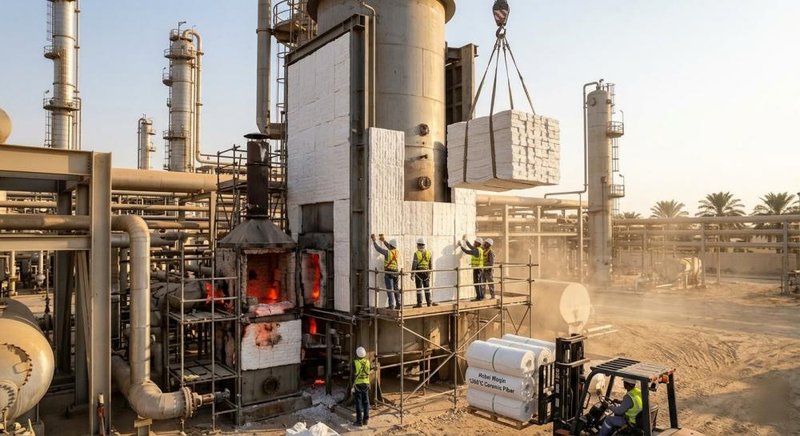
Rebuilding the Heart of the Refinery: The 1260°C Ceramic Fiber Guide for Middle East Cracking Furnaces
The Middle East is currently experiencing a massive wave of petrochemical expansion and post-conflict refinery reconstruction. At the very core of these mega-facilities are the Cracking Furnaces and Fired Heaters—the beating hearts of the plant.
These colossal structures operate under punishing physical conditions: internal temperatures routinely exceed 1000°C to 1200°C, accompanied by relentless mechanical vibration and high-velocity gas flow. In such an unforgiving environment, standard rock wool is immediately incinerated. Even inferior ceramic fiber linings frequently fail, leading to catastrophic plant shutdowns that cost EPC contractors and operators millions of dollars per week.
To secure long-term operational safety, engineering teams must base their refractory selection on strict thermodynamic and mechanical data. Here is how Hebei Woqin’s 1260°C High-Purity Ceramic Fiber (Alumina Silicate) system solves the three most critical physical failures in Middle East cracking furnaces.
1. Defeating the "Hot Spot" Crisis: The Physics of Dimensional Stability
The most feared critical failure for any cracking furnace operator is the sudden appearance of a "Hot Spot" on the exterior steel casing.
Hot spots occur when low-grade ceramic fiber modules undergo crystallization and massive linear shrinkage (often between 3% to 5%) under prolonged 1200°C heat. This physical shrinkage creates hazardous gaps between the insulation modules. Once a gap forms, searing flames and corrosive flue gases bypass the refractory lining and directly attack the furnace shell, creating an immediate explosion risk.
Hebei Woqin eliminates this risk at the microstructural level. Our 1260°C high-purity ceramic fiber is engineered for extreme dimensional stability, backed by a verified Linear Shrinkage of just -1.5% (@ 800°C × 24h). This ensures that the refractory modules remain tightly interlocked and compressed over years of continuous firing, effectively preventing gap formation and flame channeling.
👉 Read our technical analysis on how to Stop Single-Layer Failures with 1260°C Ceramic & Aerogel Composites
2. Conquering "Vibration Slump" with 44 kPa Tensile Strength
Fired heaters are not static environments; they vibrate violently. The continuous roar of high-capacity burners and exhaust fans subjects the entire furnace to high-frequency mechanical stress.
When standard, loosely woven ceramic fiber is subjected to this constant shaking, the material begins to break down. The fibers snap, generate dust, and eventually suffer from Vibration Slump—a fatal condition where the insulation sags or tears away from the furnace roof and walls, causing instantaneous heat loss.
Through an advanced double-needling manufacturing process, Hebei Woqin’s ceramic fiber blanket achieves an exceptional Tensile Strength of 44 kPa. This extreme mechanical resilience allows the refractory lining to absorb continuous motor and burner shock without tearing, dusting, or slumping, ensuring the furnace roof stays fully protected even in the harshest Middle East operating conditions.
👉 Learn how to guarantee mechanical stability in our guide to Kiln Lining Tensile Strength and Traceability
3. Shielding Against High-Velocity Gas Erosion
Inside a cracking furnace, the heavy-duty burners generate a superheated "hurricane." Flue gases can reach velocities of 15 to 30 meters per second, directly scouring the refractory walls.
Inferior ceramic blankets with poor fiber interlocking lack the surface integrity to withstand this wind shear. Over time, the high-velocity gas literally peels the insulation away layer by layer (Gas Erosion), progressively thinning the refractory wall until the steel shell is exposed.
Hebei Woqin counters this aerodynamic wear with an optimal Bulk Density of 107 kg/m³ and a highly dense surface matrix. The tightly interwoven fibers act as a physical shield, providing superior resistance to gas erosion and ensuring the refractory lining maintains its original thickness and thermal resistance against the constant blast of the burners.
4. Immunity to Chemical Attack and "Fluxing"
In many Middle Eastern refineries, fired heaters utilize Heavy Fuel Oil (HFO) or un-desulfurized off-gases to reduce operating costs. The combustion of these heavy fuels fills the furnace atmosphere with highly corrosive sulfur compounds, vanadium, and alkali metal vapors.
When these corrosive gases interact with low-grade insulation containing high levels of impurities (such as iron oxide, Fe₂O₃, or sodium/potassium), a catastrophic chemical reaction occurs. The impurities act as a flux, causing the ceramic fibers to melt, clump together, and turn into rigid glass-like slag at temperatures well below 1200°C (a process known as Fluxing). Once fluxed, the blanket loses all insulating properties and falls off as dead weight.
Hebei Woqin protects your investment through uncompromising material purity. Our 1260°C Alumina Silicate is refined to maintain exceptional Chemical Inertness. With strictly controlled, ultra-low impurity levels, our ceramic fibers do not react with sulfur or alkali vapors, remaining fluffy, resilient, and structurally intact even in the most corrosive heavy-oil combustion environments.
5. Surviving Thermal Shock During the Decoking Process
Ethylene cracking furnaces require periodic "Decoking"—a maintenance process where high-temperature steam and air are injected to burn off carbon deposits inside the furnace tubes. This creates sudden, extreme temperature spikes and rapid cooling cycles.
Traditional refractory bricks or inferior fiber modules cannot handle this "thermal whiplash." The repetitive thermal expansion and contraction create internal stress, leading to severe spalling, cracking, and structural collapse (Thermal Shock Failure).
Hebei Woqin’s ceramic fiber system is engineered with Zero Thermal Inertia and outstanding mechanical elasticity. Unlike rigid bricks, our flexible interlocking fiber matrix acts as a thermal shock absorber. It effortlessly accommodates the rapid structural deformations caused by decoking, surviving hundreds of extreme heating and cooling cycles without a single crack.
6. Eliminating the "Slag Ball" Energy Penalty
Beyond structural survival, Middle East petrochemical plants are under immense pressure to optimize thermal efficiency and reduce natural gas consumption.
A hidden "energy penalty" often lurks within locally sourced, low-cost insulation: a high percentage of unfiberized mineral drops known as Slag Balls. Slag balls do not insulate; they add useless dead weight to the furnace roof and act as thermal bridges, driving up the material's thermal conductivity and wasting millions of dollars in fuel over the furnace's lifespan.
Hebei Woqin utilizes precision-controlled centrifugal spinning technology to guarantee a remarkably low Slag Ball Content of just 11.6% (Φ>0.212mm). This exceptionally pure fiber matrix traps micro-pockets of air more effectively, delivering a superior Thermal Conductivity of 0.134 W/(m·K) at 500°C. By eliminating the dead weight of slag, we maximize the thermal resistance of every square inch of the furnace lining.
👉 Understand the hidden costs of unfiberized impurities in our technical analysis: Ceramic Fiber Blanket Density & Slag Content
Partner with the Refractory Experts for Middle East Reconstruction
At Hebei Woqin, we do not merely supply insulation rolls; we engineer high-temperature survival armor for the world's most demanding petrochemical environments. Whether you are reconstructing a war-damaged fired heater in Saudi Arabia or upgrading a mega-cracker in the UAE, our Class A1 non-combustible ceramic fiber solutions provide the traceability, longevity, and thermal precision your project demands.
Secure your plant's reliability today. Contact Hebei Woqin's engineering team for customized 1260°C ceramic fiber modules, complete Technical Data Sheets (TDS), and advanced thermodynamic design support.
Written by - Ruibin An
Industry Veteran with 13+ Years of Experience. Deeply rooted in the insulation industry for over 13 years, specializing in supply chain optimization and global market trends for Rock Wool and Aerogel materials.
LATEST NEWS
Cutting Pipeline Insulation Labor Costs by 40% in 50°C Middle East Heat
2026-06-18
Acoustic & Thermal Insulation for HVAC Piping in Middle East Luxury Hotels
2026-06-16
Calculated Oppression: How Thermal Drift and Structural Sagging Bleed Millions from Middle East Piping TCO (And the 20-Year Closed-Loop Solution)
2026-06-15
District Cooling in the Gulf: The Physics of Inevitable Condensation and How Pre-Formed Glass Wool Shells Stop It
2026-06-12
CCGT Power Plant Pipe Insulation English Marketing Copy (99-point Final Benchmark Version)
2026-06-10