
Preventing "Red Shell" Failures: The High-Tensile Ceramic Fiber Guide for Middle East Mega-Cement Kilns
During the Middle East's construction boom, mega-cement kilns face extreme 1400°C heat, severe vibration, and alkali attacks. Learn how Hebei Woqin’s 44 kPa high-tensile, low-slag ceramic fiber prevents "red shell" failures and guarantees uninterrupted operations.
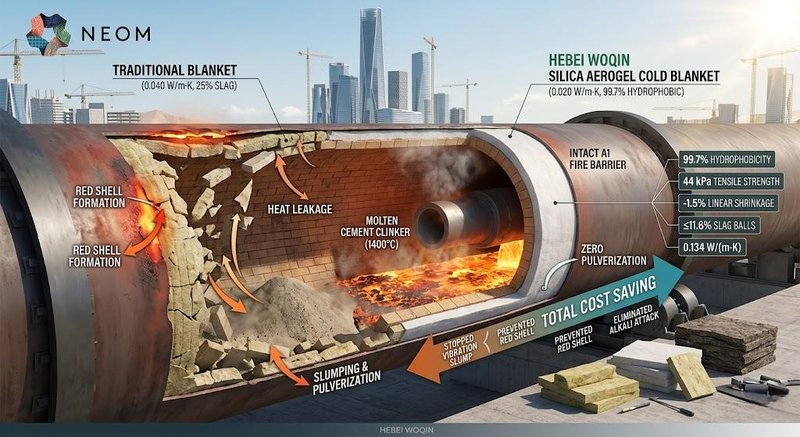
1. Introduction: The NEOM Boom and Equipment Extremes
The Gulf region is currently experiencing an unprecedented infrastructure super-cycle. Megaprojects like Saudi Arabia’s NEOM are consuming tens of millions of tons of cement, pushing regional cement plants to operate their 10,000-ton-per-day mega-lines at absolute maximum capacity.
At the very heart of this production frenzy is the Rotary Kiln—a massive steel cylinder that must rotate continuously, 24/7, while containing internal temperatures exceeding 1400°C. However, in an attempt to lower initial CAPEX, many plants install low-grade backup insulation (ceramic fiber blankets) between the refractory bricks and the steel shell.
This is a fatal miscalculation. In this article, we reveal how cheap ceramic fibers collapse under extreme mechanical vibration, chemical attacks, and thermal whiplash, and how Hebei Woqin’s verified 44 kPa High-Tensile Ceramic Fiber serves as the ultimate defense against catastrophic "Red Shell" failures and unplanned kiln shutdowns.
2. The "Red Shell" Crisis: Vibration Pulverization vs. 44 kPa Tensile Strength
A rotary kiln is a heavy-duty, vibrating beast. The backup insulation layer is subjected to immense, continuous mechanical grinding and shear forces caused by the rotating thousands of tons of refractory bricks and clinker.
Standard commercial ceramic fiber blankets typically possess a low tensile strength of just 15 to 20 kPa. Under relentless rotational stress, their weak fiber matrices are rapidly crushed and milled into fine dust—a phenomenon known as Vibration Pulverization. As the pulverized fiber settles and leaks through the gaps, empty voids form between the bricks and the kiln shell. With the insulation gone, 1400°C heat directly attacks the steel casing, causing it to glow red, warp, and deform. Once a "Red Shell" occurs, the internal refractory bricks collapse, forcing an immediate, disastrous plant shutdown.
The Woqin Defense: Hebei Woqin eliminates pulverization at the structural level. Utilizing an advanced double-needling process, our 107 kg/m³ ceramic fiber blankets achieve an extreme, verified Tensile Strength of 44 kPa. This ultra-tough, flexible fiber matrix acts as a high-tensile shock absorber. No matter how aggressively the kiln rotates, our fibers refuse to snap, settle, or pulverize. They maintain their original thickness and structural integrity, securely guarding the steel shell against extreme heat.
3. Surviving the Chemical War: Alkali Attack and the 11.6% Slag Content Rule
To optimize fuel economics, many Middle Eastern cement plants burn alternative fuels, heavy fuel oil (HFO), or high-sulfur petcoke. These fuels introduce a highly corrosive chemical warfare into the kiln, generating massive amounts of alkali vapors (potassium and sodium) and sulfur compounds.
When these corrosive gases penetrate the refractory bricks and reach cheap backup insulation, they seek out impurities. Standard fibers often contain high levels of unfiberized mineral drops known as "Slag Balls". These impurities react violently with alkali vapors—a process known as Fluxing. This chemical reaction causes the fluffy ceramic fiber to undergo severe Sintering, turning it into a rigid, glass-like mass with zero insulating properties.
The Woqin Defense: Chemical survival depends on absolute purity. Through precision-controlled centrifugal spinning technology, Hebei Woqin guarantees an exceptionally low Slag Ball Content of ≤11.6% (Φ>0.212mm). This ultra-pure, chemically inert alumina-silicate composition provides almost no reactive sites for alkali vapors to attack. Our fibers survive the harshest high-sulfur combustion environments, remaining fluffy, resilient, and highly insulative year after year.
4. Thermal Whiplash in the Kiln Hood & Grate Cooler: The -1.5% Shrinkage Shield
As the 1300°C clinker exits the rotary kiln, it plunges into the Grate Cooler and Kiln Hood, where it is instantly blasted by massive cooling fans. The refractory lining in these areas—often constructed from suspended Ceramic Fiber Modules—experiences brutal, repetitive temperature spikes and drops (Thermal Shock).
Inferior fiber modules suffer from high linear shrinkage under these drastic temperature fluctuations. As the modules shrink, wide gaps are torn open between them. Searing flames and hot gases channel through these thermal gaps and melt the stainless-steel anchoring hardware. Once the anchors fail, hundreds of kilograms of insulation modules detach and crash down onto the cooling clinker, severely damaging the equipment.
The Woqin Defense: Dimensional stability is the ultimate safety net. Hebei Woqin’s high-purity ceramic fiber modules are engineered with zero thermal inertia and deliver an incredibly low Linear Shrinkage of just -1.5% (@ 800°C × 24h). When installed, our modules remain tightly compressed and seamlessly interlocked. They easily absorb extreme thermal whiplash without opening gaps, ensuring your anchoring systems remain 100% protected and eliminating the risk of roof collapse.
5. The Economics of Uninterrupted Production
For EPC contractors and cement plant operators in the NEOM era, the true metric of success is the Total Cost of Ownership (TCO) and uninterrupted uptime.
- Zero Downtime Penalties: In a 10,000-ton-per-day mega-line, a single day of unplanned downtime due to a Red Shell can cost hundreds of thousands of dollars in lost profits. Upgrading to 44 kPa high-tensile fiber is an insurance policy for continuous cash flow.
- Fuel Efficiency: Thanks to the low slag content, our fiber network traps air more effectively, delivering a superior Thermal Conductivity of just 0.134 W/(m·K) at 500°C. This precision insulation drastically cuts conductive heat loss through the kiln shell, saving millions of dollars in natural gas and heavy oil consumption over the plant's lifespan.
6. Conclusion & Call to Action
The super-kilns powering the Middle East’s construction boom cannot afford cheap compromises. When confronting brutal mechanical vibration, corrosive alkali attacks, and extreme thermal shock, Hebei Woqin’s high-purity, high-tensile ceramic fiber is the definitive survival armor for your cement production line.
Is your cement plant preparing for a major turnaround? Don't risk a catastrophic Red Shell crisis. Contact Hebei Woqin today. Reach out to our engineering team to request the certified Technical Data Sheets (TDS) and secure custom-engineered refractory solutions for your rotary kiln, kiln hood, and grate cooler systems.

Written by - Ruibin An
Industry Veteran with 13+ Years of Experience. Deeply rooted in the insulation industry for over 13 years, specializing in supply chain optimization and global market trends for Rock Wool and Aerogel materials.
LATEST NEWS
Cutting Pipeline Insulation Labor Costs by 40% in 50°C Middle East Heat
2026-06-18
Acoustic & Thermal Insulation for HVAC Piping in Middle East Luxury Hotels
2026-06-16
Calculated Oppression: How Thermal Drift and Structural Sagging Bleed Millions from Middle East Piping TCO (And the 20-Year Closed-Loop Solution)
2026-06-15
District Cooling in the Gulf: The Physics of Inevitable Condensation and How Pre-Formed Glass Wool Shells Stop It
2026-06-12
CCGT Power Plant Pipe Insulation English Marketing Copy (99-point Final Benchmark Version)
2026-06-10