
The Unseen Pillars of Efficiency: Why Load-Bearing HDPU Boards are the Ultimate Solution for Thermal Bridging
In modern high-performance architecture and heavy industry, the conflict between structural integrity and thermal efficiency often leads to "Thermal Bridging" at critical support points. Ruibin An, founder of Hebei Woqin Trading, analyzes how High-Density Rigid Polyurethane (HDPU) foam boards, with compressive strengths up to 2100psi and a 3% water absorption limit, serve as the perfect "Cold Break." This article details the technical superiority of HDPU in cryogenic LNG terminals, curtain wall systems, and industrial pipe supports, proving that specialized insulation is a structural necessity, not just a thermal addition.
I. The Load-Bearing Crisis: When R-Value Isn't Enough
In my 15 years of navigating the complex landscapes of material science and international trade, I’ve witnessed a recurring tragedy in engineering: the failure of "perfect" insulation at the most critical points—the supports.
Whether it is a heavy steel beam in a petrochemical plant, a massive glass curtain wall on a skyscraper, or a vibration-heavy engine mount, these contact points are the Achilles' heel of thermal design. In the past, engineers were trapped in a binary choice: use a high-strength but conductive material like wood or recycled plastic, or use a soft insulator that eventually collapses under the weight.
At Hebei Woqin, we recognized this "Load-Bearing Crisis" early on. Our mission was to engineer a material that possesses the "muscle" of a structural component and the "heart" of an insulator. The result? Our High-Density Rigid Polyurethane (HDPU) Foam Boards.
II. Examining the "Muscle": The Physics of 2100psi
In the polyurethane world, density is the direct precursor to performance. While standard EPS (Expanded Polystyrene) or low-density spray foams are excellent for filling wall cavities, they deform or "creep" under the slightest structural load.
1. The Strength Spectrum
We don't just offer one type of board; we provide a spectrum of resilience. Our HDPU boards range from 350psi (approx. 2.4 MPa) to a staggering 2100psi (approx. 14.5 MPa). To put that in perspective, our high-end boards can support the weight of industrial heavy-duty piping and structural steel without losing a millimeter of thickness.
2. Customization as a Standard
As an experienced manufacturer, I know that "standard" rarely fits "specific." While our 600kg/m³ density is a popular baseline, we frequently customize density and geometry. We provide:
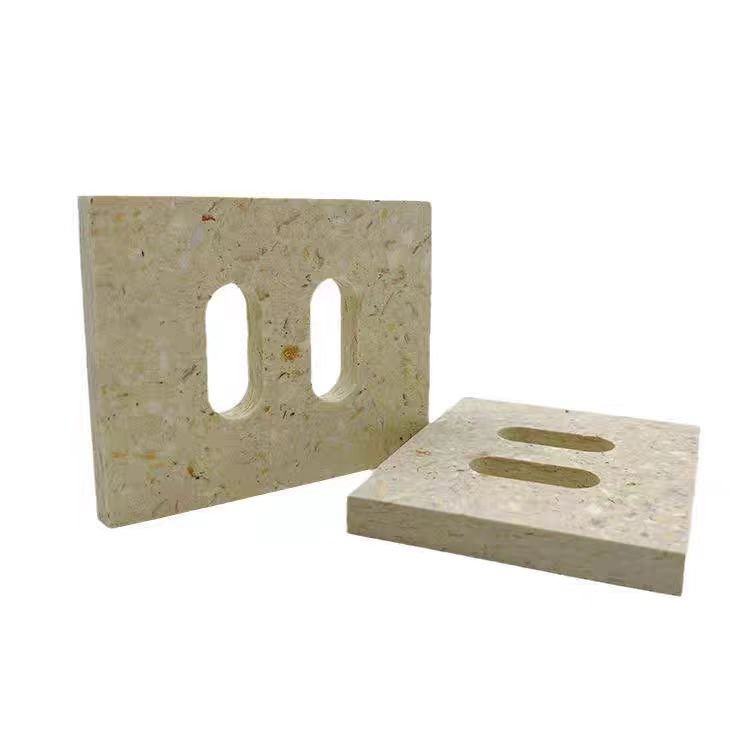
- Pre-drilled Anchor Holes: For easy integration into curtain wall brackets.
- CNC Precision Cutting: Custom shapes for passive house foundation pads.
- Machinery Support Blocks: Engineered to dampen vibration while maintaining a thermal break.
III. Fire Safety: Negotiating the Global Standards
When exporting to Europe, the Middle East, or North America, fire safety is never a "secondary" feature—it is a legal mandate. Polyurethane has historically faced scrutiny regarding flammability, but at Hebei Woqin, we’ve moved beyond those legacy limitations.
- B1 (Fire Retardant): Our standard HDPU boards are B1 rated (per GB 8624 or equivalent international standards). They are difficult to ignite, contribute minimal smoke, and are self-extinguishing.
- A2 (Non-Combustible) Options: For specialized high-risk infrastructure or public buildings where A1/A2 ratings are required, we offer hybrid mineral-reinforced versions that meet the strictest non-combustibility codes.
- The Green Mandate: In alignment with EU RoHS and REACH regulations, our production process is Freon-free. We use advanced blowing agents that protect the ozone layer while ensuring no toxic "off-gassing" occurs during the material's 30-year lifespan.
IV. The Moisture Adversary: The 3% Closed-Cell Defense
Moisture is the silent killer of insulation value. Materials like rock wool or glass wool are "open-cell" by nature; they act as sponges. Once water infiltrates the fibers, the air pockets are replaced by water, and the R-value plummets.
The HDPU Advantage:
Our high-density polyurethane features a microscopic, closed-cell structure. With a water absorption rate of ≤ 3%, it is essentially waterproof. This is critical for:
- Rooftop Equipment Supports: Where standing water is a constant threat.
- Cold Storage Flooring: Where condensation and ice-heave can destroy low-grade insulation.
- Coastal Infrastructure: Where salt-heavy humidity can corrode traditional "bridge" materials like wood.
Because moisture cannot penetrate the core, the thermal conductivity (≤ 0.080 W/mK) remains stable for the entire lifecycle of the building.
V. Versatility: From Cryogenic Deep-Freeze to High-Heat Stability
I often tell my clients that HDPU is the "all-terrain vehicle" of the insulation world. Its operating window is one of the widest in the industry.
1. Cryogenic Applications (-196°C)
In LNG (Liquefied Natural Gas) terminals and ethylene plants, our HDPU blocks serve as the vital "Cold Break." They prevent the extreme cold from reaching the steel support structures, which would otherwise become brittle and fail. Unlike many plastics, Woqin HDPU does not shatter at cryogenic temperatures.
2. High-Heat Stability (+120°C)
On the other end of the spectrum, our boards maintain dimensional stability in high-heat environments like industrial steam lines or specialized underfloor heating systems. They won't warp, shrink, or lose their load-bearing capacity even under sustained thermal stress.
VI. The Economic Logic: 30 Years of Peace of Mind
I often have the "Initial Cost vs. Lifecycle Value" talk with procurement officers. A high-density HDPU block costs more than a piece of treated timber or a standard foam sheet. However, the ROI is undeniable:
- Zero Maintenance: HDPU is inorganic. It does not rot, it is not eaten by termites, and it does not degrade under UV exposure if properly clad. You install it once, and it performs for 30+ years.
- Energy ROI: By eliminating thermal bridges, you can reduce the total HVAC load of a commercial building by 10-15%. In a 50-story skyscraper, the energy saved by "thermal break" brackets pays for the HDPU premium within 18 months.
VII. Why Partner with Hebei Woqin?
At Hebei Woqin, we don't just ship boxes of foam; we ship engineered solutions. We understand that a mistake in density calculation can lead to a structural failure.
- Data-Driven Selection: My team and I are here to help you specify. Tell us the dead load, the live load, and the operating temperature. We will provide the engineering data to ensure you are using the correct density (be it 400kg/m³, 600kg/m³, or 1000kg/m³).
- Global Logistics: Whether you need a 40HQ container sent to the Port of Ravenna or a specialized LCL shipment to Houston, we manage the logistics and certifications (including EC REP via TOCYA TRADING) to ensure a smooth customs process.
Conclusion: Building for Resilience
The era of "simple insulation" is over. We are now in the era of Functional Insulation. High-density rigid polyurethane foam boards are the invisible heroes that hold up our skyscrapers, protect our LNG tankers, and keep our homes energy-efficient.
Don’t let your structural supports become the thermal leaks that drain your budget. Choose a foundation that is as strong as it is smart.
Ready to eliminate thermal bridges in your next project?Contact me with your load requirements today.
Ruibin An
Founder, Hebei Woqin Trading Co., Ltd.
Your Partner in High-Performance Structural Insulation

Written by - Ruibin An
Industry Veteran with 13+ Years of Experience. Deeply rooted in the insulation industry for over 13 years, specializing in supply chain optimization and global market trends for Rock Wool and Aerogel materials.
LATEST NEWS
District Cooling in the Gulf: The Physics of Inevitable Condensation and How Pre-Formed Glass Wool Shells Stop It
2026-06-12
CCGT Power Plant Pipe Insulation English Marketing Copy (99-point Final Benchmark Version)
2026-06-10
Locking in 600°C: Composite Shells for CSP Molten Salt Pipelines in the GCC
2026-06-10
Blocking 55°C Desert Sun: Glass Wool Shells for Mega Water Transmission
2026-06-10
Stop the $18M Steam Pipe Burst: Dual-Defense Insulation That Survives C5-M
2026-06-04