
The -40°C Survival Guide for SRU Piping: Preventing Liquid Sulfur Freeze with Pre-formed Shells
In -40°C Arctic refineries, Sulfur Recovery Unit (SRU) piping faces a fatal paradox: drop below 115°C and sulfur crystallizes; exceed 155°C and viscosity surges. Legacy soft blankets cause catastrophic cold spots and tracing overheating. Discover how Hebei Woqin’s Tri-Core Pre-formed Shells deliver absolute thermal uniformity.
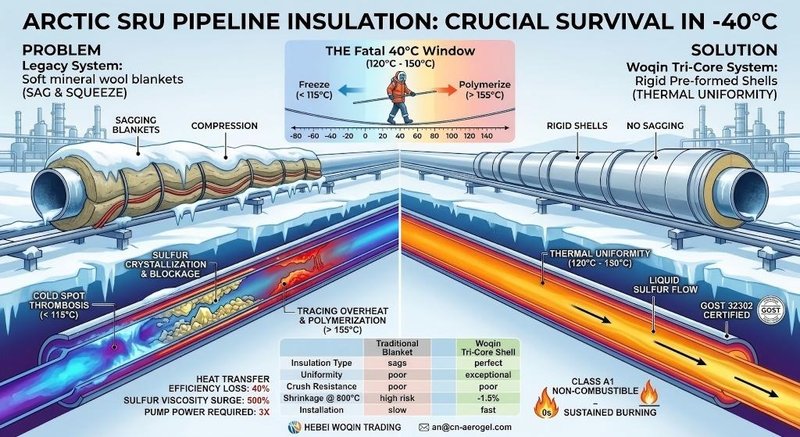
Chapter 1: Walking the Thermodynamic Tightrope: The Fatal 40°C Window
In the punishing sub-zero theaters of the CIS region and the Arctic Circle, petrochemical refineries battle ambient temperatures that routinely plummet to -40°C. Within this frozen landscape, the Sulfur Recovery Unit (SRU) represents the plant's environmental and operational bottleneck. For the engineers managing liquid sulfur transport, pipeline insulation is a brutal fight for thermodynamic survival.
Liquid sulfur possesses a highly counter-intuitive and unforgiving "Physical Personality." To maintain flow, the pipeline's internal temperature must be fiercely locked within a microscopic 40°C window (120°C to 150°C):
- The Freezing Threshold (< 115°C): If the temperature drops below 115°C, liquid sulfur rapidly crystallizes into a solid as hard as concrete, instantly blocking the pipeline.
- The Viscosity Surge (> 155°C): Conversely, if the temperature exceeds 155°C, sulfur undergoes rapid polymerization. Its viscosity increases exponentially, transforming it into a thick, unpumpable sludge.
In -40°C conditions, a single frozen SRU pipeline triggers the "Domino Shutdown Effect." Because lethal H2S gas cannot be vented, the failure of one liquid sulfur line forces the immediate shutdown of upstream desulfurization units and the entire main refinery. The cost? Estimated at $500,000 per hour in lost production and hazardous maintenance.
Chapter 2: The Failure of Soft Blankets: Cold Spots and the Over-Heating Trap
To combat Arctic cold, SRU pipelines utilize heavy steam or electrical heat tracing (EHT). However, the critical failure point almost always lies in the legacy hand-wrapped soft mineral wool blankets.
1. "Cold Spot Thrombosis" from Structural Sagging
Soft blankets lack the compressive strength to withstand gravity, snow loads, or maintenance foot traffic. Over time, the insulation sags and thins at the top of the pipe. In a -40°C blizzard, even a minor thickness inconsistency creates a "Cold Spot." This acts as a crystallization seed, triggering a "thrombosis" effect that chokes the entire pipe network.
2. The "Tenting Effect" and the Mathematical Cost of Over-compensation
Wrapping soft insulation over tracing cables inevitably creates air gaps—the "Tenting Effect." The physical and economic consequences are quantifiable and severe:
- Heat Transfer Loss: A standard 100mm soft blanket with a mere 10mm air gap reduces heat transfer efficiency by 40%.
- The Over-heating Spiral: To compensate for the resulting cold spots, operators push the tracing power to its limit. This causes localized temperatures to skyrocket past 160°C.
- The Viscosity Explosion: At 160°C, liquid sulfur viscosity increases by 500%, demanding 3x the pump power and rapidly destroying mechanical seals and motor windings.
Chapter 3: The Tri-Core Defense: Eradicating SRU Freezing with Data-Driven Armor
To survive the microscopic 40°C temperature window and neutralize the devastating effects of tracing over-compensation, traditional soft blankets are mathematically obsolete. Hebei Woqin has engineered the Tri-Core Pre-formed Shell System—a rigid, multi-layered thermodynamic armor designed specifically for CIS and Arctic refineries.
We do not rely on marketing claims; we rely on brutal, destructive test data.
Defense Line 1: High-Temperature Alumino-Silicate Inner Shield
(Targeting Pain Point: Thermal Shrinkage & Cold Wind Infiltration)
When EHT systems overdrive to compensate for cold spots, the localized heat can easily bake the pipeline. Standard insulation degrades, shrinks, and cracks under this sustained high temperature, opening deadly fissures that allow -40°C Arctic winds to slice directly into the sulfur line.
- The Hard Data: Under rigorous testing, our high-purity Alumino-Silicate inner shell boasts a thermal conductivity of 0.134 W/(m·K) at 500°C. More importantly, after being subjected to a blistering 800°C for 24 continuous hours, its Linear Shrinkage is a mere -1.5%.
- The Engineering Result: Absolute dimensional stability. The seams remain permanently locked, absorbing the intense heat of the tracing system without cracking, guaranteeing zero cold-wind infiltration.
Defense Line 2: High-Density Rock Wool Pre-formed Outer Shell
(Targeting Pain Point: Structural Sagging & "Cold Spot Thrombosis")
To maintain the liquid sulfur strictly between 120°C and 150°C, the insulation thickness must be perfect across every single meter of the pipeline. You cannot achieve this with a blanket that sags under the weight of accumulated snow or the boots of maintenance crews.
- The Hard Data: Engineered with a formidable bulk density of 80 to 150 kg/m³, Woqin’s primary thermal barrier utilizes factory-machined, Pre-formed Rock Wool Shells that refuse to compress. They deliver a highly efficient thermal conductivity of ≤0.043 W/(m·K) (at 70°C) and possess a Hot Load Shrinkage Temperature of ≥600°C.
- The Engineering Result: Structural immortality on the pipe rack. The pre-formed rigidity guarantees 100% uniform thickness across kilometers of SRU piping, completely eradicating the "Cold Spots" that cause liquid sulfur thrombosis.
The Auxiliary Armor: Extreme-Cold Flame-Retardant Mastic
(Targeting Pain Point: Blizzard Moisture & Freeze-Thaw Ruptures)
An Arctic blizzard doesn't just bring cold; it drives freezing moisture into every microscopic gap.
- The Hard Data: To seal the joints of our Tri-Core shells, we apply a proprietary Flame-Retardant Mastic. Laboratory tested for extreme freeze-thaw cycles, it survives alternating temperatures from -40°C to +60°C with zero cracking. It boasts a microscopic water absorption rate of ≤0.5% and is completely self-extinguishing (0 seconds sustained burning).
- The Engineering Result: A seamless, flexible, and waterproof outer exoskeleton that deflects melting snow and ice, ensuring the internal thermal dynamics remain completely undisturbed.
The Ultimate Benchmark: Traditional Soft Blankets vs. Woqin Tri-Core
The choice between legacy insulation and Woqin’s engineered system is the choice between guaranteed failure and absolute thermal certainty.
| Performance Dimension | Traditional Soft Blankets (Mineral Wool) | Woqin Tri-Core Pre-formed Shell System |
| Thickness Uniformity | Poor (Prone to severe sagging & compression) | Perfect (Rigid, factory-machined precision) |
| Crush / Snow Resistance | Poor (Permanent deformation under weight) | Exceptional (High density: 80-150 kg/m³) |
| High-Temp Resistance | High risk of shrinkage and cracking near tracing | Alumino-Silicate: Only -1.5% shrinkage @ 800°C |
| Moisture / Weathering | Poor (Seams allow Arctic water infiltration) | Mastic Seal: Water absorption ≤0.5% |
| Installation Speed | Slow (Manual wrapping, highly error-prone) | Fast (Snap-on shells, zero guesswork) |
Chapter 4: Compliance & Survival: GOST and Class A1 Fire Safety
In the CIS region, superior thermodynamics mean nothing without strict legal and safety compliance. Using uncertified or combustible insulation in an SRU network exposes the EPC and the facility owner to massive legal liability. Hebei Woqin eliminates all bureaucratic and safety risks:
- GOST 32302 Certified (Certificate № 00841950): Our pre-formed shells carry official Russian Federation certification. This guarantees seamless customs clearance, rapid technical audits, and frictionless project handovers across Russia and Central Asia.
- Class A1 Non-Combustible: In a highly volatile refinery environment, safety is absolute. Under rigorous destructive testing, our insulation recorded a Furnace Temperature Rise of ≤30°C and a Sustained Burning Time of 0 seconds. It acts as an impenetrable firebreak, never igniting or emitting toxic smoke, even if the electrical tracing system critically shorts.
Chapter 5: Conclusion - The Mathematics of Operational Uptime
In an Arctic petrochemical facility, liquid sulfur pipeline insulation is not a consumable building material—it is a million-dollar thermodynamic insurance policy.
Attempting to save a fraction of the CAPEX by specifying legacy soft blankets is a mathematical error that inevitably leads to catastrophic "Cold Spot Thrombosis," burnt-out mechanical pumps, and $500,000-per-hour plant shutdowns. By upgrading to Hebei Woqin’s GOST-certified Tri-Core Pre-formed Shells, you eradicate the fatal 40°C window, neutralize the Arctic wind, and permanently secure your plant's operational uptime.
Stop heating the Siberian sky and destroying your mechanical seals. Secure your thermal lifeline today.
🛡️ Secure Your SRU Pipeline Today:
- 📐 Get a Free SRU Thermal Uniformity Analysis: Don't guess your cold spot risk—calculate it. Send us your pipe diameter, tracing type (steam/EHT), and ambient extreme (e.g., -40°C). Our engineers will model the exact heat transfer and recommend the optimal Tri-Core thickness to keep your sulfur flowing.
- 📚 Download the CIS Compliance Pack: Access our full library of English/Russian GOST 32302 certificates, Class A1 fire reports, and detailed Technical Data Sheets (TDS) for your next EPC project bid.
- 📦 Claim Your "SRU Sample Box": Qualified refinery engineers and EPCs can request a physical sample kit. We will ship a cross-section of our Tri-Core layers (Alumino-Silicate + Rock Wool + Flame-Retardant Mastic) directly to your office. Test the rigidity and shrinkage resistance in your own hands.
Contact our technical team directly: an@cn-aerogel.com
Related CIS Refinery Solutions:
- [Arctic Pump Station Insulation Pillar: GOST Pre-formed Shells]
- [Substation Winterization with Superfine Glass Wool]
- [Defeating -40°C Bottom-Ice in Condensate Lines]

Written by - Ruibin An
Industry Veteran with 13+ Years of Experience. Deeply rooted in the insulation industry for over 13 years, specializing in supply chain optimization and global market trends for Rock Wool and Aerogel materials.
LATEST NEWS
High-Density Rigid PU Thermal Break Blocks: North American Code-Compliant Structural Solution
2026-07-01
Beyond Insulation: Why Structural Thermal Breaks Are Essential for Modern Industrial Infrastructure
2026-06-29
The Ultimate Guide: "Survival Rules" and System Defenses for Industrial Piping Insulation in Extreme Middle Eastern Environments
2026-06-25
Unlocking Aramco & SABIC Compliance: The Highly Secure Path to Mechanical Completion Sign-Off
2026-06-25
Cutting Pipeline Insulation Labor Costs by 40% in 50°C Middle East Heat
2026-06-18