
The Industrial Lifeline Across the Frozen Earth: Securing CIS Substations Against Condensation
In the CIS region, a single arc flash incident costs an average of $2 million in equipment damage and lost production. For Arctic substation utility piping, preventing condensation is a matter of electrical survival. Discover how Hebei Woqin’s GOST-certified Superfine Glass Wool Shells (≤7.0μm) deliver absolute dew point control, outperforming standard insulation to permanently secure your high-voltage infrastructure.
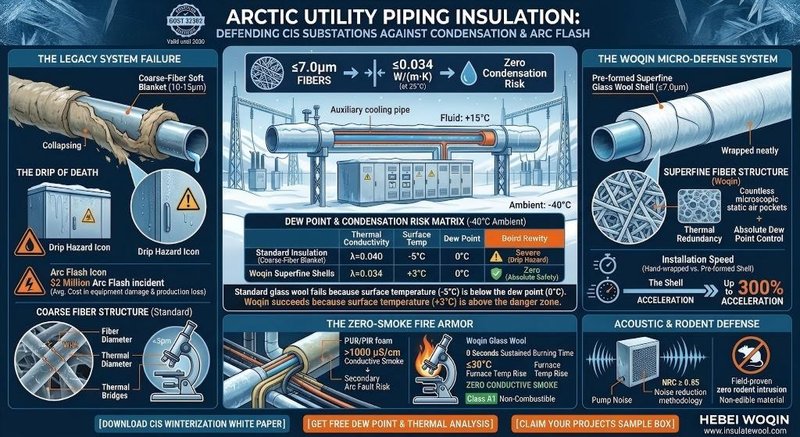
In the extreme sub-zero operational theaters of the CIS region, Siberia, and Central Asia, an industrial substation is the beating heart of any petrochemical plant or mining complex. While electrical engineers meticulously design these facilities to withstand -40°C ambient blizzards, a silent and deadly threat often lurks right above the high-voltage equipment: the auxiliary utility piping.
In the CIS region, a single arc flash incident caused by water ingress or condensation costs an average of $2 million in equipment destruction and facility-wide blackout.
Substations rely on a network of auxiliary pipelines for equipment cooling and firewater supply. Because these pipes carry fluids significantly warmer than the freezing ambient air, a massive temperature differential is created. When EPC contractors insulate these pipes with legacy materials, the thermal barrier inevitably fails. The result is "The Drip of Death." The cold air meets the poorly insulated pipe surface, rapidly reaching the dew point and forming condensation. A single drop of water falling onto a live transformer terminal can instantly trigger a catastrophic short circuit.
The Engineering Selection: Why Superfine Glass Wool?
At Hebei Woqin, we manufacture a wide spectrum of thermal armor. While our ultra-thin Aerogel solutions are critical for extremely confined offshore environments or tight valve matrices, substation utility piping often resides in wider cable trenches or overhead racks. In these scenarios, extreme space-saving is not the constraint. Instead, achieving absolute thermal redundancy—ensuring that even under extreme Arctic wind-chill factors, your pipeline surface remains perfectly dry—while optimizing CAPEX is the primary goal. Our Superfine Glass Wool Pre-formed Shells provide an ultra-low 0.034 W/(m·K) thermal conductivity, offering the highest return on investment for standard substation dew point control.
Line 1: The Micro-Defense – Defeating Condensation with ≤7.0μm Fibers
Preventing overhead condensation is a matter of strict physics: the surface temperature of the pipe insulation must permanently remain above the ambient dew point.
Standard glass wool used in many CIS substations has a coarse average fiber diameter of 10-15μm, resulting in fewer static air pockets and a higher thermal conductivity (typically 0.038 to 0.042 W/(m·K)). This allows the winter cold to penetrate the insulation layer, chilling the outer jacket to the point of condensation.
Hebei Woqin engineered a micro-structural defense mechanism. Our Superfine Glass Wool Pre-formed Shells are manufactured with an extraordinarily fine average fiber diameter of ≤7.0μm. Because our glass fibers are exceptionally fine and densely interwoven, they create an exponentially higher number of microscopic static air pockets. This structural superiority achieves an ultra-low thermal conductivity of ≤0.034 W/(m·K) at 25°C.
To understand the operational impact, consider this thermodynamic projection for a utility water line operating in a -40°C Siberian ambient environment:
Dew Point & Condensation Risk Matrix (At -40°C Ambient)
| Insulation Specification | Thermal Conductivity (λ) | Projected Surface Temp | Dew Point | Condensation Risk |
| Standard Glass Wool (10-15μm) | 0.040 W/(m·K) | -5°C | 0°C | ⚠️ Severe (Drip Hazard) |
| Woqin Superfine Shells (≤7.0μm) | 0.034 W/(m·K) | +3°C | 0°C | 🛡️ Zero (Absolute Safety) |
Engineering Verdict: Standard glass wool fails because its surface temperature (-5°C) drops below the dew point. Woqin succeeds because our micro-defense keeps the surface (+3°C) safely above the danger zone.
By locking in the heat with unmatched micro-metric efficiency, the Woqin Glass Wool Shell ensures the outer surface temperature of your piping never drops to the condensation threshold. The pipes remain bone-dry. The switchgear below remains secure.
Line 2: The Zero-Smoke Fire Armor (Class A1 Non-Combustible)
While thermodynamic control is the first line of defense, fire safety in a high-voltage substation is absolute. Auxiliary utility pipelines often run parallel to massive bundles of power cables and oil-filled transformers. If a localized electrical fire occurs, traditional organic insulation materials (such as PUR/PIR or elastomeric rubber foams) will easily ignite.
Worse, they violently release carbon-rich smoke with a conductivity of >1000 μS/cm—enough to bridge a 100mm air gap between live terminals. In a confined substation, this conductive smoke causes a catastrophic chain reaction of secondary arc faults and facility-wide blackouts.
Hebei Woqin’s Glass Wool Shells eliminate this risk entirely. Certified to strict Class A1 Non-Combustible standards, our 100% inorganic matrix acts as an impenetrable firebreak. During rigorous destructive testing, our material recorded a Furnace Temperature Rise of ≤30°C and a Sustained Burning Time of exactly 0 seconds. It will never ignite, it will never spread flames, and crucially, it emits zero conductive smoke. By specifying Woqin, you ensure that your insulation protects your electrical network rather than weaponizing a fire.
Line 3: The Pre-formed Advantage, Acoustic Control, and Rodent Defense
Installing insulation in a substation is notoriously difficult. Auxiliary utility pipes are frequently routed through cramped underground cable trenches or tight equipment mezzanines. Forcing contractors to manually wrap standard soft mineral wool rolls in these confined spaces is an ergonomic nightmare. It inevitably results in inconsistent thermal barriers and dangerous loose fibers scattered across sensitive electrical equipment.
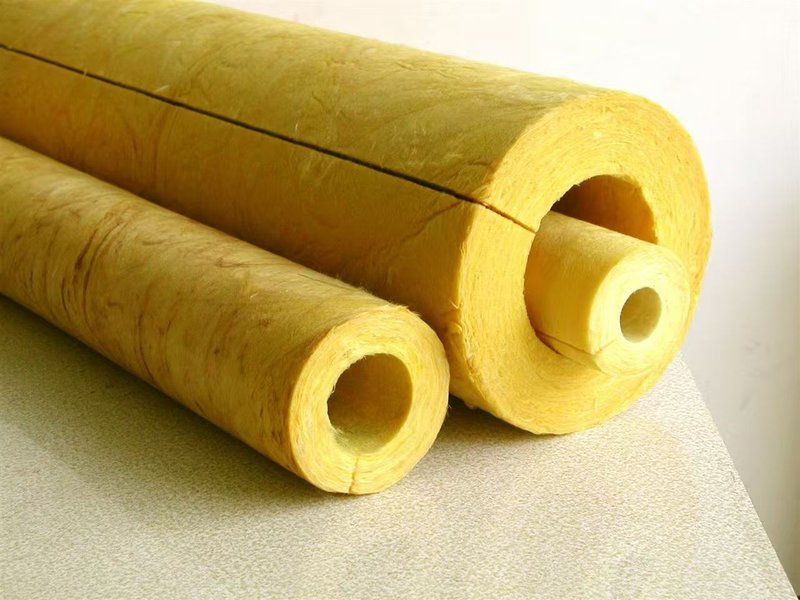
Woqin’s Pre-formed Shells revolutionize installation geometry. Manufactured to exact pipe diameters, the rigid two-piece shells simply snap around the metal pipe. In the narrowest cable trenches, a single technician can lock the thermal armor into place in seconds. This accelerates installation speed by up to 300% compared to hand-wrapped mineral wool rolls, ensuring a perfect thermodynamic fit with zero messy fiber fallout.
Beyond thermodynamics and fire safety, these shells deliver two critical secondary defenses for remote CIS facilities:
Acoustic Dampening: Engineered with an ultra-low slag ball content of ≤0.3%, the pure interlaced glass fibers provide exceptional acoustic absorption. With a Noise Reduction Coefficient (NRC) of ≥0.85, the shells aggressively dampen the low-frequency mechanical noise generated by utility cooling pumps, protecting the hearing of station engineers.
Rodent Intrusion Prevention: In the deep Siberian winter, rats seeking warmth will chew through soft foam insulation, destroying both the thermal envelope and adjacent control cables. Because Woqin's material is 100% inorganic molten glass, it provides zero food source. Field-proven in Siberian substations, our shells guarantee zero rodent intrusion, permanently securing your underground infrastructure.
GOST 32302 Certification: Eliminating Bureaucratic Friction
In the CIS engineering sector, superior physical performance is meaningless if the material fails local technical audits or gets delayed in customs. Hebei Woqin eliminates all bureaucratic and compliance risks for international EPC contractors.
Our Superfine Glass Wool Pre-formed Shells, as part of our broader Tri-Core Insulation System, carry official Russian Federation GOST 32302 certification (Valid until 2030). This guarantees seamless customs clearance, frictionless technical audits, and immediate approval from state safety inspectors across Russia, Kazakhstan, and the wider Central Asian region.
Conclusion: Invest in Substation Certainty
In a high-voltage Arctic substation, the cost of auxiliary piping insulation is mathematically insignificant compared to the cost of its failure. A single drop of condensation can vaporize a multi-million-dollar switchgear and cause facility-wide operational paralysis. By specifying Hebei Woqin’s GOST-certified, Class A1 Superfine Glass Wool Shells, you are not merely purchasing insulation—you are investing in an ultimate thermodynamic and fireproof insurance policy for your electrical infrastructure.
Stop risking your substations with legacy soft blankets. Secure your Arctic operations today.
Secure Your High-Voltage Infrastructure Today:
Download the CIS Substation Winterization White Paper: Accelerate your engineering design. Request our comprehensive technical guide, which explicitly includes dew point calculation templates, extreme-weather thickness selection tables, and GOST compliance checklists.
Get a Free Dew Point & Thermodynamics Analysis: Do not guess your condensation risk. Send us your auxiliary pipe diameter, fluid temperature, and ambient minimum temperature (e.g., -40°C). Our engineers will return a customized thermodynamic report, calculating the exact insulation thickness required to keep your surface temperature permanently above the dew point.
Claim Your "CIS Project Sample Box": Stop specifying blind. Qualified EPC firms and substation designers can request an exclusive physical sample kit of our Tri-Core Shell System. Experience the structural rigidity and microscopic fineness of our ≤7.0μm glass fibers in your own hands.
Contact our engineering team immediately at: an@cn-aerogel.com
Related Winterization & Condensation Solutions:
- The Physics of Condensation: Why Vapour Barriers Fail in Heritage Retrofits
- Defeating -40°C Bottom-Ice: Rock Wool Shells for Condensate Lines
- Locking in the Heat: Grooved Pre-formed Shells for EHT Systems

Written by - Ruibin An
Industry Veteran with 13+ Years of Experience. Deeply rooted in the insulation industry for over 13 years, specializing in supply chain optimization and global market trends for Rock Wool and Aerogel materials.
LATEST NEWS
High-Density Rigid PU Thermal Break Blocks: North American Code-Compliant Structural Solution
2026-07-01
Beyond Insulation: Why Structural Thermal Breaks Are Essential for Modern Industrial Infrastructure
2026-06-29
The Ultimate Guide: "Survival Rules" and System Defenses for Industrial Piping Insulation in Extreme Middle Eastern Environments
2026-06-25
Unlocking Aramco & SABIC Compliance: The Highly Secure Path to Mechanical Completion Sign-Off
2026-06-25
Cutting Pipeline Insulation Labor Costs by 40% in 50°C Middle East Heat
2026-06-18