
Arctic Pump Station Insulation Pillar: GOST Pre-formed Shells for CIS Winterization
In the CIS region, unplanned downtime due to frozen pipelines costs an estimated $500,000 per hour. Explore the 7 deadly failures of traditional insulation and discover how Hebei Woqin’s GOST-certified pre-formed shells provide the ultimate -40°C thermal armor for your critical pump stations.
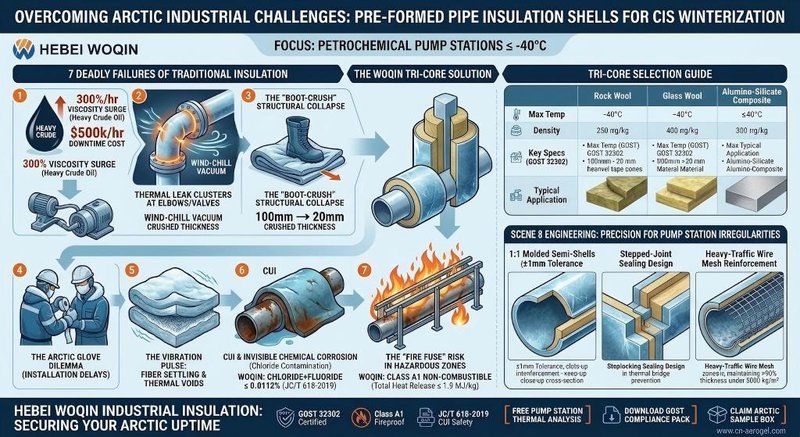
Arctic Pump Station Insulation Pillar: GOST Pre-formed Shells for CIS Winterization
In the punishing sub-zero corridors of the CIS region, Siberia, and the Arctic Circle, petrochemical refineries and mining complexes operate in a thermodynamic war zone. Here, ambient temperatures routinely plummet below -40°C. In these environments, unplanned downtime due to frozen pipelines costs an estimated $500,000 per hour in lost production.
Pipeline insulation is not merely a consumable building material—it is the industrial lifeline that prevents catastrophic infrastructure failure. Yet, many facilities still rely on legacy "manual-wrap" soft blankets, which are the leading cause of million-dollar energy leaks. At Hebei Woqin, we are leading a paradigm shift toward high-precision, Pre-formed Tri-Core Shell Systems designed to secure your uptime.
The 7 Deadly Failures of Arctic Pipeline Insulation
To understand why pre-formed engineering is essential, we must first examine the 7 specific, quantifiable failures that plague chemical loading pump stations and outdoor pipe racks in the frozen North.
1. Viscosity Surge & Pump Overload
High-viscosity media, such as heavy crude oil and chemical feedstock, are slaves to temperature. For heavy crude oil, a mere 10°C drop in temperature increases fluid viscosity by 300%, requiring 3x more pump power to move the media. If suction lines are under-insulated, this "Viscosity Surge" causes severe cavitation and instantly overloads pump motors, leading to total station burnout.
2. The Thermal Leak Cluster
A pump station is a maze of irregular nodes: elbows, tees, flanges, and valves. Thermal imaging scans of CIS pump stations consistently reveal that traditional soft blankets fail at these complex geometries. They leave significant air gaps where wind-chill acts as a "thermal vacuum," aggressively sucking heat out of the system and forming freeze-plugs exactly where the fluid needs to flow freely.
3. The "Boot-Crush" Effect
Pump stations are high-frequency maintenance zones. When a 100kg inspection worker wearing heavy Arctic boots steps on traditional soft insulation, the thickness is permanently crushed from 100mm down to 20mm. This permanent deformation increases localized heat loss by 300%. In contrast, Woqin's high-density shells maintain >90% of their original thickness even under a 5,000 kg/m² load (tested to EN 826 compressive strength standards).
4. The Arctic Glove Dilemma
In -40°C gales, workers must wear thick extreme-cold protective gloves. Executing the "measure, cut, wrap, and wire-bind" sequence of traditional insulation is physically impossible. Woqin's rigid, pre-formed shells utilize a "Snap-on" interlocking design that reduces on-site manipulation time by 80%, ensuring the pipe is sealed before the media can freeze.
5. The Vibration Pulse
Industrial pumps generate relentless high-frequency vibrations. In soft-wrapped systems, these pulses cause mineral fibers to break and settle over time, leaving thermal voids at the top of the pipe. Woqin shells utilize a high-density fiber-interlocking matrix, achieving a vibration mass loss rate of ≤ 0.3% (tested to GB/T 34336-2017), ensuring zero structural settling over a 20-year lifespan.
6. CUI & The Invisible Chemical Killer
Corrosion Under Insulation (CUI) is the quiet destroyer of stainless steel lines. Standard commercial rock wool often contains >0.05% leachable chlorides, which mix with snow-melt to trigger Stress Corrosion Cracking. Hebei Woqin eliminates this risk by strictly controlling the combined chloride and fluoride ion content to ≤ 0.0112% (tested to JC/T 618-2019), neutralizing the CUI threat at the chemical level.
7. The "Fire Fuse" Risk
Chemical loading zones are high-explosive risk areas. Organic foams or oil-soaked blankets act as a "fire fuse" along pipe racks. Woqin's Class A1 Non-Combustible materials possess a total heat release of ≤ 1.9 MJ/kg—which is 90% lower than organic foam insulations. They will never ignite or accelerate flames, preserving your emergency shut-off windows.
The Woqin Tri-Core Solution: Simplifying Arctic Specifying
When engineering for extreme Delta-T and structural loads, a "one-size-fits-all" approach fails. Hebei Woqin simplifies procurement for CIS EPCs with our Tri-Core Pre-formed Shell matrix. Whether you are dealing with long-distance heating mains or high-traffic chemical pump stations, we provide the exact thermal armor required:
Core Material: High-Density Rock Wool
Max Operating Temp: ≤ 600°C
Key Features & Applications: Heavy-Duty & Fireproof. Ideal for high-traffic pump stations and hazardous zones requiring extreme compressive strength.
Woqin Certified Data: Density: 80-150 kg/m³ / Class A1 Fireproof (0s burning).
Core Material: Fine-Fiber Glass Wool
Max Operating Temp: ≤ 400°C
Key Features & Applications: Lightweight & Long-Haul. Perfect for long-distance district heating mains. Reduces pipe rack load limits significantly while providing rapid heat-up.
Woqin Certified Data: Thermal Conductivity: ≤ 0.034 W/(m·K) / Fiber Diameter: ≤ 7.0 μm.
Core Material: Alumino-Silicate Composite
Max Operating Temp: ≤ 800°C
Key Features & Applications: Extreme Heat & Tracing. Built for Electrical Heat Tracing (EHT) networks and reactor discharges, resisting extreme thermal shock.
Woqin Certified Data: Linear Shrinkage: -1.5% @ 800°C.
Scene 8 Engineering: Precision for Pump Station Irregularities
Pump stations are notorious "Thermal Leak Clusters." Standard insulation simply cannot seal the complex geometry of elbows, tees, and large valves. Woqin’s Scene 8 Specialized Engineering utilizes pre-formed technology to turn these vulnerabilities into strong points.
1:1 Molded Semi-Shells (±1mm Tolerance)
We provide factory-molded semi-shells tailored for your specific piping nodes. Manufactured with a strict ±1mm tolerance, these shells ensure a perfect, airtight fit over complex valve and flange dimensions, eliminating the air gaps that cause viscosity surges.
Stepped-Joint Sealing Design
Unlike straight-cut manual insulation, our pre-formed shells feature an interlocking Stepped-Joint design. This physical overlap completely eliminates linear thermal bridges, stopping -40°C wind-chill penetration dead in its tracks.
Heavy-Traffic Wire Mesh Reinforcement
For pump stations requiring constant manual inspection, our high-density rock wool shells can be engineered with an integrated steel wire mesh reinforcement. This guarantees zero structural collapse under the boots of your maintenance crews, maintaining your protective envelope permanently.
Conclusion: Invest in Thermal Certainty
In Arctic petrochemical operations, the cost of insulation material is mathematically insignificant compared to the cost of its failure. A single pump failure caused by fluid solidification can cost millions in lost uptime. Hebei Woqin’s GOST-certified pre-formed shells are not just materials—they are a high-yield insurance policy for your plant’s operational stability.
Secure Your Arctic Strategy Today:
Get a Free Pump Station Thermal Analysis: Don't operate blindly. Send us your pipe parameters (diameter, media, ambient wind speed). We will return a comprehensive PDF report including heat loss calculations, surface temperature profiles, and recommended insulation thickness within 48 hours.
Download the CIS Compliance Pack: Access our full library of GOST 32302 certificates (valid until 2030), Class A1 fire reports, and JC/T 618-2019 CUI safety data to strengthen your next EPC project bid.
Claim Your "Arctic Project Sample Box": We ship physical samples of our high-density rock wool and glass wool shells to qualified EPC firms. Experience the structural rigidity and precision fit firsthand. Contact our technical team today at: an@cn-aerogel.com.
Related Arctic Solutions:

Written by - Ruibin An
Industry Veteran with 13+ Years of Experience. Deeply rooted in the insulation industry for over 13 years, specializing in supply chain optimization and global market trends for Rock Wool and Aerogel materials.
LATEST NEWS
High-Density Rigid PU Thermal Break Blocks: North American Code-Compliant Structural Solution
2026-07-01
Beyond Insulation: Why Structural Thermal Breaks Are Essential for Modern Industrial Infrastructure
2026-06-29
The Ultimate Guide: "Survival Rules" and System Defenses for Industrial Piping Insulation in Extreme Middle Eastern Environments
2026-06-25
Unlocking Aramco & SABIC Compliance: The Highly Secure Path to Mechanical Completion Sign-Off
2026-06-25
Cutting Pipeline Insulation Labor Costs by 40% in 50°C Middle East Heat
2026-06-18