
Surviving the Salt and Vibration: The Vacuum-Formed Ceramic Fiber Guide for Desalination Plant Steam Networks
Middle Eastern desalination plants face two ultimate threats: extreme CUI (Corrosion Under Insulation) from coastal salt environments, and high-frequency vibration from TVC ejectors. Discover how Hebei Woqin’s vacuum-formed ceramic fiber pipe shells and high-tensile blankets provide the definitive physical and chemical defense for high-temperature steam networks.
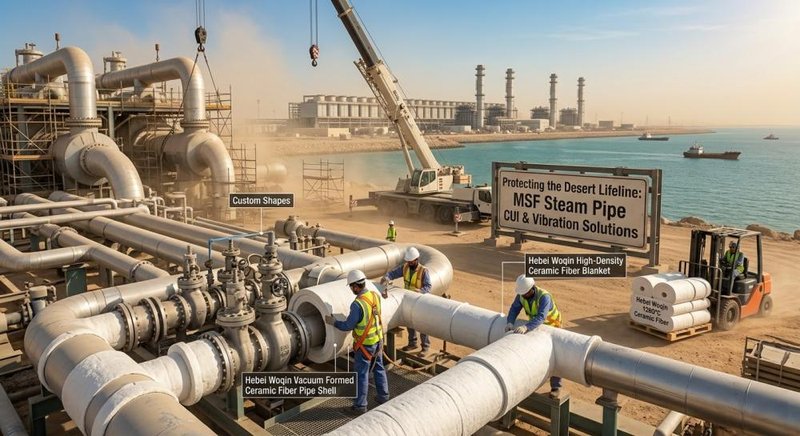
Surviving the Salt and Vibration: The Vacuum-Formed Ceramic Fiber Guide for Desalination Plant Steam Networks
For countries across the Middle East, such as Saudi Arabia and the UAE, desalination plants are not just industrial facilities—they are the lifelines of the nation. The dominant technologies, such as Multi-Stage Flash (MSF) and Multiple Effect Distillation (MED), rely entirely on the continuous, efficient transport of high-temperature, high-pressure steam.
However, the steam pipe networks in these mega-plants are built in some of the most unforgiving environments on Earth: coastal zones saturated with highly corrosive salt air, combined with the relentless mechanical vibration of heavy-duty pumps. In these extreme conditions, standard rock wool and rigid calcium silicate frequently fail, leading to catastrophic pipeline ruptures and massive energy losses.
To secure the nation's water supply, EPC contractors must rethink their insulation strategy. Here is how Hebei Woqin’s Vacuum-Formed Ceramic Fiber Pipe Shells and High-Density Blankets solve the most fatal vulnerabilities in desalination steam networks.
1. Ending the "Salt-Sponge" CUI Nightmare
Corrosion Under Insulation (CUI) is the silent killer of coastal desalination plants. The atmosphere around the Persian Gulf and Red Sea is heavily loaded with chlorides (salt mist).
When the outer jacketing of traditional rock wool or low-grade insulation is even slightly compromised, the material acts like a "salt-sponge." It absorbs the chloride-rich moisture and traps it directly against the scorching steel pipes. Under continuous high-temperature baking, these trapped chlorides rapidly aggressively attack the metal, triggering fatal Stress Corrosion Cracking (SCC) in stainless steel pipes, leading to unexpected blowouts.
Hebei Woqin eliminates the CUI threat through absolute chemical inertness and advanced moisture control. Our high-purity alumina silicate fibers are strictly free of leachable chlorides. More importantly, verified laboratory data confirms an ultra-low Moisture Content of just 0.2% (Max). Our insulation refuses to absorb moisture, effectively cutting off the "Water + Chlorides + Heat" triangle and providing a flawless protective barrier for your main steam lines against the harsh coastal environment.
2. Defeating "Vibration Pulverization" from TVC Ejectors
The heart of a thermal desalination plant features massive high-pressure feed pumps and Thermal Vapor Compressors (TVC ejectors). These immense machines subject the surrounding main steam pipelines to continuous, severe high-frequency vibration.
Many engineering teams default to using rigid insulation, such as calcium silicate pipe shells, for their mechanical strength. However, these materials are dangerously brittle. Under months of relentless vibration, the rigid internal structure is quite literally shaken to dust (Pulverization). The insulation crumbles, drops out of the jacketing, and leaves the bare pipes completely exposed to the elements.
Hebei Woqin solves this paradox with our advanced Vacuum-Formed Ceramic Fiber Pipe Shells and our flagship 44 kPa Tensile Strength blankets. By utilizing precision vacuum-forming technology, we deliver the structural support of a rigid shell combined with the microscopic resilience of a flexible fiber matrix.
This "shock-absorber effect" means our insulation accommodates high-frequency vibration without cracking, dusting, or slumping. The pipe shell maintains its full structural integrity and thermal resistance, year after year, no matter how hard the TVC ejectors roar.
3. Surviving "Thermal Cycling Tears" in IWPP Facilities
The vast majority of Middle Eastern desalination capacity is driven by Independent Water and Power Projects (IWPP), where gas turbines generate electricity and the exhaust heat produces steam for desalination. Because power and water demands fluctuate wildly between day and night, the main steam pipes undergo extreme, daily Thermal Cycling (rapid expansion and contraction).
When rigid insulation materials are subjected to these continuous dimensional changes, they cannot adapt. The rigid seams are literally torn apart, creating massive thermal bridges and "Air Gaps" where heat escapes freely.
Hebei Woqin’s alumina silicate fiber eliminates this failure mode through its natural Resilience and Zero Thermal Inertia. Our vacuum-formed shells and blankets act as dynamic thermal armor. When the steel pipe expands, the fiber matrix compresses; when the pipe contracts, the material instantly rebounds to its original thickness. This permanent, elastic grip ensures the insulation joints never tear open, maintaining a seamless thermal barrier through thousands of extreme heating and cooling cycles.
4. Navigating the Geometry Maze: Eradicating Heat Leaks
A desalination steam network is not just straight pipe; it is a complex, three-dimensional maze consisting of thousands of heavy-duty valves, flanges, T-joints, and reducers.
Attempting to force standard flat blankets or rigid boards around these irregular geometries inevitably leaves gaps, blind spots, and exposed steel. In a high-temperature steam network, these poorly insulated irregular components become the primary "bleeding points" for severe heat loss and localized CUI.
Hebei Woqin solves this critical installation challenge by manufacturing Custom Pre-formed Shapes & Shells. Using our 3D vacuum-forming technology, we engineer bespoke ceramic fiber insulation covers specifically tailored to the exact geometry of your valves and flanges. Installing them is as precise and simple as interlocking Lego bricks. This 360-degree, gap-free coverage completely eradicates thermal bleeding points and drastically reduces on-site installation time and human error.
5. Stopping Steam Enthalpy Loss: The Energy Efficiency Mandate
Ultimately, the core metric of any MSF or MED desalination plant is its Gain Output Ratio (GOR)—how much freshwater can be produced per ton of steam. To maximize the GOR, the steam must retain its Enthalpy (thermal energy) from the boiler all the way to the evaporators.
Poor insulation allows the steam's temperature and pressure to degrade during transit. To compensate for this enthalpy loss and keep the city's water supply running, operators are forced to burn tens of millions of dollars in excess natural gas every year.
Hebei Woqin protects your steam enthalpy with world-class thermal resistance. Our high-density ceramic fiber network minimizes convective heat transfer, delivering an exceptional Thermal Conductivity of just 0.134 W/(m·K) at 500°C. By locking every joule of energy inside the pipe, we help EPCs deliver plants with maximized GOR and drastically reduced lifecycle fuel costs.
Secure the Lifeline: Partner with Hebei Woqin
Operating a desalination plant in the Middle East is a battle against the elements. Standard commercial insulation simply cannot survive the salt, the vibration, and the extreme thermal cycling of the Persian Gulf.
At Hebei Woqin, we engineer survival-grade insulation systems for the world’s most critical water infrastructure. Whether you are battling CUI on coastal steam lines or outfitting complex TVC ejectors, our vacuum-formed ceramic fiber solutions guarantee structural integrity and maximum thermal efficiency.
Stop losing steam to the desert. Contact Hebei Woqin's engineering team today for project-specific TDS, custom pre-formed shape designs, and direct-from-factory pricing.

Written by - Ruibin An
Industry Veteran with 13+ Years of Experience. Deeply rooted in the insulation industry for over 13 years, specializing in supply chain optimization and global market trends for Rock Wool and Aerogel materials.
LATEST NEWS
Cutting Pipeline Insulation Labor Costs by 40% in 50°C Middle East Heat
2026-06-18
Acoustic & Thermal Insulation for HVAC Piping in Middle East Luxury Hotels
2026-06-16
Calculated Oppression: How Thermal Drift and Structural Sagging Bleed Millions from Middle East Piping TCO (And the 20-Year Closed-Loop Solution)
2026-06-15
District Cooling in the Gulf: The Physics of Inevitable Condensation and How Pre-Formed Glass Wool Shells Stop It
2026-06-12
CCGT Power Plant Pipe Insulation English Marketing Copy (99-point Final Benchmark Version)
2026-06-10